
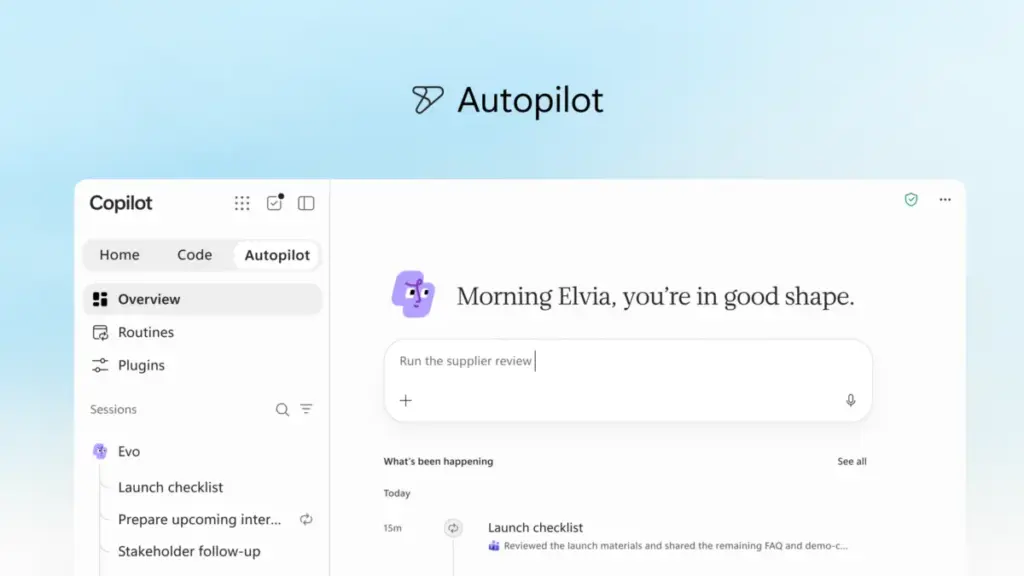
REDMOND, Wash. — In a major step toward redefining the intersection of artificial intelligence and enterprise productivity, Microsoft has announced a comprehensive reimagining of its Copilot platform. This evolution, described by the company as the "new Copilot," marks a transition from a simple conversational assistant to a multifaceted AI environment designed to support the "flow of human ambition." By introducing autonomous agents, low-code development capabilities, and deeper integration into the Microsoft 365 suite, the tech giant aims to provide a unified experience where individuals and organizations can build, customize, and scale AI-driven workflows with unprecedented ease.
The update introduces a trio of primary pillars—Home, Code, and Autopilot—each catering to different modes of professional labor. As work continues to evolve into a hybrid of synchronous meetings and asynchronous digital collaboration, Microsoft is positioning Copilot not merely as a tool, but as a persistent digital infrastructure that connects the legacy tools people rely on with a next-generation intelligence layer.
A New Experience for Every Mode of Work
At the center of this transformation is the "Home" experience, which serves as the primary gateway for the user’s workday. Recognizing that modern professional life is often fragmented across emails, chats, documents, and various applications, Microsoft has designed Home to act as a digital anchor. It is here that two distinct modes of AI interaction converge: Chat and Cowork.
Chat remains the familiar, instant interface for quick inquiries, drafting short messages, and retrieving specific pieces of information. Cowork, however, represents a more significant shift toward delegation. In this mode, users define a complex task—such as responding to a Request for Proposal (RFP), creating a product launch kit, or preparing a financial close package—and the AI executes the workflow from end to end. This "agentic" approach allows the system to iterate on a project and return a completed result, rather than requiring the user to guide every incremental step.
Crucially, Microsoft is removing the friction of choosing between these modes. The company announced that in the near future, Copilot will automatically route user requests to whichever capability—Chat, Cowork, or Code—is best suited for the specific task at hand. This intent-based routing ensures that users do not need to understand the underlying mechanics of the AI to achieve their desired outcomes.

The integration of the "Office in Copilot" feature further bridges the gap between the AI interface and the production environment. By embedding the full capabilities of Word, Excel, and PowerPoint directly into the Copilot app, Microsoft is addressing a long-standing pain point: the loss of context and formatting that often occurs when moving data between a chatbot and a document. Users can now draft briefs, model budgets, or build slide decks within Copilot, and the system will create live, editable files that are synced across the entire team. This allows for side-by-side refinement, where @mentions and real-time edits by human collaborators appear instantly, ensuring that progress remains fluid across different applications.
The specific enhancements to the Office suite are equally noteworthy. PowerPoint now features the ability to keep presentations automatically on-brand while allowing for the fine-tuning of images and custom templates via AI. In Excel, a new transparency layer allows users to see exactly what changes Copilot or other collaborators have made and why, accompanied by recommendations for data visualization. Furthermore, the introduction of "Skills" brings role-specific expertise—such as legal analysis in Word or advanced financial modeling in Excel—directly into the apps, enabling organizations to standardize best practices across their workforce.
 Productivity Software & Office Suites
Microsoft Reimagines Copilot as a Centralized Engine for the Future of AI-Driven Work
In a major strategic shift aimed at redefining the intersection of human...
 Productivity Software & Office Suites
Microsoft Democratizes Software Development with Natural Language App Building in Copilot Studio
The landscape of software development is undergoing a fundamental transformation as artificial...
 Productivity Software & Office Suites
Microsoft Launches Copilot Cowork Globally, Bringing Agentic AI to the Fortune 500
Microsoft has officially announced the general availability of Copilot Cowork, marking a...






