
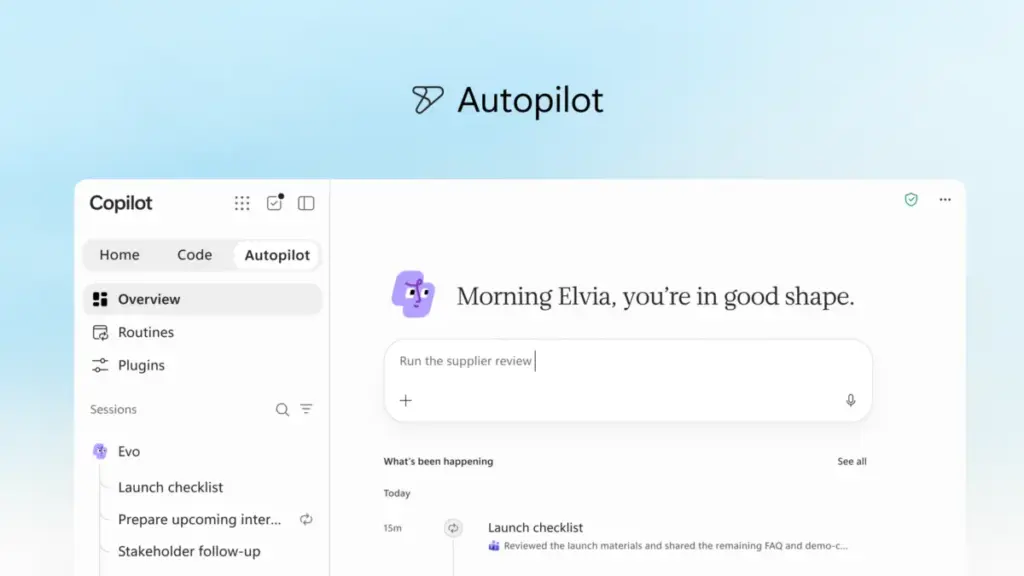
In a significant shift for the future of digital productivity, Microsoft has announced a comprehensive reimagining of its Copilot platform. The tech giant is moving beyond the concept of a simple AI assistant to create a unified environment designed to integrate directly into the flow of human ambition. This evolution aims to expand what individuals and organizations can achieve by connecting essential tools with a new generation of AI capabilities focused on building, customizing, and scaling intelligence across the modern enterprise.
Jared Spataro, who leads Microsoft’s AI at Work efforts, emphasized that the goal is to enable work as it evolves. The new Copilot experience is built to ground users in their daily tasks while providing the power to delegate complex workflows to autonomous agents. By introducing several core pillars—Home, Code, and Autopilot—Microsoft is positioning Copilot as the primary interface through which professional work is conducted, managed, and automated.
A New Experience for Every Mode of Work
The centerpiece of this transformation is the introduction of "Home," a new starting point designed to ground users in their daily activities. As modern work frequently fluctuates between meetings, chats, documents, and emails, Home serves as a digital command center where users can get their bearings and maintain momentum. Within this interface, two distinct modes of interaction coexist: Chat and Cowork.
Chat remains the conversational heart of the experience, optimized for instant interactions, quick lookups, and the creation of initial drafts. However, it is the introduction of "Cowork" that marks a significant shift in how AI is utilized. Unlike traditional chatbots that require constant prompting, Cowork is designed for tasks that a user delegates entirely. Once a task is defined—such as responding to a Request for Proposal (RFP), creating a product launch kit, or preparing a financial close package—the AI runs the process end-to-end. This allows the user to focus on higher-level strategy while the AI handles the iterative, complex work required to return a completed result.
Further bridging the gap between AI and traditional productivity, Microsoft is launching "Office in Copilot." This feature integrates the full power of Word, Excel, and PowerPoint directly into the Copilot experience. The intent is to eliminate the friction of context switching and broken formatting. Users can now ask Copilot to draft a brief or model a budget from within the Home interface, and the system will create or update a real, editable document that remains live for the entire team. This synchronization ensures that as a user refines a document side-by-side with the AI, or as a teammate makes edits via an @mention, the progress remains consistent across both the Copilot interface and the standalone Office applications.
The individual Office apps are also receiving specialized updates. PowerPoint can now automatically keep presentations on-brand while allowing for the fine-tuning of images and custom templates. Excel users can now see a clear audit trail of changes made by Copilot or other collaborators, with the AI providing recommendations for the most effective data visualizations. Across the Microsoft 365 suite, "Skills" are being introduced to bring role-specific expertise, such as legal or financial workflows, directly into the applications to scale organizational best practices.

Empowering Non-Developers with ‘Code’
Microsoft is also looking to redefine the boundaries of software development through its new "Code" capability. Traditionally, the fundamental units of knowledge work have been files—the document, the spreadsheet, and the presentation deck. Microsoft argues that a fourth unit is emerging: the purpose-built solution.
 Productivity Software & Office Suites
Microsoft Launches Copilot Cowork Globally, Bringing Agentic AI to the Fortune 500
Microsoft has officially announced the general availability of Copilot Cowork, marking a...
 Productivity Software & Office Suites
Microsoft Reimagines Copilot as a Unified AI Platform for the Next Generation of Work
In a significant shift that signals the next phase of the artificial...
 Productivity Software & Office Suites
Microsoft Shifts Focus to Enterprise AI Utility: A New Strategic Framework for Agents, Economics, and Partnership
In an era defined by a relentless cycle of artificial intelligence breakthroughs,...







