
REDMOND, Wash. — In a major step toward redefining the intersection of artificial intelligence and enterprise productivity, Microsoft has announced a comprehensive reimagining of its Copilot platform. This evolution, described by the company as the "new Copilot," marks a transition from a simple conversational assistant to a multifaceted AI environment designed to support the "flow of human ambition." By introducing autonomous agents, low-code development capabilities, and deeper integration into the Microsoft 365 suite, the tech giant aims to provide a unified experience where individuals and organizations can build, customize, and scale AI-driven workflows with unprecedented ease.
The update introduces a trio of primary pillars—Home, Code, and Autopilot—each catering to different modes of professional labor. As work continues to evolve into a hybrid of synchronous meetings and asynchronous digital collaboration, Microsoft is positioning Copilot not merely as a tool, but as a persistent digital infrastructure that connects the legacy tools people rely on with a next-generation intelligence layer.
A New Experience for Every Mode of Work
At the center of this transformation is the "Home" experience, which serves as the primary gateway for the user’s workday. Recognizing that modern professional life is often fragmented across emails, chats, documents, and various applications, Microsoft has designed Home to act as a digital anchor. It is here that two distinct modes of AI interaction converge: Chat and Cowork.
Chat remains the familiar, instant interface for quick inquiries, drafting short messages, and retrieving specific pieces of information. Cowork, however, represents a more significant shift toward delegation. In this mode, users define a complex task—such as responding to a Request for Proposal (RFP), creating a product launch kit, or preparing a financial close package—and the AI executes the workflow from end to end. This "agentic" approach allows the system to iterate on a project and return a completed result, rather than requiring the user to guide every incremental step.
Crucially, Microsoft is removing the friction of choosing between these modes. The company announced that in the near future, Copilot will automatically route user requests to whichever capability—Chat, Cowork, or Code—is best suited for the specific task at hand. This intent-based routing ensures that users do not need to understand the underlying mechanics of the AI to achieve their desired outcomes.

The integration of the "Office in Copilot" feature further bridges the gap between the AI interface and the production environment. By embedding the full capabilities of Word, Excel, and PowerPoint directly into the Copilot app, Microsoft is addressing a long-standing pain point: the loss of context and formatting that often occurs when moving data between a chatbot and a document. Users can now draft briefs, model budgets, or build slide decks within Copilot, and the system will create live, editable files that are synced across the entire team. This allows for side-by-side refinement, where @mentions and real-time edits by human collaborators appear instantly, ensuring that progress remains fluid across different applications.
The specific enhancements to the Office suite are equally noteworthy. PowerPoint now features the ability to keep presentations automatically on-brand while allowing for the fine-tuning of images and custom templates via AI. In Excel, a new transparency layer allows users to see exactly what changes Copilot or other collaborators have made and why, accompanied by recommendations for data visualization. Furthermore, the introduction of "Skills" brings role-specific expertise—such as legal analysis in Word or advanced financial modeling in Excel—directly into the apps, enabling organizations to standardize best practices across their workforce.
The second major pillar, "Code," aims to democratize the creation of software solutions. For decades, the primary unit of digital work has been the file—a document or a spreadsheet. Microsoft is now introducing a fourth unit: the purpose-built solution. Through Code, users who lack traditional programming backgrounds can describe an app, a tracker, or an automation workflow in natural language. Powered by the same technology as GitHub Copilot, this feature allows for the creation of persistent desktop widgets, interactive dashboards, and cloud-hosted internal applications.
To ensure these user-created solutions are enterprise-ready, Microsoft is launching the "Copilot Managed Runtime." This hosting infrastructure allows custom code to run safely within a company’s Microsoft 365 environment, governed by IT protocols but accessible to everyone. This ensures that while everyone can be a "builder," the solutions they create remain secure, grounded in the context of the organization’s data, and hosted within the tenant’s security boundary.
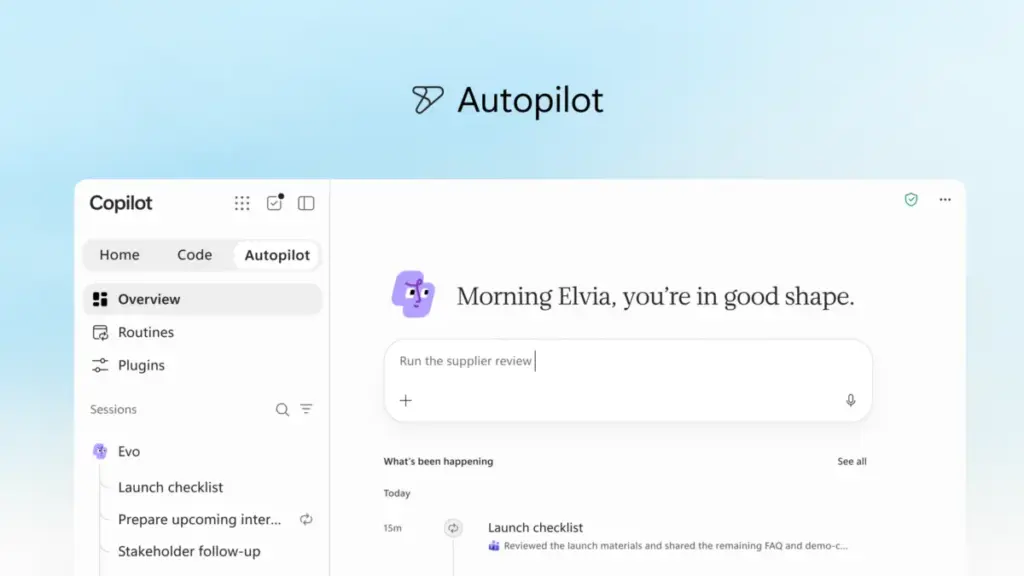
The third pillar, "Autopilot," represents the most autonomous version of the platform to date. Formerly known as Scout, Autopilot is described as a persistent, proactive digital teammate. Unlike standard AI assistants that wait for a prompt, Autopilot can be assigned a name, a role, and a specific goal. It is capable of monitoring communication channels, following up on threads, and managing long-running processes—such as a supplier review—while the user is offline. Because it is cloud-hosted and possesses its own identity and memory within the organization’s tenant, it can handle scheduling, stakeholder outreach, and follow-ups autonomously, keeping the human user informed of its progress without requiring constant supervision.
Expanding Your Business Context
The effectiveness of any AI is fundamentally limited by the data it can access. To address this, Microsoft is expanding the "business context" available to Copilot through Microsoft IQ, a unified intelligence platform. By connecting the operational data of a business with the institutional knowledge it holds, Microsoft IQ provides a real-time view of the organization that is both secure and governed.

A key component of this expansion is "Fabric IQ," which integrates more than 20 million semantic models from Power BI directly into the Copilot environment. This grounding allows Chat and Cowork to provide insights based on verified corporate data. Furthermore, Microsoft is rolling out a public preview that grounds Copilot in data from Dynamics 365 and the Power Platform. For a sales professional, this means Copilot can pull deal history and customer support tickets directly into a proposal document without the need to switch apps or conduct manual lookups.
To further extend these capabilities, Microsoft is launching a new unified plugin registry. This catalog will bring together first-party, partner, and custom-built plugins in a single location, allowing IT departments to centrally approve and manage how Copilot interacts with external services. This move is designed to simplify the introduction of new AI capabilities at scale while maintaining the control necessary for enterprise-grade security.
Managing AI Spend
As AI capabilities become more complex, the economics of deploying these tools have become a central concern for business leaders. Microsoft is addressing this through a dual-pronged approach to "FinOps for AI," balancing fixed-cost subscriptions with usage-based billing.
For "everyday AI" tasks like drafting emails or summarizing meetings, Microsoft utilizes a User Subscription License (USL). At the heart of this model is a feature called "Auto," which evaluates each request based on accuracy, speed, and cost, routing the task to the most appropriate AI model. This ensures that organizations receive high-quality outputs without overpaying for excessive computational power on simple tasks.
However, more advanced "agentic" work—such as the long-running processes handled by Cowork, Code, and Autopilot—will operate on usage-based billing (UBB). This model allows organizations to use the most advanced frontier models, such as Astra and Fable, while maintaining full control over their expenditures.
To help organizations navigate these costs, Microsoft is introducing new administrative tools within "Agent 365." These features allow IT admins to manage spending policies, route credit requests from users through automated approval workflows, and restrict certain model families to specific groups of users. For business leaders, new insights will provide a clear picture of which AI-driven tasks are generating the most value, allowing for data-driven decisions on where to expand or optimize AI usage. Even end-users will have visibility into their own credit usage and history, encouraging responsible AI consumption within the company’s guardrails.

A Sneak Peek at What’s Next
The announcements made today are positioned as the foundation for a series of upcoming innovations. Microsoft provided a glimpse into "Today," a personalized command center coming to the Home experience. "Today" is designed to act as a proactive assistant that scans mail, calendars, and Teams threads to surface what needs immediate attention. It doesn’t just list tasks; it prepares the work, such as having a draft ready for edit or a schedule change already proposed, allowing users to jump directly into high-value activities.
Additionally, the company is preparing to launch "@Copilot in Teams," which will allow the AI to participate in group chats and channels with full access to the shared context of the conversation. By understanding the history of product decisions and cross-functional dependencies, Copilot can prepare reviews and identify open questions, ensuring that teams remain aligned as projects move across different departments.
These new features are currently rolling out through Microsoft’s Frontier program, with broader availability expected in the coming months. The company invited its partners and customers to the upcoming Microsoft Ignite conference in November to explore these innovations further. As Jared Spataro, Microsoft’s lead for AI at Work, noted, the goal remains helping every organization leverage agents and AI to solve unique business problems and drive new value creation in an increasingly complex digital landscape.
 Productivity Software & Office Suites
Microsoft Shifts Focus to Enterprise AI Utility: A New Strategic Framework for Agents, Economics, and Partnership
In an era defined by a relentless cycle of artificial intelligence breakthroughs,...
 Productivity Software & Office Suites
Microsoft Announces Fifth Annual Power Platform Community Conference in Las Vegas to Bridge the Gap Between AI Innovation and Business Process
As the global enterprise landscape continues to evolve, the fundamental machinery of...
 Productivity Software & Office Suites
Microsoft Reimagines Copilot as a Centralized Engine for the Future of AI-Driven Work
In a major strategic shift aimed at redefining the intersection of human...






