
The second major pillar, "Code," aims to democratize the creation of software solutions. For decades, the primary unit of digital work has been the file—a document or a spreadsheet. Microsoft is now introducing a fourth unit: the purpose-built solution. Through Code, users who lack traditional programming backgrounds can describe an app, a tracker, or an automation workflow in natural language. Powered by the same technology as GitHub Copilot, this feature allows for the creation of persistent desktop widgets, interactive dashboards, and cloud-hosted internal applications.
To ensure these user-created solutions are enterprise-ready, Microsoft is launching the "Copilot Managed Runtime." This hosting infrastructure allows custom code to run safely within a company’s Microsoft 365 environment, governed by IT protocols but accessible to everyone. This ensures that while everyone can be a "builder," the solutions they create remain secure, grounded in the context of the organization’s data, and hosted within the tenant’s security boundary.
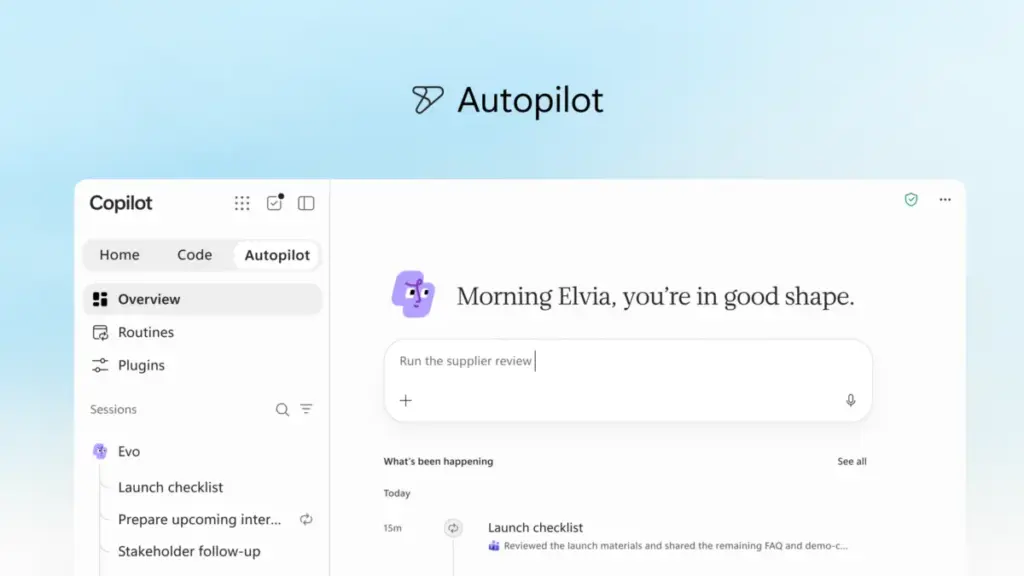
The third pillar, "Autopilot," represents the most autonomous version of the platform to date. Formerly known as Scout, Autopilot is described as a persistent, proactive digital teammate. Unlike standard AI assistants that wait for a prompt, Autopilot can be assigned a name, a role, and a specific goal. It is capable of monitoring communication channels, following up on threads, and managing long-running processes—such as a supplier review—while the user is offline. Because it is cloud-hosted and possesses its own identity and memory within the organization’s tenant, it can handle scheduling, stakeholder outreach, and follow-ups autonomously, keeping the human user informed of its progress without requiring constant supervision.
Expanding Your Business Context
The effectiveness of any AI is fundamentally limited by the data it can access. To address this, Microsoft is expanding the "business context" available to Copilot through Microsoft IQ, a unified intelligence platform. By connecting the operational data of a business with the institutional knowledge it holds, Microsoft IQ provides a real-time view of the organization that is both secure and governed.

A key component of this expansion is "Fabric IQ," which integrates more than 20 million semantic models from Power BI directly into the Copilot environment. This grounding allows Chat and Cowork to provide insights based on verified corporate data. Furthermore, Microsoft is rolling out a public preview that grounds Copilot in data from Dynamics 365 and the Power Platform. For a sales professional, this means Copilot can pull deal history and customer support tickets directly into a proposal document without the need to switch apps or conduct manual lookups.
To further extend these capabilities, Microsoft is launching a new unified plugin registry. This catalog will bring together first-party, partner, and custom-built plugins in a single location, allowing IT departments to centrally approve and manage how Copilot interacts with external services. This move is designed to simplify the introduction of new AI capabilities at scale while maintaining the control necessary for enterprise-grade security.
Managing AI Spend
As AI capabilities become more complex, the economics of deploying these tools have become a central concern for business leaders. Microsoft is addressing this through a dual-pronged approach to "FinOps for AI," balancing fixed-cost subscriptions with usage-based billing.
 Productivity Software & Office Suites
Microsoft Unveils Reimagined Copilot with Agentic Capabilities and New "Autopilot" Digital Teammate
Microsoft has announced a sweeping overhaul of its Copilot platform, signaling a...
 Productivity Software & Office Suites
Microsoft Announces New AI-Integrated Office Suites to Streamline Small Business Operations
In the demanding ecosystem of small business management, success is often measured...
 Productivity Software & Office Suites
Microsoft Announces Microsoft 365 G7 and Agent 365 to Accelerate AI Adoption and Governance Across U.S. Government Agencies
In an era where the public sector faces the dual challenge of...






