
In a comprehensive memo addressed to the global business community, Jared Spataro, Microsoft’s Chief Marketing Officer for AI at Work, has detailed the company’s strategic vision for the next phase of the artificial intelligence revolution. Acknowledging the "sound and fury" currently dominating the technology landscape, Spataro argued that the industry has moved beyond the era of mere benchmarks and loud claims. According to Microsoft’s leadership, the focus has shifted toward a more pragmatic and rigorous objective: deploying AI that performs genuine, economically valuable work while maintaining safety, affordability, and scalability.
The communication arrives at a pivotal moment for the enterprise software sector. As organizations move past the initial novelty of generative AI, they are increasingly grappling with the complexities of implementation, the unpredictability of costs, and the cultural shifts required to integrate autonomous agents into daily workflows. Spataro’s message serves as both a progress report and a playbook for how Microsoft intends to support its customers through this transition, focusing on three core pillars: platform flexibility, a bifurcated business model, and deep-touch partnerships.
Platform
The current AI landscape is characterized by what Spataro describes as a "constant game of leapfrog" among research laboratories. With new models emerging weekly from players like OpenAI, Anthropic, and others, the performance hierarchy is in a state of perpetual flux. Microsoft’s strategy, therefore, is rooted in the belief that no single model is a panacea for every corporate need. Because different models are trained on different datasets and architectures, they exhibit unique strengths and, crucially, they fail in different ways.
To mitigate the risk of betting on a single trend or provider, Microsoft has positioned its platform as a multi-model gateway. By offering access to leading models from across the industry, the company aims to provide enterprises with a level of agility that single-model platforms cannot match. However, the strategy extends beyond simple access. Spataro emphasized that the true value of AI in a corporate setting is realized when intelligence is embedded directly into the applications employees use daily, such as the Microsoft 365 suite.
A critical component of this platform strategy is the grounding of AI in an organization’s specific context and intellectual property. For AI to be useful, it must understand the unique data and proprietary knowledge that differentiate a business from its competitors. This necessitates a robust infrastructure for building and managing "agents"—autonomous or semi-autonomous entities designed to complete specific tasks. Microsoft is providing tools that allow organizations to monitor, secure, and govern these agents from a centralized location, ensuring that the deployment of AI does not result in a fragmented or "shadow" IT environment.
 Productivity Software & Office Suites
Microsoft Shifts Focus to Enterprise AI Utility: A New Strategic Framework for Agents, Economics, and Partnership
In an era defined by a relentless cycle of artificial intelligence breakthroughs,...
 Productivity Software & Office Suites
Microsoft Confirmed as Headline Sponsor for ESPC 2026 in Amsterdam as AI Transformation Takes Center Stage
The European Microsoft community is preparing for one of its most significant...
 Productivity Software & Office Suites
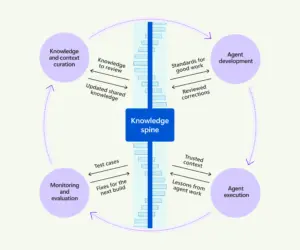
The Rise of the Knowledge Spine: How Frontier Firms are Redefining Enterprise AI through Agentic Systems
In the rapidly evolving landscape of corporate technology, the conversation among business...