In the rapidly evolving landscape of corporate technology, the conversation among business leaders has shifted from the basic capabilities of artificial intelligence to the structural requirements for long-term transformation. At the center of this shift is the concept of the "Frontier Firm"—an organization that does not merely deploy AI tools but builds a self-reinforcing system of learning across its entire structure. While the theoretical appeal of such a system is clear, the practical execution remains a significant challenge for most global enterprises.
To bridge the gap between theory and practice, Microsoft recently launched a comprehensive research initiative in collaboration with Keystone, a global technology and advisory firm. The resulting study, which includes a Harvard Business School working paper titled “Organizing AI at Enterprise Scale,” offers a rare look into the operational patterns of companies that are leading the charge in AI adoption. By measuring the current state of major enterprises, the research identifies a roadmap for those seeking to move beyond isolated pilot programs toward a fully integrated agentic operating model.
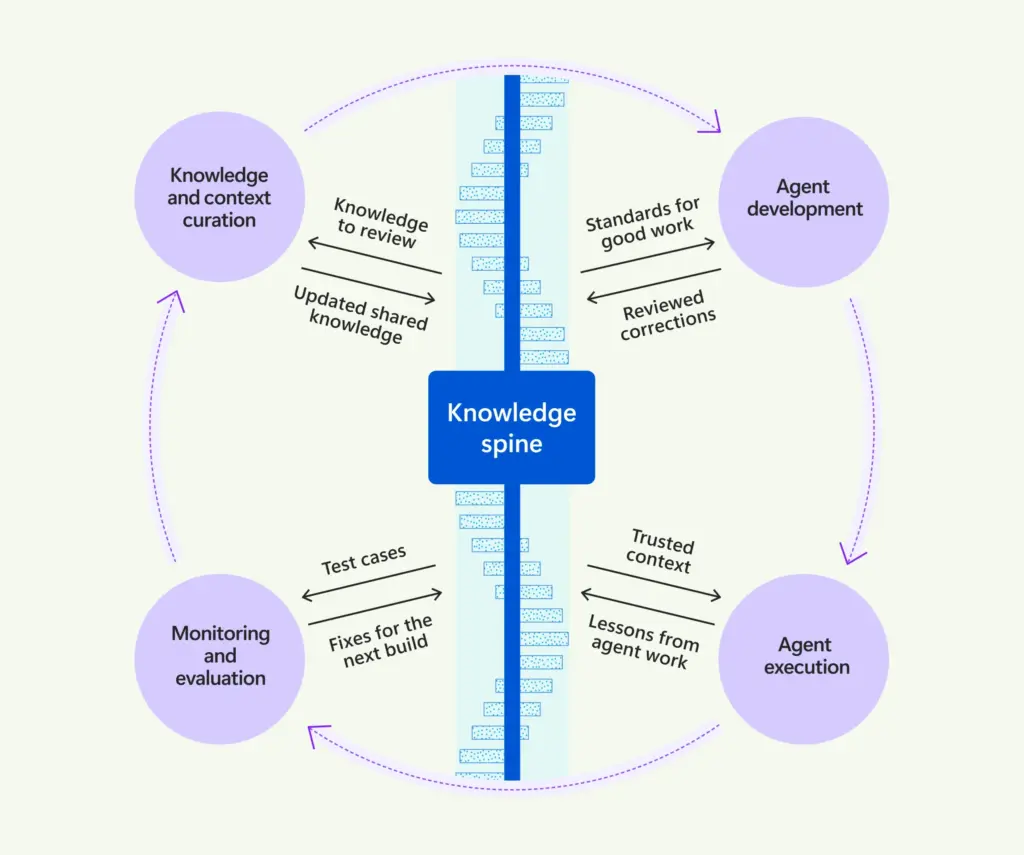
The findings suggest that the most successful organizations are moving toward a "knowledge spine"—a centralized, shared system that serves as the cognitive foundation for AI agents. This infrastructure stores and updates the context that agents rely on, while simultaneously capturing the corrections, tests, and lessons derived from the agents’ daily operations. The research indicates that this approach is not just a technical preference but a financial imperative. Companies that have implemented these practices saw significantly higher gains in operating margins and return on assets between 2022 and 2025 compared to their less mature counterparts.
A New Framework for Enterprise Transformation
The study analyzed more than 200 enterprises, each with over 1,000 employees, spanning sectors from financial services and healthcare to manufacturing and retail. To understand the journey of transformation, researchers categorized these organizations into four distinct stages based on their AI maturity and operational practices.
At Stage One, companies are characterized by a patchwork of disconnected AI pilot projects. These efforts are often limited to basic chat functionalities and lack coordination across departments. Because these projects are not deeply integrated into real business workflows, they often show minimal impact on the bottom line. For these firms, AI remains a peripheral tool rather than a core component of the business strategy.
Stage Two represents a significant step forward, as companies begin to use AI agents to tackle substantive business tasks. These agents are targeted at specific workflows across various functions, such as customer service or supply chain management. However, these organizations still lack automated systems for management and orchestration. Instead, they rely on human-led committees and teams to prioritize investments and provide necessary checks and balances. This "human orchestration" becomes a bottleneck; as the number of agents grows, the ability of humans to monitor and coordinate them fails to scale, making it difficult to realize a full return on investment.

The true turning point occurs at Stage Three. Here, companies begin to shift the burden of coordination from people to systems. This is achieved either by sharing a common knowledge base among agents or by implementing automated monitoring systems that guide agent activity based on desired business outcomes. While this level of maturity often starts within a single department or a specific set of workflows, it represents a fundamental change in how the organization functions.
 Productivity Software & Office Suites
Microsoft Shifts Focus from AI Hype to Enterprise Utility as Jared Spataro Outlines New Strategic Roadmap
In a comprehensive message addressed to the global business community, Jared Spataro,...
 Productivity Software & Office Suites
Microsoft Announces Fifth Annual Power Platform Community Conference in Las Vegas to Bridge the Gap Between AI Innovation and Business Process
As the global enterprise landscape continues to evolve, the fundamental machinery of...
 Productivity Software & Office Suites
Microsoft Set to Headline ESPC 2026 in Amsterdam: A Deep Dive into the Future of AI-Powered Work
The European tech landscape is bracing for a significant milestone in the...