
In the rapidly evolving landscape of corporate technology, the conversation among business leaders has shifted from the basic capabilities of artificial intelligence to the structural requirements for long-term transformation. At the center of this shift is the concept of the "Frontier Firm"—an organization that does not merely deploy AI tools but builds a self-reinforcing system of learning across its entire structure. While the theoretical appeal of such a system is clear, the practical execution remains a significant challenge for most global enterprises.
To bridge the gap between theory and practice, Microsoft recently launched a comprehensive research initiative in collaboration with Keystone, a global technology and advisory firm. The resulting study, which includes a Harvard Business School working paper titled “Organizing AI at Enterprise Scale,” offers a rare look into the operational patterns of companies that are leading the charge in AI adoption. By measuring the current state of major enterprises, the research identifies a roadmap for those seeking to move beyond isolated pilot programs toward a fully integrated agentic operating model.
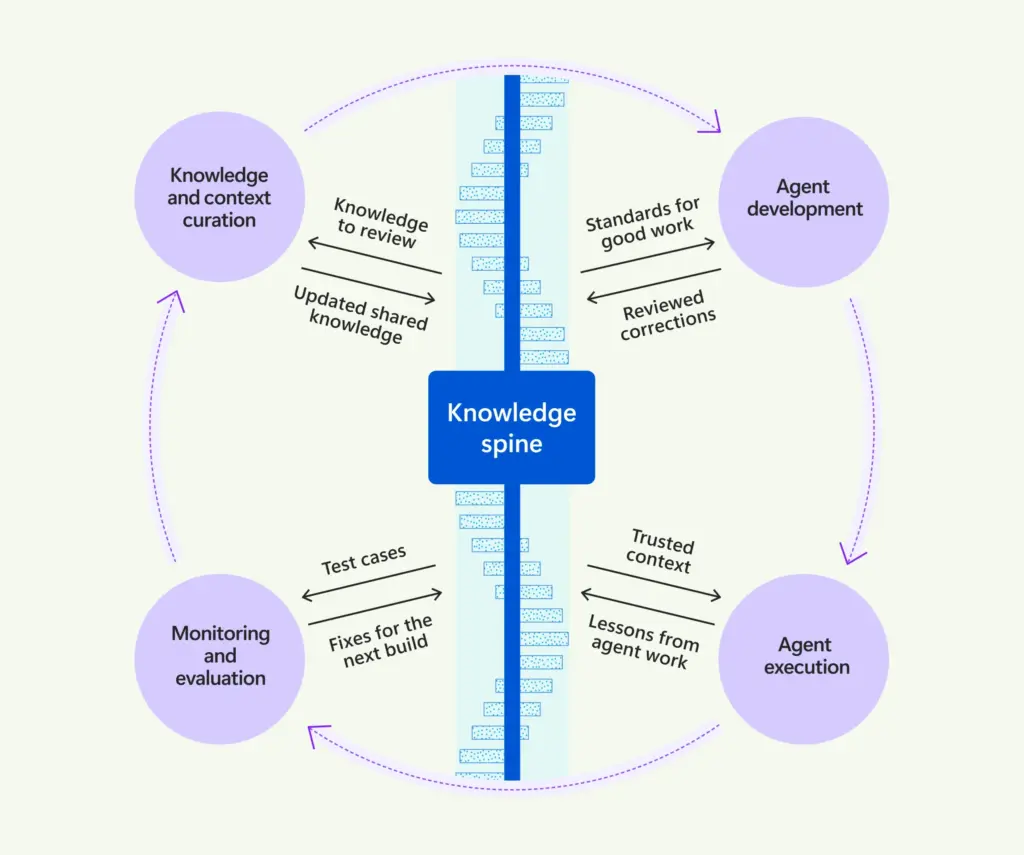
The findings suggest that the most successful organizations are moving toward a "knowledge spine"—a centralized, shared system that serves as the cognitive foundation for AI agents. This infrastructure stores and updates the context that agents rely on, while simultaneously capturing the corrections, tests, and lessons derived from the agents’ daily operations. The research indicates that this approach is not just a technical preference but a financial imperative. Companies that have implemented these practices saw significantly higher gains in operating margins and return on assets between 2022 and 2025 compared to their less mature counterparts.
A New Framework for Enterprise Transformation
The study analyzed more than 200 enterprises, each with over 1,000 employees, spanning sectors from financial services and healthcare to manufacturing and retail. To understand the journey of transformation, researchers categorized these organizations into four distinct stages based on their AI maturity and operational practices.
At Stage One, companies are characterized by a patchwork of disconnected AI pilot projects. These efforts are often limited to basic chat functionalities and lack coordination across departments. Because these projects are not deeply integrated into real business workflows, they often show minimal impact on the bottom line. For these firms, AI remains a peripheral tool rather than a core component of the business strategy.
Stage Two represents a significant step forward, as companies begin to use AI agents to tackle substantive business tasks. These agents are targeted at specific workflows across various functions, such as customer service or supply chain management. However, these organizations still lack automated systems for management and orchestration. Instead, they rely on human-led committees and teams to prioritize investments and provide necessary checks and balances. This "human orchestration" becomes a bottleneck; as the number of agents grows, the ability of humans to monitor and coordinate them fails to scale, making it difficult to realize a full return on investment.

The true turning point occurs at Stage Three. Here, companies begin to shift the burden of coordination from people to systems. This is achieved either by sharing a common knowledge base among agents or by implementing automated monitoring systems that guide agent activity based on desired business outcomes. While this level of maturity often starts within a single department or a specific set of workflows, it represents a fundamental change in how the organization functions.
Finally, Stage Four companies represent the current frontier of enterprise AI. At this level, orchestration, governance, and a "knowledge spine" are fully integrated. These firms have established a single agentic operating model where lessons learned by an agent in one part of the business are fed back into a shared system, improving the performance of all other agents. In these organizations, the system itself takes on the majority of the coordination and learning tasks, allowing the business to scale its AI efforts with unprecedented efficiency.
The Financial Impact of AI Maturity
The research provides compelling evidence that AI maturity correlates with superior financial performance. By comparing the financial results of over 100 public companies in the study, researchers found a stark contrast between those in the top and bottom quartiles of the maturity scale.
Companies in the top quartile—those with the most advanced AI practices—improved their operating margins by more than 5 percentage points more than those in the bottom quartile. Similarly, their return on assets saw an improvement of approximately 2 percentage points more than their lower-scoring peers. While the study notes that these results show correlation rather than direct causation, the trend is undeniable: the more a company integrates advanced AI practices, the more its margins tend to grow.
The researchers also addressed a common phenomenon known as the "J-curve." In many cases, when a transformative new technology is introduced, a company’s performance may initially dip or stagnate as it reorganizes its workflows and retrains its workforce. This lag is often visible in companies that deploy AI agents faster than they can build the systems to coordinate them. The study suggests that the key to navigating this J-curve is not necessarily to spend less on AI, but to manage that spending more effectively by tying AI costs directly to business outcomes and reducing the "hidden cost" of human oversight through better system orchestration.
The Architecture of the Knowledge Spine
Central to the success of Stage Four firms is the "knowledge spine." This ecosystem is designed to turn shared learning into proprietary know-how, creating a competitive advantage that is unique to the firm. Microsoft’s own enterprise intelligence layer, Microsoft IQ, is built on this principle—updating shared knowledge in a central location so that every agent across the organization can access and utilize it.

Building a knowledge spine involves four critical practices. First, organizations must collect context from a diverse array of sources—including chat applications, internal documentation, and systems of record—and store it centrally. This ensures that agents are always working with the most current and accurate information. Second, the organization must treat every correction as valuable data. When a human intervenes to fix an agent’s mistake, that correction should be transformed into a test case for future versions of the agent.
The third practice involves using this combined information to actively shape agent actions. Rather than simply correcting a single output, the system should use the error to refine how the agent handles similar tasks in the future. Finally, the knowledge spine must have a clear owner. This individual or team is accountable for determining which data sources are trustworthy, resolving conflicts between different information streams, and ensuring that outdated information is purged from the system.
Underpinning these practices is the principle of observability. Before an agent is deployed, advanced firms create a "golden dataset"—a set of test cases with defined results that serve as a benchmark for quality. Once the agent is in production, these firms capture detailed operational telemetry on every action the agent takes. This allows the organization to identify exactly why an agent might need a fix and how to implement it effectively.
The Path Forward for Enterprises
While the prospect of building a firm-wide knowledge spine may seem daunting, the research suggests a practical, incremental path forward. Most companies will not transform their entire operation overnight. Instead, the most successful approach is often to start small—building a knowledge spine for a single team or a specific set of connected workflows. Once the system is proven to work in a limited capacity, it can be extended across the organization.
As leaders evaluate their own progress, the research poses three essential questions: When an agent is corrected, does that lesson benefit other agents? Is there a shared standard for "good work" that improves whenever an error occurs? And finally, is there a designated owner for the knowledge the agents rely on? A negative answer to any of these questions provides a clear starting point for improvement.
The broader shift in enterprise AI is moving away from isolated models toward integrated systems. As AI capabilities become more commoditized, the true competitive advantage will lie in a company’s infrastructure and its ability to coordinate intelligence across its entire operation. While AI models will continue to change and evolve, the proprietary lessons an organization’s agents learn from their own work will remain a permanent asset. This study serves as an initial roadmap for navigating that journey, offering a glimpse into how the next generation of frontier firms is being built today.
 Productivity Software & Office Suites
Microsoft Reimagines Copilot as a Comprehensive AI System for Enterprise Automation and Custom Development
In a significant shift that signals the next phase of the generative...
 Productivity Software & Office Suites
Microsoft Outlines Strategic Roadmap for Enterprise AI: Navigating the Shift from Hype to Economic Value
In a comprehensive memo addressed to the global business community, Jared Spataro,...
 Productivity Software & Office Suites
Microsoft Launches Copilot Cowork Globally, Bringing Agentic AI to the Fortune 500
Microsoft has officially announced the general availability of Copilot Cowork, marking a...







