
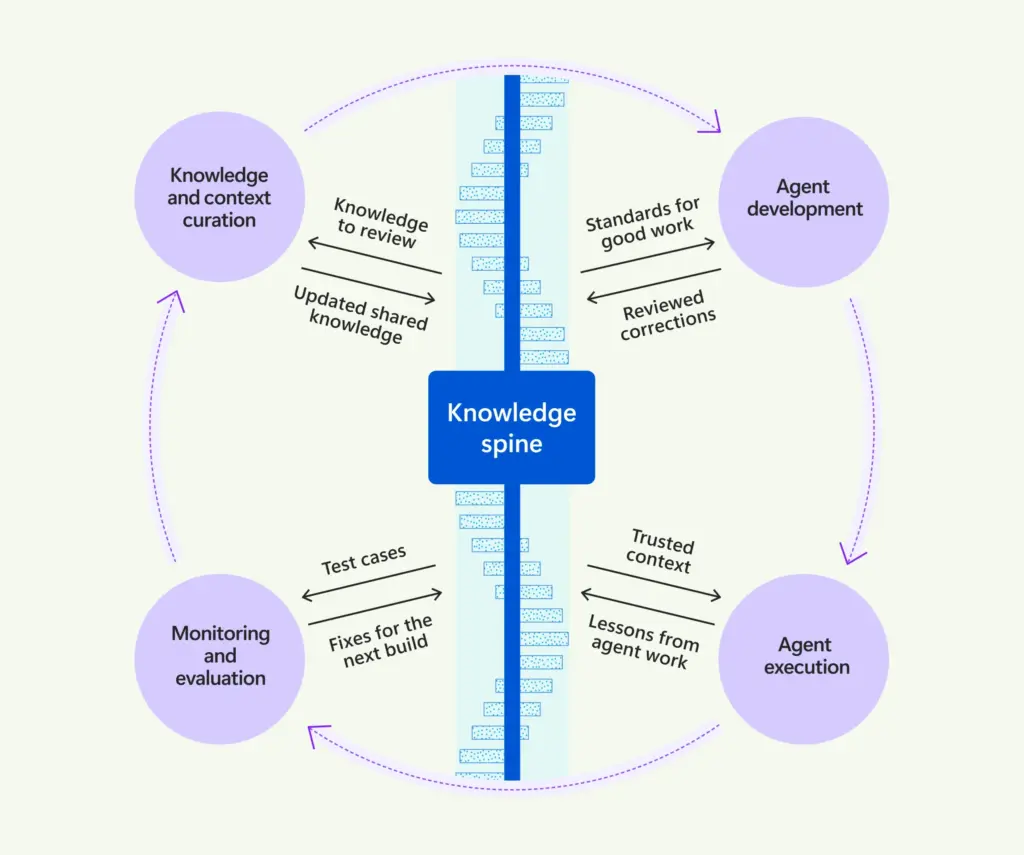

Building a knowledge spine involves four critical practices. First, organizations must collect context from a diverse array of sources—including chat applications, internal documentation, and systems of record—and store it centrally. This ensures that agents are always working with the most current and accurate information. Second, the organization must treat every correction as valuable data. When a human intervenes to fix an agent’s mistake, that correction should be transformed into a test case for future versions of the agent.
The third practice involves using this combined information to actively shape agent actions. Rather than simply correcting a single output, the system should use the error to refine how the agent handles similar tasks in the future. Finally, the knowledge spine must have a clear owner. This individual or team is accountable for determining which data sources are trustworthy, resolving conflicts between different information streams, and ensuring that outdated information is purged from the system.
Underpinning these practices is the principle of observability. Before an agent is deployed, advanced firms create a "golden dataset"—a set of test cases with defined results that serve as a benchmark for quality. Once the agent is in production, these firms capture detailed operational telemetry on every action the agent takes. This allows the organization to identify exactly why an agent might need a fix and how to implement it effectively.
The Path Forward for Enterprises
While the prospect of building a firm-wide knowledge spine may seem daunting, the research suggests a practical, incremental path forward. Most companies will not transform their entire operation overnight. Instead, the most successful approach is often to start small—building a knowledge spine for a single team or a specific set of connected workflows. Once the system is proven to work in a limited capacity, it can be extended across the organization.
As leaders evaluate their own progress, the research poses three essential questions: When an agent is corrected, does that lesson benefit other agents? Is there a shared standard for "good work" that improves whenever an error occurs? And finally, is there a designated owner for the knowledge the agents rely on? A negative answer to any of these questions provides a clear starting point for improvement.
The broader shift in enterprise AI is moving away from isolated models toward integrated systems. As AI capabilities become more commoditized, the true competitive advantage will lie in a company’s infrastructure and its ability to coordinate intelligence across its entire operation. While AI models will continue to change and evolve, the proprietary lessons an organization’s agents learn from their own work will remain a permanent asset. This study serves as an initial roadmap for navigating that journey, offering a glimpse into how the next generation of frontier firms is being built today.
 Productivity Software & Office Suites
The Agentic Edge: New Research Reveals the ‘Knowledge Spine’ Powering the World’s Most Advanced AI Enterprises
In the rapidly evolving landscape of corporate technology, the conversation among C-suite...
 Productivity Software & Office Suites
Microsoft Unveils Reimagined Copilot with Agentic Capabilities and New "Autopilot" Digital Teammate
Microsoft has announced a sweeping overhaul of its Copilot platform, signaling a...
 Productivity Software & Office Suites
Microsoft Unveils Strategic Roadmap for Enterprise AI, Emphasizing Agentic Workflows and Hybrid Pricing Models
In an era defined by a relentless cycle of artificial intelligence breakthroughs...







