

In a comprehensive memo addressed to the global business community, Jared Spataro, Microsoft’s Chief Marketing Officer for AI at Work, has detailed the company’s strategic vision for the next phase of the artificial intelligence revolution. Acknowledging the "sound and fury" currently dominating the technology landscape, Spataro argued that the industry has moved beyond the era of mere benchmarks and loud claims. According to Microsoft’s leadership, the focus has shifted toward a more pragmatic and rigorous objective: deploying AI that performs genuine, economically valuable work while maintaining safety, affordability, and scalability.
The communication arrives at a pivotal moment for the enterprise software sector. As organizations move past the initial novelty of generative AI, they are increasingly grappling with the complexities of implementation, the unpredictability of costs, and the cultural shifts required to integrate autonomous agents into daily workflows. Spataro’s message serves as both a progress report and a playbook for how Microsoft intends to support its customers through this transition, focusing on three core pillars: platform flexibility, a bifurcated business model, and deep-touch partnerships.
Platform
The current AI landscape is characterized by what Spataro describes as a "constant game of leapfrog" among research laboratories. With new models emerging weekly from players like OpenAI, Anthropic, and others, the performance hierarchy is in a state of perpetual flux. Microsoft’s strategy, therefore, is rooted in the belief that no single model is a panacea for every corporate need. Because different models are trained on different datasets and architectures, they exhibit unique strengths and, crucially, they fail in different ways.
To mitigate the risk of betting on a single trend or provider, Microsoft has positioned its platform as a multi-model gateway. By offering access to leading models from across the industry, the company aims to provide enterprises with a level of agility that single-model platforms cannot match. However, the strategy extends beyond simple access. Spataro emphasized that the true value of AI in a corporate setting is realized when intelligence is embedded directly into the applications employees use daily, such as the Microsoft 365 suite.
A critical component of this platform strategy is the grounding of AI in an organization’s specific context and intellectual property. For AI to be useful, it must understand the unique data and proprietary knowledge that differentiate a business from its competitors. This necessitates a robust infrastructure for building and managing "agents"—autonomous or semi-autonomous entities designed to complete specific tasks. Microsoft is providing tools that allow organizations to monitor, secure, and govern these agents from a centralized location, ensuring that the deployment of AI does not result in a fragmented or "shadow" IT environment.
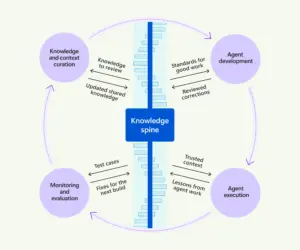
Furthermore, Spataro introduced the concept of the "continuous improvement loop." He noted that an AI agent is not a finished product upon deployment; rather, deployment is merely the starting point. The organizations currently gaining a competitive edge are those that define clear metrics for "good work," measure their agents against those standards, and iteratively refine them. By building these feedback loops directly into the platform, Microsoft intends to help businesses compound small, incremental improvements into a significant and defensible competitive advantage. This approach shifts the perception of AI from a static tool to a dynamic employee-like entity that evolves over time.
Business model
One of the most significant challenges facing modern executives is the management of AI-related costs. For two decades, the enterprise software industry has operated under the predictable "User Subscription License" (USL) model—a flat monthly fee per employee that grants unlimited access to a software suite. While this model provided budget certainty, the advent of AI and agentic workflows has introduced a level of computational variability that the traditional USL model was not designed to handle.
Spataro identified a common pitfall in current corporate strategy: attempting to judge the new costs of AI through the lens of old subscription logic. To address this, Microsoft is advocating for a dual-structured business model. The first component remains the traditional subscription, which provides broad access to AI productivity tools at a predictable price. Under this model, the underlying intelligence continues to improve through model updates, but the cost to the customer remains stable.
The second component is "Usage-Based Billing" (UBB), which is tied specifically to the volume of work performed rather than the number of people involved. Spataro argued that because long-running, complex agentic jobs vary so significantly in their computational demands, a flat fee is no longer sustainable or equitable. Crucially, he framed these usage-based costs not as traditional IT overhead, but as capital investment. In this view, spending on AI "work" is akin to investing in headcount or capability; it is a direct driver of business output.
To simplify this transition, Microsoft has introduced "Copilot Credits." This serves as a shared currency that aggregates various AI operations across the platform. Whether an organization is using Copilot for basic chat functions or employing "Copilot Cowork" for more advanced agentic tasks, the expenses draw from a single meter. This system is designed to provide transparency and control, allowing businesses to see exactly where their spend is going and to set hard limits before an invoice is generated. By providing these tools, Microsoft aims to demystify the economics of AI, making it as manageable as any other core business utility.
Partnership
Despite the rapid technological advancements, Spataro noted that the most difficult aspect of the AI transition is not the software itself, but the human element. Rewiring how work gets done and building trust in automated systems are the primary reasons many AI initiatives stall. This "change management" phase is often the most neglected part of the digital transformation journey, yet it is the most critical for long-term success.
Microsoft’s response to this challenge is a commitment to deep, long-term partnerships rather than simple vendor-client transactions. This includes the deployment of "Forward Deployed Engineers" who work directly alongside customer teams to solve technical hurdles and integrate AI into specific business processes. By putting "skin in the game," Microsoft is attempting to distinguish itself from competitors who may offer powerful models but lack the enterprise-grade support structure required to see a project through to completion.
This partnership model also involves a high degree of knowledge sharing. Spataro highlighted that Microsoft is drawing on its own internal transformation, as well as its extensive research and cross-industry collaborations, to help customers navigate the pitfalls of AI adoption. The goal is to move beyond the "demo" phase—where AI looks impressive in a controlled environment—to the "production" phase, where it must perform reliably in the messy, high-stakes reality of daily business operations.
In closing, Spataro positioned Microsoft as a "purposefully understated" player in an industry often defined by hype. The company’s philosophy is built on the conviction that AI should be a tool for expanding human agency rather than narrowing it. By providing the platform, the economic framework, and the necessary partnership, Microsoft is betting that the winners of the AI era will not be the ones with the flashiest demonstrations, but the ones who build the most resilient and reliable systems. The ultimate measure of success, according to the memo, will be found in the work itself and the people who use these tools to move their businesses forward.
 Productivity Software & Office Suites
Microsoft Launches Microsoft 365 G7 and Agent 365 to Accelerate Secure AI Adoption Across U.S. Government Agencies
In a significant move to modernize the digital infrastructure of the U.S....
 Productivity Software & Office Suites
Microsoft Unveils Natural Language App Creation in Copilot Studio, Bridging the Gap Between AI Innovation and Enterprise Governance
The landscape of software development is undergoing a fundamental transformation, driven by...
 Productivity Software & Office Suites
The Rise of the Agentic Enterprise: New Research Identifies the ‘Knowledge Spine’ as the Key to AI Transformation
In the current corporate landscape, the conversation surrounding artificial intelligence has shifted...







