
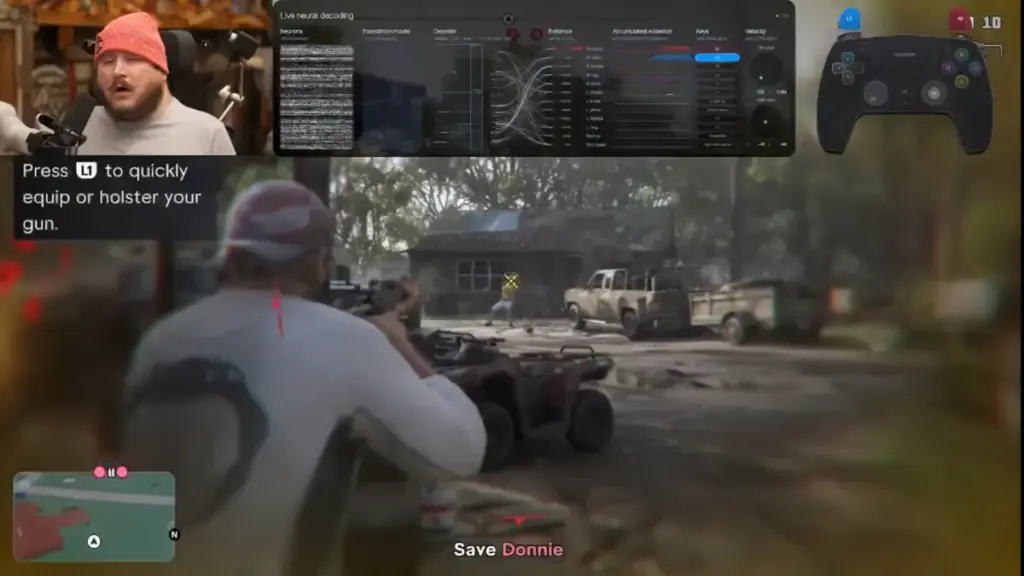
The core of this breakthrough lies in the sophisticated way the Neuralink team has mapped the patient’s neural activity to a digital environment. According to the details provided in the demonstration, the engineering team successfully translated specific imagined physical movements into commands that a standard PlayStation 5 controller could interpret. This process involves a high degree of calibration, where the implant—a device known as the "Link"—detects the firing patterns of neurons in the motor cortex and assigns them to specific button presses or joystick movements. For the participant in this trial, the interface was customized to respond to subtle mental triggers. For instance, the simple act of the patient thinking about tapping their ring finger was mapped to the "square" button on the PlayStation controller. In the context of the game, this allowed the player to interact with the environment or perform specific character actions simply by intending to move a part of their body that they may no longer be able to physically control.
The demonstration further highlighted the complexity of the controls by showcasing how the patient managed more fluid, analog-style movements. When the trial participant imagined sliding their right hand forward, the system interpreted this as a directional command, which in the demonstration was used to pull the nose of an airplane upward during flight. This type of three-dimensional navigation is significantly more difficult to achieve than binary button clicks, as it requires the BCI to interpret the intensity and direction of the patient’s intent. Furthermore, the team mentioned that another specific control had been bound to the patient’s imagined foot movement. While the specific in-game action linked to this foot-based command was not explicitly detailed in the footage, the inclusion of multiple "limbs" in the control scheme suggests that Neuralink is successfully tapping into various regions of the motor cortex to create a more robust and multi-faceted user experience.
This level of control is a far cry from the early days of BCI technology, which often struggled with lag, low resolution, and limited input options. The ability to play a game as complex as a Grand Theft Auto title, which requires simultaneous management of movement, camera angles, and various action buttons, serves as a high-performance benchmark for the technology. It demonstrates that the "Link" can handle high-bandwidth data transfers between the brain and an external device with low enough latency to permit real-time gaming. This is not merely about entertainment; for individuals living with paralysis or other motor impairments, the ability to engage with complex software represents a profound return of autonomy. The demonstration also touched upon the broader sensory experience, noting that the patient is utilizing artificial intelligence to assist with communication. In a particularly moving aspect of the trial’s results, the patient is reportedly using AI to narrate digital content using a synthesized version of his own voice, further bridging the gap between his internal thoughts and external expression.
The clinical trial currently underway is part of what Neuralink calls the PRIME Study, which stands for Precise Robotically Implanted Brain-Computer Interface. The study aims to evaluate the safety of the N1 implant and the R1 surgical robot, while also testing the initial functionality of the BCI for enabling people with paralysis to control external devices. The fact that patients are already seeing such "impressive results" within the first few years of clinical testing suggests that the hardware and software iterations are moving at a speed rarely seen in the medical device industry. Neuralink’s approach differs from many of its competitors by opting for a fully implantable, cosmetically invisible device that transmits signals wirelessly. The N1 implant contains 1,024 electrodes distributed across 64 threads, which are thinner than a human hair. These threads are placed by the R1 robot into the specific area of the brain that controls movement intention, allowing for a high density of signal collection.
As the trial progresses, the team continues to refine how these signals are decoded. The mapping of the PlayStation 5 controller is a strategic choice, as it allows the patient to tap into a vast ecosystem of existing software without requiring developers to create bespoke BCI-compatible versions of their games or applications. By emulating a standard input device, Neuralink effectively "tricks" the console into seeing a regular controller, when in reality, the inputs are being generated by the user’s thoughts. This "plug-and-play" potential could eventually extend to other devices, such as smartphones, tablets, and personal computers, allowing users to navigate the digital world with the same fluidity as an able-bodied person using their hands.
The success of the unnamed patient in the GTA demonstration also points to the rapid learning curve associated with the device. In traditional BCI setups, patients often had to undergo months of training to move a simple cursor across a screen. However, the integration of advanced machine learning algorithms allows the Neuralink system to adapt to the user’s neural patterns more quickly. As the patient "practices" imagining movements, the software becomes better at distinguishing between different intentions, reducing the cognitive load required to operate the interface. The mention of mapping a foot movement alongside hand and finger movements is particularly telling, as it indicates a move toward "multi-modal" control, where a user could theoretically perform multiple actions simultaneously, such as steering a vehicle with their "hands" while accelerating with their "feet," all within the digital space.
While the primary focus of these early trials is to restore digital autonomy to those with quadriplegia, the implications of this demonstration reach much further. The ability to narrate with a personal AI voice and play high-fidelity games suggests a future where the physical limitations of the body no longer dictate an individual’s ability to participate in culture, work, or social interaction. The use of a PlayStation 5 controller as the intermediary also highlights the potential for the "Link" to become a universal translator for human intent. As Neuralink continues to monitor the health and progress of its trial participants, the data gathered will be crucial for seeking broader regulatory approval. The company has maintained a rigorous schedule of updates, often sharing these milestones directly with the public to demonstrate the tangible impact of their research.
The transition from the first human patient, who gained headlines for playing digital chess and other software, to this second phase involving more complex control schemes like those seen in the GTA footage, indicates a growing confidence in the stability of the implant. Earlier challenges, such as the physical displacement of some of the electrode threads, appear to have been addressed through refined surgical techniques and software compensations. This iterative process is central to Neuralink’s philosophy of rapid development. By pushing the boundaries of what the interface can do—such as flying an airplane in a simulated environment—the team can identify the limits of the current hardware and develop the next generation of neural threads and sensors.
As the video of the patient concludes, the sense of possibility is palpable. The medical trial participant, though remaining unnamed, has become a pioneer in a new era of human-computer interaction. The combination of neural implants, AI-driven voice synthesis, and standard gaming hardware creates a powerful toolkit for overcoming physical disability. While there is still much work to be done in terms of long-term safety monitoring and expanding the number of trial participants, the results seen less than three years into clinical trials are a testament to the transformative potential of brain-computer interfaces. The ability to navigate the complex world of a modern video game using nothing but thought is no longer a concept confined to science fiction; it is a reality currently being refined in the labs and homes of Neuralink’s trial participants.
 Hardware Reviews & PC Building
Custom Power Distribution Mod Surfaces to Tackle RTX 5090 Overheating Concerns
The launch of NVIDIA’s flagship GeForce RTX 5090 has been met with...
 Hardware Reviews & PC Building
GlobalFoundries Unveils FDX Fusion: Aiming for 7nm Performance with Planar Transistors and No EUV by 2030
In a strategic move that reinforces its departure from the traditional "leading-edge"...
 Hardware Reviews & PC Building
Intel Signals Extended Life for LGA 1700 Platform as Raptor Lake Next Driver and Shipping Data Surface
Intel appears to be moving forward with a strategic extension of its...







