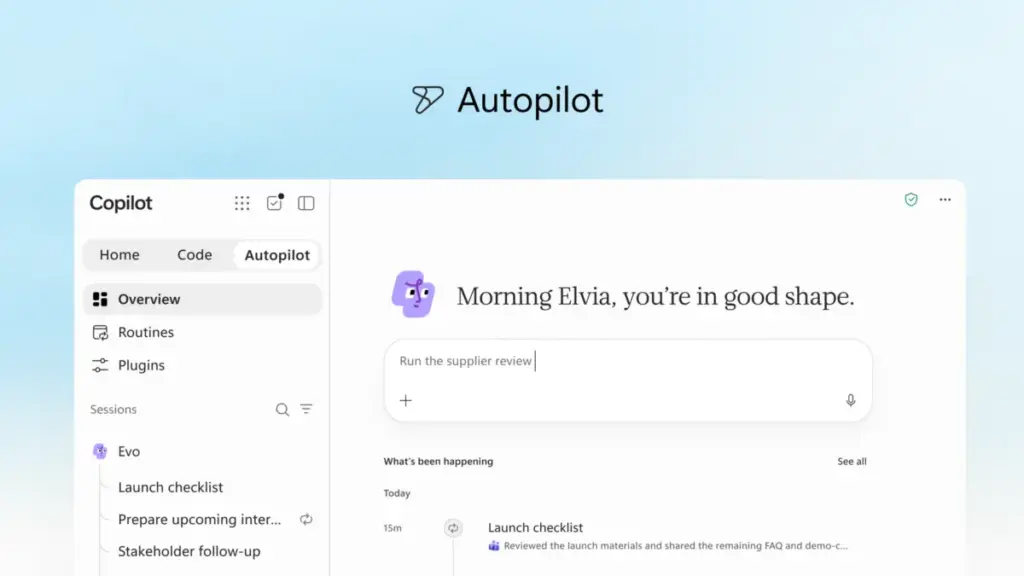
In a significant evolution of its artificial intelligence strategy, Microsoft has unveiled a comprehensive reimagining of Microsoft Copilot. This transformation is designed to align with the rapidly changing landscape of modern work, aiming to bridge the gap between human ambition and organizational achievement. By introducing a new architecture for Copilot, the company is seeking to integrate the essential tools that professionals rely on with a next-generation suite of AI capabilities, allowing for the seamless building, customization, and scaling of intelligence across every layer of the enterprise.
The announcement marks a shift from AI as a simple conversational assistant to a more integrated, proactive, and versatile ecosystem. According to Microsoft, this new era of Copilot is centered on three primary pillars: Home, Code, and Autopilot. Together, these features represent a move toward "agentic" workflows—where AI does not merely respond to prompts but actively participates in the completion of complex, multi-stage projects.
A New Experience for Every Mode of Work
At the heart of this update is the new Copilot Home, which serves as the primary starting point for users. In the modern workplace, tasks are often fragmented across meetings, emails, documents, and various third-party applications. Home is designed to act as a grounding force, providing a centralized location where users can regain their bearings and maintain momentum.
Within Home, Microsoft has integrated two distinct but complementary modes of interaction: Chat and Cowork. Chat remains the go-to interface for instant, conversational needs—handling quick inquiries, data lookups, and the creation of initial drafts. It is built for the "in-the-moment" requirements of a busy workday, keeping users informed and responsive.
In contrast, Cowork represents a deeper level of delegation. Instead of asking for a single piece of information, users can define a broad task and allow Copilot to manage it from inception to completion. Examples of these delegated tasks include the generation of a comprehensive Request for Proposal (RFP) response, the assembly of a product launch kit, or the preparation of a financial close package. Cowork is built for iteration, allowing the AI to handle the "heavy lifting" of complex projects that would otherwise require hours of manual coordination.
A critical component of this new experience is the deeper integration of Microsoft Office. Through "Office in Copilot," the full capabilities of Word, Excel, and PowerPoint are now native to the Copilot experience. This eliminates the friction often associated with AI-generated content, such as broken formatting or the need to copy-paste text between different applications. From the Home interface, a user can request a budget model or a presentation deck, and Copilot will create or update a live, editable document that is immediately accessible to the entire team.

This integration extends to real-time collaboration. As Copilot works on a document, teammates can be @mentioned, and their edits appear alongside the AI’s contributions. This ensures that progress remains synchronized across the Copilot app and the traditional Office suite. Furthermore, Microsoft has enhanced the specific "Skills" within these apps. PowerPoint can now automatically maintain brand consistency, while Excel can provide visual data recommendations and track exactly what changes were made during a collaborative session. Role-specific workflows, such as legal expertise in Word or financial modeling in Excel, are also being scaled to help organizations implement best practices across their entire workforce.
Looking ahead, Microsoft plans to remove the need for users to manually choose between these modes. Soon, users will simply state their objective, and Copilot will intelligently route the request to Chat, Cowork, or Code, depending on which capability is best suited for the specific job.
Democratizing Solution Building with Code
Perhaps the most radical shift in the new Copilot is the introduction of "Code," a feature that aims to move solution-building beyond the exclusive domain of professional software developers. For decades, the fundamental unit of knowledge work has been the file—the document, the spreadsheet, or the slide deck. Microsoft is now introducing a fourth unit: the small, purpose-built solution.
 Productivity Software & Office Suites
Microsoft Unveils Specialized AI Capabilities for Finance Professionals in Excel to Address Sector-Specific Complexity
The trajectory of transformative technology has followed a consistent, predictable rhythm for...
 Productivity Software & Office Suites
Microsoft Unveils Microsoft 365 G7: A New Frontier for AI-Driven Governance in the Public Sector
In a move designed to redefine how the public sector interacts with...
 Productivity Software & Office Suites
Microsoft Reimagines Copilot as a Central Hub for Autonomous AI and Agentic Work
Microsoft has announced a significant evolution of its AI strategy, unveiling what...