
The trajectory of transformative technology has followed a consistent, predictable rhythm for decades. From the advent of the personal computer to the rise of relational databases and the eventual migration to the cloud, new tools almost always find their first home among developers. However, the finance department is rarely far behind. For finance professionals, the adoption of new technology is not merely about staying current; it is a search for an edge. In a field where the primary objective is to model reality with increasing precision, the tools must be as rigorous as the analysts who use them.
For nearly forty years, the definitive tool for this purpose has been Microsoft Excel. It is the environment where the quarterly close is finalized, where multi-year forecasts are debated line by line, and where every single figure must be traceable back to an immutable source. As artificial intelligence begins to permeate the corporate landscape, the finance sector has maintained a cautious stance. For AI to be accepted in this high-stakes environment, it must clear a formidable bar: it must show its work, utilize only trusted and verified data, and provide a transparent audit trail for every calculation performed.
Recognizing these industry-specific requirements, Microsoft has announced a suite of new features for Microsoft 365 Copilot in Excel. These updates are designed to transform the AI from a general-purpose assistant into a specialized financial analyst capable of handling the intricate, multi-step workflows that define modern financial planning and analysis (FP&A), accounting, and treasury operations.
Built for the Complexity of Finance Work
The introduction of AI into the financial workflow is not a simple matter of integration; it is a matter of validation. Microsoft has acknowledged that finance professionals cannot rely on "black box" logic. To address this, the company has implemented a rigorous evaluation framework for Copilot, testing the AI against graded levels of task complexity and industry-standard benchmarks. This ensures that the system does not merely complete isolated tasks but can navigate the nuances of a multi-step financial workflow with a result that is both trusted and verifiable.
This development process has been heavily influenced by Microsoft’s own internal finance organization. By running Copilot in Excel within its own real-world workflows—spanning tax, compliance, treasury, and FP&A—the company has used its internal teams as a primary testing ground. These professionals have acted as both users and architects, pushing the product to meet the standards of a global finance operation. According to the company, the features reaching the public have already been "pressure-tested at the frontier," allowing teams to spend less time on manual data hunting and more time on the high-level judgment required for strategic decision-making.
A critical component of this validation effort is Microsoft’s partnership with the Financial Modeling Institute (FMI). As the global body responsible for credentialing the industry’s most advanced financial modelers, the FMI provides a library of real-world cases that have become foundational to how Copilot is evaluated. By aligning the AI’s capabilities with the FMI’s demanding standards, Microsoft aims to ensure that the tool can handle the structural integrity and logic required for high-stakes financial modeling.
Tuned to Professional Standards
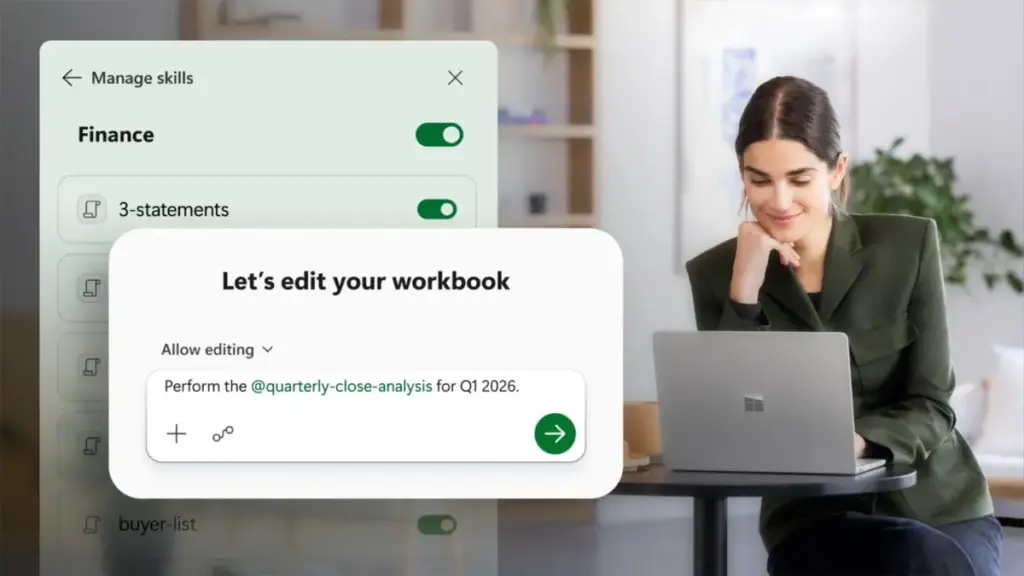
One of the most significant hurdles in automating financial work is the repetitive nature of complex processes. Tasks like building a Discounted Cash Flow (DCF) model, refreshing monthly reporting packages, or performing variance analyses often require the same logical steps but are performed manually to ensure accuracy. To solve this, Microsoft is introducing "skills" within Copilot.
 Productivity Software & Office Suites
Microsoft Announces Fifth Annual Power Platform Community Conference in Las Vegas to Bridge the Gap Between AI Innovation and Business Process
As the global enterprise landscape continues to evolve, the fundamental machinery of...
 Productivity Software & Office Suites
Microsoft Unveils Strategic Roadmap for Enterprise AI, Emphasizing Agentic Workflows and Hybrid Pricing Models
In an era defined by a relentless cycle of artificial intelligence breakthroughs...
 Productivity Software & Office Suites
Microsoft to Headline ESPC 2026 in Amsterdam: A Deep Dive into the Future of AI-Powered Work and Agentic Ecosystems
The landscape of enterprise technology is currently undergoing one of its most...







