
The trajectory of transformative technology has followed a consistent, predictable rhythm for decades. From the advent of the personal computer to the rise of relational databases and the eventual migration to the cloud, new tools almost always find their first home among developers. However, the finance department is rarely far behind. For finance professionals, the adoption of new technology is not merely about staying current; it is a search for an edge. In a field where the primary objective is to model reality with increasing precision, the tools must be as rigorous as the analysts who use them.
For nearly forty years, the definitive tool for this purpose has been Microsoft Excel. It is the environment where the quarterly close is finalized, where multi-year forecasts are debated line by line, and where every single figure must be traceable back to an immutable source. As artificial intelligence begins to permeate the corporate landscape, the finance sector has maintained a cautious stance. For AI to be accepted in this high-stakes environment, it must clear a formidable bar: it must show its work, utilize only trusted and verified data, and provide a transparent audit trail for every calculation performed.
Recognizing these industry-specific requirements, Microsoft has announced a suite of new features for Microsoft 365 Copilot in Excel. These updates are designed to transform the AI from a general-purpose assistant into a specialized financial analyst capable of handling the intricate, multi-step workflows that define modern financial planning and analysis (FP&A), accounting, and treasury operations.
Built for the Complexity of Finance Work
The introduction of AI into the financial workflow is not a simple matter of integration; it is a matter of validation. Microsoft has acknowledged that finance professionals cannot rely on "black box" logic. To address this, the company has implemented a rigorous evaluation framework for Copilot, testing the AI against graded levels of task complexity and industry-standard benchmarks. This ensures that the system does not merely complete isolated tasks but can navigate the nuances of a multi-step financial workflow with a result that is both trusted and verifiable.
This development process has been heavily influenced by Microsoft’s own internal finance organization. By running Copilot in Excel within its own real-world workflows—spanning tax, compliance, treasury, and FP&A—the company has used its internal teams as a primary testing ground. These professionals have acted as both users and architects, pushing the product to meet the standards of a global finance operation. According to the company, the features reaching the public have already been "pressure-tested at the frontier," allowing teams to spend less time on manual data hunting and more time on the high-level judgment required for strategic decision-making.
A critical component of this validation effort is Microsoft’s partnership with the Financial Modeling Institute (FMI). As the global body responsible for credentialing the industry’s most advanced financial modelers, the FMI provides a library of real-world cases that have become foundational to how Copilot is evaluated. By aligning the AI’s capabilities with the FMI’s demanding standards, Microsoft aims to ensure that the tool can handle the structural integrity and logic required for high-stakes financial modeling.
Tuned to Professional Standards
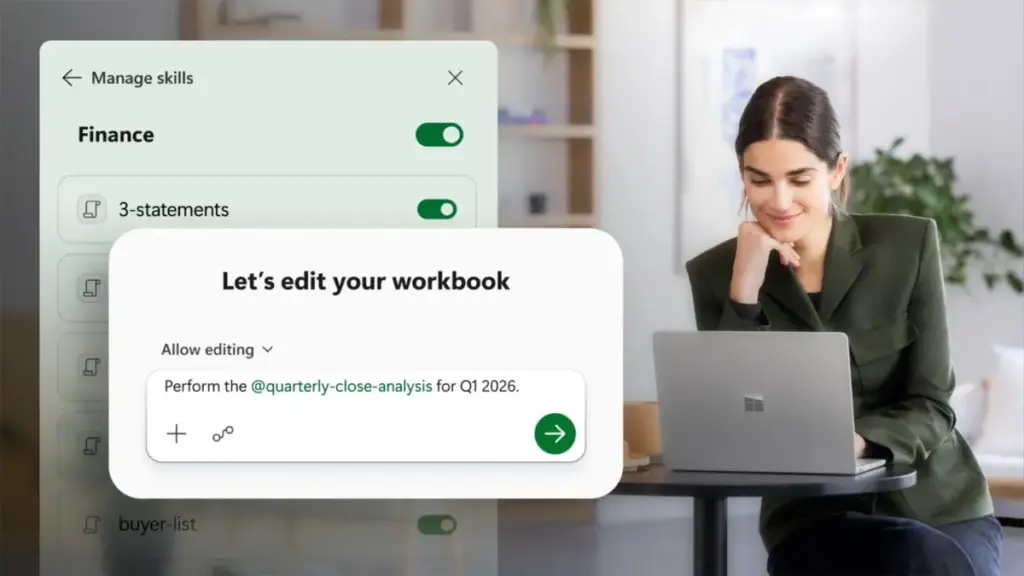
One of the most significant hurdles in automating financial work is the repetitive nature of complex processes. Tasks like building a Discounted Cash Flow (DCF) model, refreshing monthly reporting packages, or performing variance analyses often require the same logical steps but are performed manually to ensure accuracy. To solve this, Microsoft is introducing "skills" within Copilot.
These skills allow finance teams to define exactly how Copilot should execute specific, repeatable processes. Rather than starting from a blank slate with a generic prompt, a skill acts as a guided roadmap for the AI. It instructs Copilot on the specific structure, formatting, and logical flow required for a particular output. This standardization makes the final product easier to review and reuse across an organization, fostering a higher level of trust in the AI-generated content.
The system is designed to be extensible. While Microsoft provides a library of sample finance skills, organizations can create their own custom skills using an open-standard markdown file. By saving a "SKILL.md" file in a shared OneDrive folder, a finance team can ensure that Copilot adheres to their specific internal methodology when building a three-statement model or a board-ready package. This move toward customization is further supported by an upcoming ecosystem in the Microsoft Marketplace, where developers and partners such as LSEG, Ramp, Rogo, Samaya AI, Velixo, and Vena will be able to deploy specialized skills for their own platforms and ERP solutions.
To further align the AI with individual user habits, Microsoft has also introduced personalization features and workbook rules. Personalization allows users to set their preferences once—such as preferred naming conventions or formatting styles—and have Copilot apply them consistently across all future interactions. Workbook rules go a step further by capturing the specific structural and formulaic conventions of a particular file, ensuring that the AI operates within the established logic of that specific document.

Grounded in Data You Trust
In the world of finance, an analysis is only as good as the data that feeds it. Manual data pulls from external terminals and disparate databases are not only time-consuming but are also a primary source of human error. To mitigate this, Microsoft is expanding its ecosystem of financial connectors, allowing Copilot to pull market data, fundamentals, and research directly into the Excel environment.
This direct connection to external data sources ensures that analysis begins with the most current information available. Building on the previous release of connectors for LSEG and Moody’s, Microsoft is adding more options for both public and private market data. Notably, FactSet is currently in preview and is expected to reach general availability in July. These connectors allow Copilot to ground its responses in high-fidelity, professional-grade data, moving beyond the limitations of general web searches or static internal spreadsheets.
By combining this data grounding with "Work IQ"—which provides context based on the user’s internal documents and organizational data—Copilot can now tackle sophisticated prompts. For example, an analyst could ask the AI to pull the last five years of a competitor’s income statement and perform a comparative analysis against their own internal projections, all while maintaining the integrity of the source data.
Unlocking Finance Workflows with Greater Control
The ultimate goal of these features is to unlock the most demanding workflows in the finance department. However, Microsoft recognizes that in finance, the final answer is rarely enough; the methodology is what matters. To address the need for transparency, the company has introduced "Plan with Copilot."
Before the AI takes action on a spreadsheet, it can now provide an outline of its intended changes. This includes specifying which cell ranges, formulas, and assumptions it plans to update, and offering the user a chance to ask clarifying questions before any data is modified. This "look-before-you-leap" approach is designed to prevent the accidental overwriting of critical data and to give the human analyst final veto power over the AI’s logic.
Traceability is further enhanced by improvements to the "Show Changes" pane. Every edit made by the AI remains traceable, with direct links back to the affected cells. Crucially, these changes are now explicitly attributed to Copilot, distinguishing the AI’s contributions from those of human collaborators. This creates a clear audit trail, allowing managers and auditors to see exactly where the AI intervened in a model and why.
The result of these updates is an AI that functions less like a chatbot and more like a junior analyst. It proposes a methodology, explains its reasoning, and ensures that every step of its work is transparent and reviewable by a professional supervisor.
Availability and Future Outlook
The rollout of these features is already underway, though availability varies by platform and region. Personalization, workbook rules, pre-built skills, and the "Plan with Copilot" feature are generally available for Microsoft 365 Copilot customers across Excel for Web, Windows, and Mac.
For organizations looking to build their own bespoke logic, custom skills are currently available via the Insiders channel for Windows and Mac, with a broader rollout to general availability expected next month. The expansion of the partner ecosystem is also on the horizon, with partner-built skills from companies like Ramp and Vena expected to arrive in the third quarter of 2026.
As these tools become more deeply integrated into the financial sector, the focus remains on bridging the gap between the speed of AI and the precision required by the world’s most demanding financial institutions. By focusing on skills, trusted data, and absolute traceability, Microsoft is positioning Excel not just as a place where numbers are stored, but as an environment where AI can finally meet the professional standards of the finance industry.
 Productivity Software & Office Suites
Microsoft Unveils Strategic Roadmap for Enterprise AI, Prioritizing Agentic Workflows and Flexible Economic Models
In an era defined by rapid-fire technological breakthroughs and a relentless cycle...
 Productivity Software & Office Suites
Microsoft Shifts Focus to Enterprise AI Utility: A New Strategic Framework for Agents, Economics, and Partnership
In an era defined by a relentless cycle of artificial intelligence breakthroughs,...
 Productivity Software & Office Suites
Microsoft Reimagines Copilot as a Central Hub for Autonomous AI and Agentic Work
Microsoft has announced a significant evolution of its AI strategy, unveiling what...







