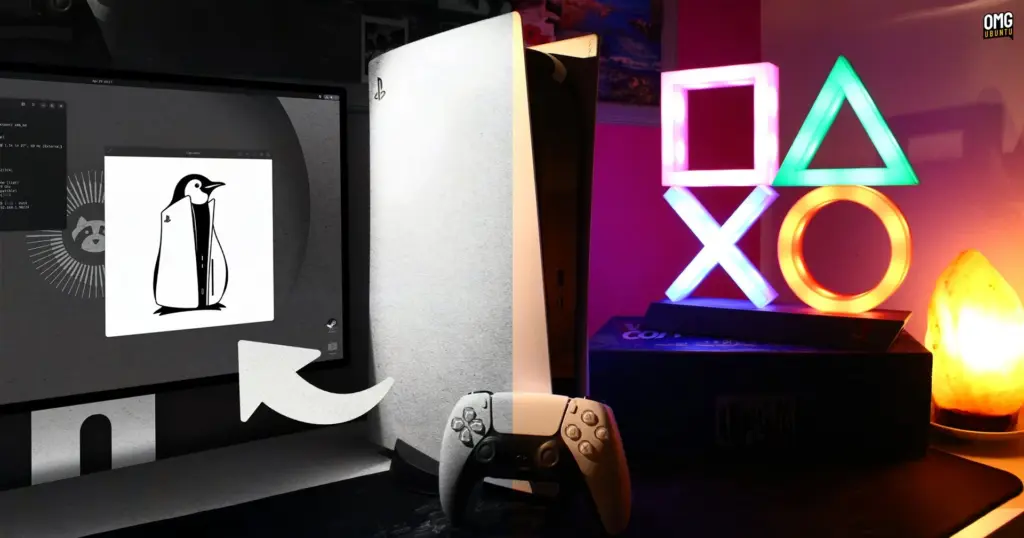
Efforts to transform home video game consoles into open computing platforms have long stood as one of the most persistent pursuits in the hardware modification and security research communities. For the PlayStation 5, the prospect of escaping Sony’s walled garden to run a full Linux distribution has historically been limited to a vanishingly small fraction of systems. Early demonstrations of alternative operating systems running on the hardware carried a major caveat: they demanded legacy firmware revisions that had been left untouched for years, well before platform architects identified and eliminated the underlying software vulnerabilities.
That landscape is shifting once again with the emergence of the pLinux5-NG project. By overhauling previous bootloader implementations and chaining together contemporary exploit methodologies, independent developers have succeeded in reviving Linux execution on significantly more modern system software versions than was previously achievable. The initiative bridges an older bootloader framework with newer privilege escalation techniques, demonstrating that despite layered defense mechanisms, the console’s proprietary environment can still be bypassed to host standard open-source kernels.
The breakthrough relies on a multi-stage software exploit chain designed to dismantle the console’s hardened internal security barriers. Central to the implementation is the integration of the Relapse jailbreak alongside Byepervisor-Reborn, a specialized tool developed to circumvent the platform’s hypervisor protections. While the development marks substantial progress in expanding the compatibility matrix of PlayStation 5 homebrew, it also highlights the delicate balance between software experimentation and the everyday realities of owning a modern connected console.
Overcoming Hardware Isolation and the Hypervisor Barrier
To appreciate the significance of booting an independent operating system on the PlayStation 5, one must consider the structural defenses built into modern console architectures. Previous generations of consoles often isolated their operating environments through standard kernel privileges. When security researchers uncovered a vulnerability within the primary operating system kernel, they frequently gained sufficient control to redirect system initialization routines, configure low-level hardware controllers, and initialize an external kernel such as Linux.
On current-generation hardware, however, platform security has shifted toward virtualization and hypervisor-enforced isolation. Sony’s system software runs atop a low-level hypervisor, a privileged software layer that sits between the physical hardware and the operating system environments that execute games and system services. The hypervisor enforces strict hardware isolation, memory write protections, and security policies that remain active even if the consumer-facing operating system kernel is completely compromised.
In practical terms, an attacker or researcher who achieves arbitrary code execution within the standard system software remains trapped inside a virtualized partition. The hypervisor prevents unauthorized modifications to critical memory mappings, restricts direct access to specific hardware controllers, and blocks the initialization of unauthorized kernels. Because of these constraints, traditional jailbreaks that merely exploit userland applications or the primary kernel are insufficient for running an operating system like Linux, which requires unhindered access to physical memory management and processing pipelines.
The pLinux5-NG initiative addresses this barrier directly by adapting the legacy PlayStation 5 Linux bootloader to work in tandem with the Byepervisor-Reborn exploit. While the Relapse jailbreak provides the initial entry point and privilege elevation within the system environment, Byepervisor-Reborn operates to undermine the hypervisor’s enforcement mechanisms. By neutralizing the restrictions imposed by this privileged monitoring layer, the project allows the modified bootloader to negotiate hardware resources, allocate system memory without hypervisor interference, and hand over execution control to a functional Linux kernel.
The Firmware Balancing Act and the 13.20 Threshold
While pLinux5-NG represents a meaningful technical leap forward, its operational requirements illustrate the persistent game of cat-and-mouse played between platform engineers and security analysts. The primary achievement of the updated bootloader is its ability to target firmware versions far closer to the contemporary ecosystem than the archaic system software versions required by initial proofs of concept.
In the broader timeline of system updates, firmware tracking projects document releases reaching as high as version 13.60, distributed in July 2026. However, the specific capabilities of the pLinux5-NG release are strictly bounded: the exploit chain in its current configuration supports consoles operating up to firmware version 13.20. While this encompasses a far wider array of hardware revisions than the early firmware branches that originally hosted Linux demonstrations, it establishes a hard ceiling for prospective users.
 Linux & Open Source Solutions
ONLYOFFICE Desktop Editors 10.0 Released as Fully Rebuilt App With Decoupled AI Tools and Over 1,000 Bug Fixes
The developers behind ONLYOFFICE have officially released version 10.0 of ONLYOFFICE Desktop...
 Linux & Open Source Solutions
Canonical Releases Official Ubuntu Desktop Images for RISC-V Hardware Ahead of Ubuntu 26.10
Installing Ubuntu on RISC-V hardware is poised to become significantly more straightforward...
 Linux & Open Source Solutions
Ubuntu 26.10 Arrives with Rust Coreutils, Passkey Authentication, and Smarter Window Snapping
Canonical has officially announced the release of Ubuntu 26.10, codenamed "Stonking Stingray."...