
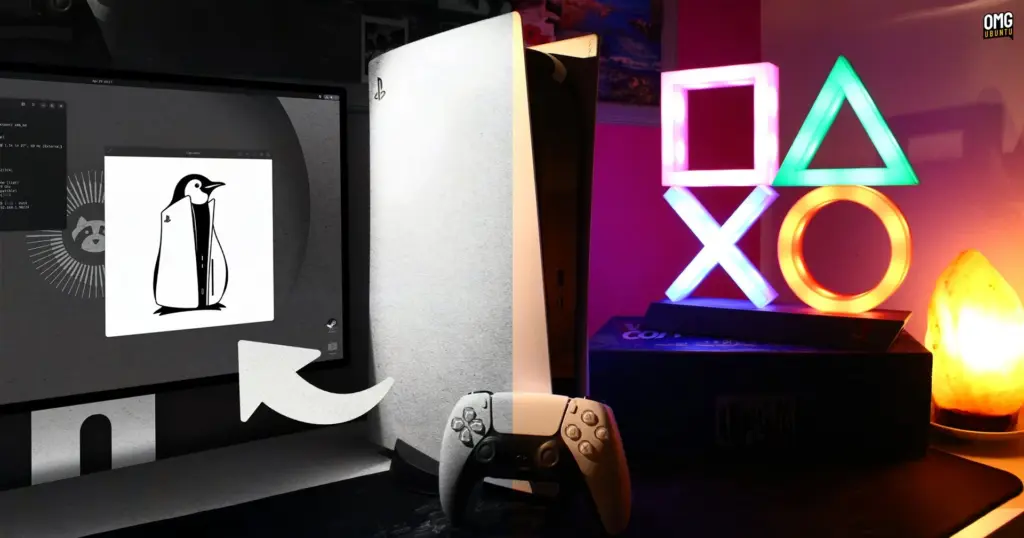
Efforts to transform home video game consoles into open computing platforms have long stood as one of the most persistent pursuits in the hardware modification and security research communities. For the PlayStation 5, the prospect of escaping Sony’s walled garden to run a full Linux distribution has historically been limited to a vanishingly small fraction of systems. Early demonstrations of alternative operating systems running on the hardware carried a major caveat: they demanded legacy firmware revisions that had been left untouched for years, well before platform architects identified and eliminated the underlying software vulnerabilities.
That landscape is shifting once again with the emergence of the pLinux5-NG project. By overhauling previous bootloader implementations and chaining together contemporary exploit methodologies, independent developers have succeeded in reviving Linux execution on significantly more modern system software versions than was previously achievable. The initiative bridges an older bootloader framework with newer privilege escalation techniques, demonstrating that despite layered defense mechanisms, the console’s proprietary environment can still be bypassed to host standard open-source kernels.
The breakthrough relies on a multi-stage software exploit chain designed to dismantle the console’s hardened internal security barriers. Central to the implementation is the integration of the Relapse jailbreak alongside Byepervisor-Reborn, a specialized tool developed to circumvent the platform’s hypervisor protections. While the development marks substantial progress in expanding the compatibility matrix of PlayStation 5 homebrew, it also highlights the delicate balance between software experimentation and the everyday realities of owning a modern connected console.
Overcoming Hardware Isolation and the Hypervisor Barrier
To appreciate the significance of booting an independent operating system on the PlayStation 5, one must consider the structural defenses built into modern console architectures. Previous generations of consoles often isolated their operating environments through standard kernel privileges. When security researchers uncovered a vulnerability within the primary operating system kernel, they frequently gained sufficient control to redirect system initialization routines, configure low-level hardware controllers, and initialize an external kernel such as Linux.
On current-generation hardware, however, platform security has shifted toward virtualization and hypervisor-enforced isolation. Sony’s system software runs atop a low-level hypervisor, a privileged software layer that sits between the physical hardware and the operating system environments that execute games and system services. The hypervisor enforces strict hardware isolation, memory write protections, and security policies that remain active even if the consumer-facing operating system kernel is completely compromised.
In practical terms, an attacker or researcher who achieves arbitrary code execution within the standard system software remains trapped inside a virtualized partition. The hypervisor prevents unauthorized modifications to critical memory mappings, restricts direct access to specific hardware controllers, and blocks the initialization of unauthorized kernels. Because of these constraints, traditional jailbreaks that merely exploit userland applications or the primary kernel are insufficient for running an operating system like Linux, which requires unhindered access to physical memory management and processing pipelines.
The pLinux5-NG initiative addresses this barrier directly by adapting the legacy PlayStation 5 Linux bootloader to work in tandem with the Byepervisor-Reborn exploit. While the Relapse jailbreak provides the initial entry point and privilege elevation within the system environment, Byepervisor-Reborn operates to undermine the hypervisor’s enforcement mechanisms. By neutralizing the restrictions imposed by this privileged monitoring layer, the project allows the modified bootloader to negotiate hardware resources, allocate system memory without hypervisor interference, and hand over execution control to a functional Linux kernel.
The Firmware Balancing Act and the 13.20 Threshold
While pLinux5-NG represents a meaningful technical leap forward, its operational requirements illustrate the persistent game of cat-and-mouse played between platform engineers and security analysts. The primary achievement of the updated bootloader is its ability to target firmware versions far closer to the contemporary ecosystem than the archaic system software versions required by initial proofs of concept.
In the broader timeline of system updates, firmware tracking projects document releases reaching as high as version 13.60, distributed in July 2026. However, the specific capabilities of the pLinux5-NG release are strictly bounded: the exploit chain in its current configuration supports consoles operating up to firmware version 13.20. While this encompasses a far wider array of hardware revisions than the early firmware branches that originally hosted Linux demonstrations, it establishes a hard ceiling for prospective users.
Complicating matters further is Sony’s subsequent release cycle. The manufacturer’s newer 14.x firmware branch addresses and closes the security vulnerabilities that the Relapse and Byepervisor-Reborn tools exploit. Consoles that have accepted these newer updates are entirely insulated from the current implementation of the bootloader, effectively locking out any machine that has been maintained on the current retail update track.
This reality introduces an unavoidable trade-off for any console owner intrigued by the technical novelty of the project. Modern consoles are designed from the ground up as cloud-connected client terminals. Retaining access to the PlayStation Network—alongside the core ecosystem features that depend on it, such as multiplayer matchmaking, digital storefronts, cloud save synchronization, and automated game patching—mandates running the absolute latest system software deployed by the platform holder.
Consequently, anyone wishing to experiment with pLinux5-NG must deliberately freeze their console’s software version at or below firmware 13.20, permanently disconnecting the device from official network infrastructure. For the vast majority of mainstream gamers, trading away active network privileges and the ability to play newly published retail titles in exchange for an experimental bootloader environment is an unappealing proposition. As a result, the practical audience for the exploit remains primarily restricted to dedicated security hobbyists and enthusiasts possessing secondary hardware kept intentionally offline.
Rewarding benchmarks show promise
The driving ambition behind running an alternative operating system on gaming console hardware has evolved over the years. When alternative operating system initiatives first appeared on earlier console platforms, enthusiasts often focused on general-purpose desktop productivity, media playback, or academic cluster computing. Today, general computing demands are easily satisfied by ubiquitous mobile devices, low-cost microcomputers, and inexpensive consumer laptops.
Very few modern users are interested in running the GNU Image Manipulation Program or loading a standard copy of Mozilla Firefox on a console tethered to a living room television. Instead, the ultimate aspiration of the homebrew community is turning the console’s custom, high-performance silicon into a full-fledged Linux gaming machine capable of accessing external PC ecosystems, such as Steam libraries and native personal computer titles.
In this context, the underlying hardware architecture of the console makes the endeavor particularly enticing. Because the hardware is fundamentally built around powerful graphics compute units and unified memory, achieving proper driver initialization under an open-source operating system could theoretically unlock remarkable performance across a wide swath of PC software.
Earlier validation testing conducted on older, heavily exploited firmware branches provided concrete indications of what the underlying silicon can deliver when freed from its native software constraints. In those earlier tests, demanding PC releases like Grand Theft Auto V Enhanced were observed running at resolutions up to 1440p while maintaining frame rates hovering near a consistent 60 frames per second.
Performance metrics of that caliber are significant because they validate the theoretical integrity of the pipeline. They prove that third-party kernels and translation software can successfully interface with the console’s graphics processing pipelines to produce fluid, high-resolution rendering without the support of proprietary platform developer kits.
It is important to emphasize that those specific benchmark results cannot be directly mapped or guaranteed on the newly adapted pLinux5-NG bootloader running on more recent firmware branches like 13.20. Each successive firmware revision introduces alterations to how memory is managed, how device drivers are laid out, and how low-level hypervisor policies function. Translating the success of an exploit chain from an older firmware version to a newer environment frequently requires re-architecting hardware initialization routines, which can introduce temporary performance overhead or system instability.
Nevertheless, the historical data points provide a vital proof of concept. They establish that the technical undertaking is grounded in measurable merit rather than mere academic curiosity. If the bootloader can achieve parity with earlier iterations, the hardware possesses the raw computational capability to serve as a formidable platform for interactive PC gaming workloads.
Practical Realities and the Engineering Mindset
Despite the technical triumphs demonstrated by projects like pLinux5-NG, the PlayStation 5 is never destined to become a practical or cost-effective alternative to a conventional Linux gaming desktop. When assessed through an everyday consumer lens, repurposing a console as a general-purpose workstation or open gaming rig involves disproportionate complexity, operational limitations, and financial friction.
Procuring a system that satisfies the rigorous firmware constraints is itself an expensive and cumbersome exercise. Because retail store shelves and official supply chains rapidly cycle forward to incorporate the latest system software, securing a machine that remains capped at firmware version 13.20 requires careful vetting of manufacturing lots or purchasing from secondary markets, where unpatched hardware frequently commands an inflated premium.
Even after acquiring a compatible console, managing a jailbroken system requires navigating an environment defined by maintenance challenges. Unlike a purpose-built desktop personal computer—where hardware configurations are modular, system firmware is user-configurable via open standards, and operating systems can be reinstalled with trivial effort—a jailbroken console exists in a perpetual state of operational fragility. The exploit chain must be reinjected, peripheral and audio driver support may remain incomplete or inconsistent across different display configurations, and any inadvertent software update can permanently eliminate the device’s capabilities.
From an economic and functional standpoint, building an entry-level personal computer, purchasing a prebuilt desktop, or upgrading an existing PC setup remains dramatically less troublesome and far more versatile. A standard PC provides native hardware driver support, full component upgradability, complete freedom from manufacturer-imposed platform lockdowns, and uninterrupted access to the broader gaming software landscape without the lingering threat of system obsolescence.
Yet framing projects like pLinux5-NG purely around consumer utility fundamentally misses the guiding spirit of the homebrew and hardware security scenes. For the independent researchers, software developers, and hobbyists who invest hundreds of hours into analyzing kernel binaries and engineering exploit chains, the primary motivation has never been rooted in consumer practicality. The work is propelled not by an evaluation of commercial necessity, but by the intellectual challenge of answering an open technical question: exploring what the machine can do simply because the silicon exists.
The ethos of hardware hacking is defined by exploring uncharted boundaries, dissecting proprietary computational architectures, and reclaiming absolute administrative ownership over consumer electronics. Every subsequent firmware revision that community developers manage to open up—navigating an increasingly sophisticated labyrinth of architectural defenses, hypervisor constraints, and cryptographic signatures—represents a distinct engineering milestone.
Each version of the system software that yields to an open operating system pushes the overarching concept of running arbitrary PC software on home console silicon closer to an attainable reality. While pLinux5-NG may not convert the PlayStation 5 into an accessible, mass-market desktop alternative, it stands as an impressive demonstration of engineering perseverance, documenting the relentless capability of the security community to analyze, adapt, and assert control over complex computing hardware.
 Linux & Open Source Solutions
New GNOME Shell Extension ‘Shader Effects’ Brings Retro CRT and VHS Aesthetics to the Modern Linux Desktop
Ever wondered what a modern Ubuntu desktop environment would look like if...
 Linux & Open Source Solutions
Canonical Publishes Official Ubuntu Desktop Images for RISC-V Hardware Ahead of Ubuntu 26.10
Installing an official Ubuntu desktop operating system on 64-bit RISC-V hardware is...
 Linux & Open Source Solutions
Ubuntu 26.10 Flavours Arrive: Community Editions Update Desktops, Graphics, and Core Tooling
Alongside the rollout of the flagship operating system, the official Ubuntu 26.10...







