
For millions of personal computer users over the past three decades, Plummer’s original utility was the ultimate digital escape hatch. Conceived during the Windows NT era and integrated into the operating system starting with Windows NT 4.0, the classic Windows Task Manager was engineered to be an unyielding, resilient watchdog capable of terminating misbehaving applications even when the rest of the graphical shell was unresponsive. Decades after contributing that critical piece of system plumbing to computing history, Plummer has turned his attention to modern diagnostic requirements, recognizing that while computing hardware has expanded from single-core processors to massively parallel multicore architectures, the fundamental challenge of diagnosing system performance bottlenecks remains as relevant as ever.
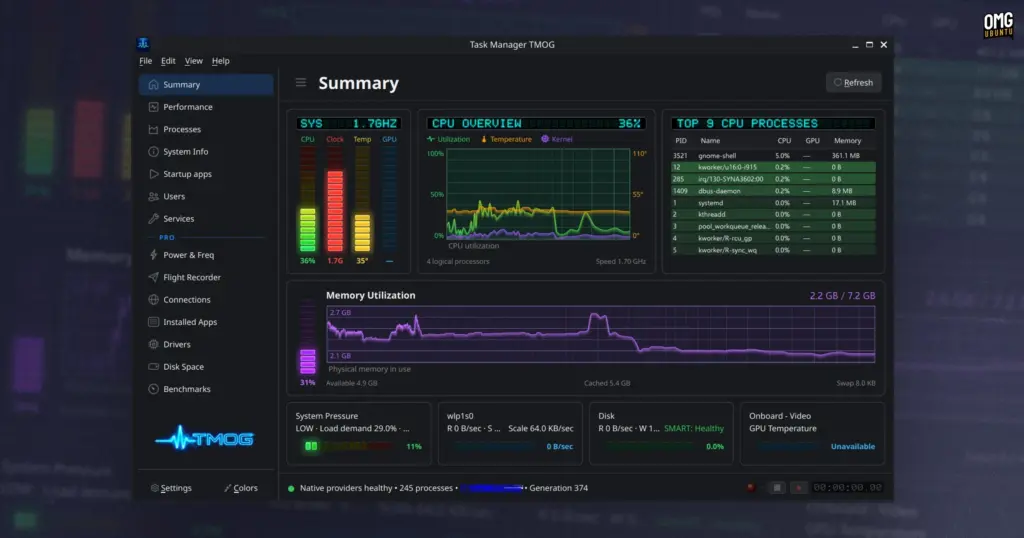
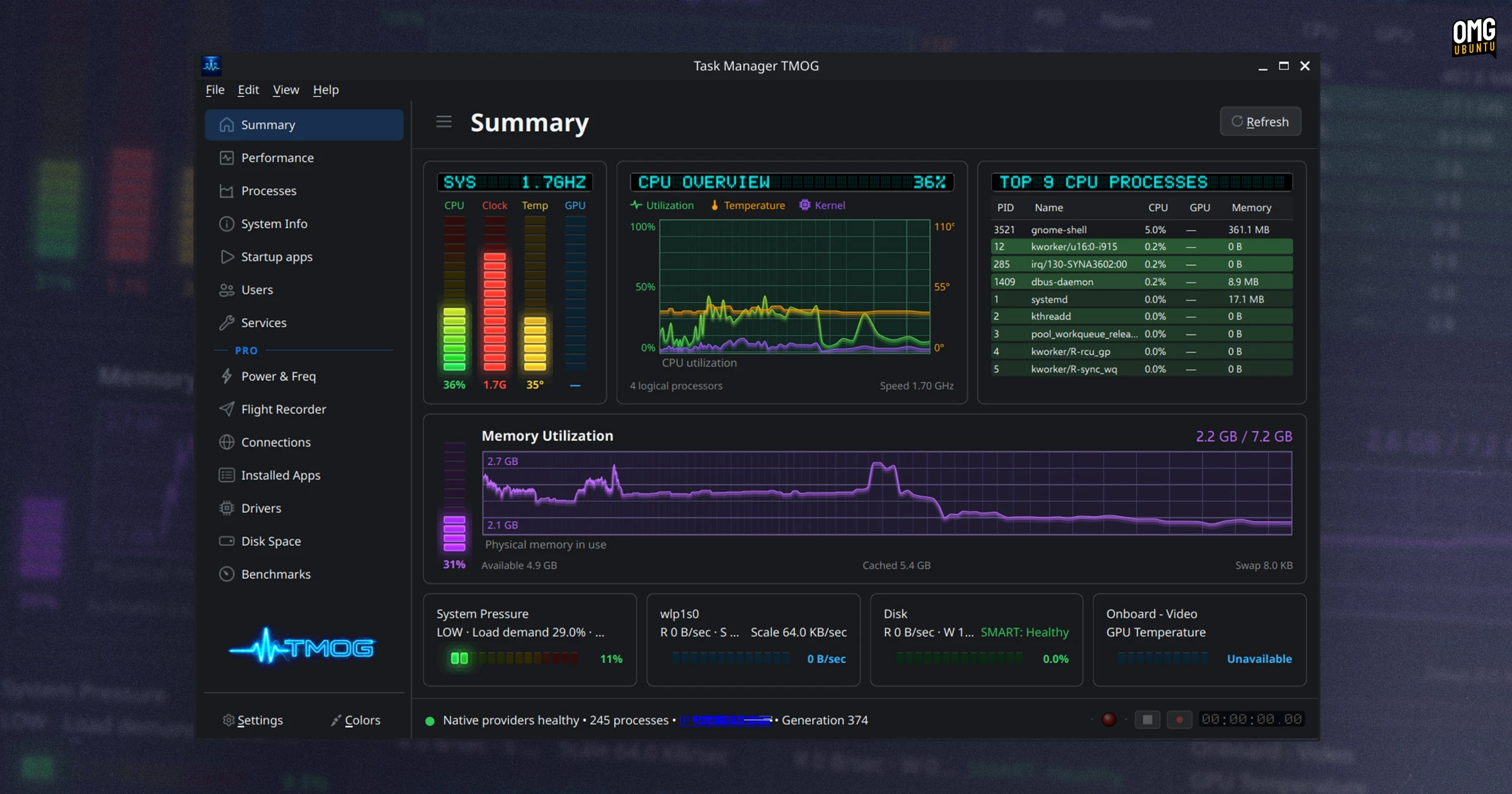
TMOG approaches this challenge with an interface that embraces a distinctive retro-futuristic aesthetic. Visually, the software leans heavily into neon accents, high-contrast diagnostic readouts, and vibrant color themes that evoke the visual style of 1990s television science-fiction interfaces. Despite its stylized graphical presentation, the program is engineered as a robust, professional utility rather than an insubstantial novelty. Beneath its visual personality lies a serious monitoring suite designed to present fine-grained operational metrics without burdening the host operating system with excessive resource overhead.
The production of TMOG has garnered significant attention across the software development industry due to Plummer’s workflow, which relied on Anthropic’s Claude Code tool to translate his technical vision into working software. The process—often colloquially termed vibe-coding—is frequently misunderstood as an effortless exercise where natural language prompts instantly yield fully formed software. Plummer, however, demonstrated that applying machine intelligence to complex systems software demands a rigorous, highly disciplined engineering framework.
To bring TMOG from initial architecture to a functional multi-platform build, Plummer authored an exhaustive specification document spanning more than one hundred pages. This document meticulously delineated the architectural topology, data collection routines, memory management models, platform-specific adaptations, and graphic pipeline specifications needed for the tool. As Plummer candidly observed on social media platform X, treating artificial intelligence as a magic wand by simply commanding a model to write a system monitor without comprehensive structural direction would almost certainly produce unusable hot garbage. By maintaining strict control over system architecture and supplying granular implementation instructions, Plummer was able to use Claude Code to accelerate the manual coding phase while preserving the technical integrity required of low-level diagnostic software.
Architecturally, TMOG achieves cross-platform parity by utilizing a shared C++ core across all supported operating systems. Building a system monitor that spans Linux, macOS, and Windows is notoriously difficult because each operating system interfaces with hardware through fundamentally different kernel architectures, subsystems, and metrics reporting frameworks. A shared C++ engine provides the backbone for data processing, calculations, and internal logic, allowing TMOG to standardize metric evaluation across disparate platforms.
Rather than adopting a heavy, one-size-fits-all cross-platform framework that might sacrifice responsiveness or introduce substantial memory overhead, Plummer chose to pair this central C++ engine with native presentation frameworks on each target operating system. On Linux, TMOG employs the Qt 6 toolkit, ensuring seamless integration and crisp rendering across modern desktop environments such as GNOME and KDE Plasma. On macOS, the user interface is rendered using native Swift and AppKit APIs to adhere to Apple’s platform design conventions and graphics pipeline. On Windows, the client relies on Direct2D hardware-accelerated rendering. This decoupled architectural model ensures that the utility remains fast, efficient, and responsive regardless of the host environment.
In terms of real-time monitoring, TMOG provides a dense, comprehensive dashboard of operational parameters. The software tracks per-process CPU consumption, memory allocation, network traffic across active sockets, disk throughput, storage capacity, and power draw. Furthermore, the dashboard offers detailed visibility into modern central processing unit behavior, reporting real-time clock frequencies, per-core activity levels, and overall hardware utilization. Users can toggle among several retro-styled visual themes, adjusting the interface’s color scheme to match their desktop setups or personal tastes.
Recognizing that users do not always want a large, comprehensive dashboard monopolizing screen real estate, Plummer integrated a flexible, floating mini-mode. This compact viewport can be pinned above other application windows, delivering a constant summary of crucial vital signs while users engage in resource-intensive tasks such as software compilation, 3D rendering, or gaming. The mini-mode embraces custom visual skins, including an aesthetic tribute inspired by the classic Winamp media player, further reinforcing the application’s affectionate celebration of 1990s software culture while maintaining practical utility for modern multitasking.
Beyond its real-time observation capabilities, TMOG seeks to address a long-standing limitation inherent to conventional system monitoring tools. In standard desktop environments, users typically launch a task manager or performance monitor reactively—only after a machine stutters, locks up, or experiences sudden latency spikes. Because the diagnostic utility is opened after the incident occurs, tracing the precise catalyst behind a temporary performance hiccup can be nearly impossible without combing through cryptic, time-stamped system logs. By the time a user brings up a performance graph, the offending process may have returned to idle, masking the root cause of the disruption.
To resolve this visibility gap, TMOG introduces an integrated Flight Recorder mechanism. Functioning much like an aircraft’s data recorder, this feature continuously captures system performance metrics over a rolling period, enabling users to rewind system activity to the exact millisecond a disruption occurred. By scrolling back in time, administrators and power users can inspect the state of system memory, thread allocation, and processor usage immediately preceding a system hang or application crash. This continuous retrospective telemetry provides a deterministic window into intermittent system problems that traditional real-time monitors routinely miss.
While TMOG provides its core real-time monitoring features free of charge, Plummer has structured advanced analytical capabilities under a commercial license. Access to the Flight Recorder rewind functionality, along with dedicated hardware benchmarking routines such as a built-in CPU benchmark tool, requires an upgrade to a paid Pro tier priced at $39.95. This freemium approach allows general users to utilize the application for everyday process inspection while providing professional developers, power users, and system administrators with specialized forensic capabilities through a commercial purchase.
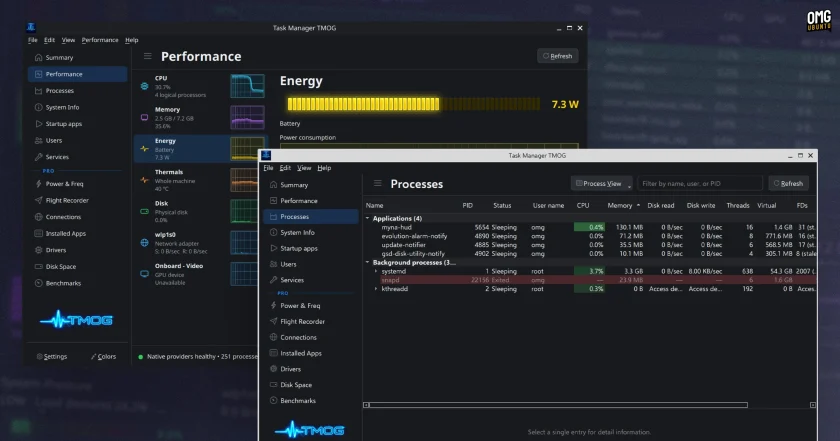
The application has entered open beta, allowing developers and enthusiasts to evaluate its performance and stability across varied hardware and software configurations. On Linux distributions, including Ubuntu, TMOG has been packaged in multiple formats to accommodate different system configurations, including standard Debian package installers (.deb), portable self-contained AppImages, and standalone binary executables. The software is compiled with support for both 64-bit x86 architectures (Intel and AMD) as well as 64-bit ARM hardware (AArch64), ensuring compatibility with modern desktops, workstations, and low-power single-board or ARM-based computing platforms.
Because TMOG remains in active beta testing, Plummer and early adopters continue to monitor for software bugs and interface quirks across different desktop managers and platform implementations. By uniting nostalgia-driven design with rigorous modern systems engineering and AI-assisted workflows, TMOG offers an intriguing perspective on how desktop diagnostic tools can evolve, bridging the gap between legacy computing culture and modern multi-platform operating systems.
 Linux & Open Source Solutions
Ubuntu 26.10 Beta Rescheduled to October 1 Following Unforeseen Infrastructure Issues
Canonical has officially postponed the public beta release of its upcoming operating...
 Linux & Open Source Solutions
Banshee Music Player Returns to Modern Linux Desktops as a Snap Package
A familiar name from the golden era of the Linux desktop has...
 Linux & Open Source Solutions
Hylki Brings Modern Rust Engineering and Deep Customization to the GNOME Desktop
For years, the Linux desktop has maintained a complicated relationship with the...






