
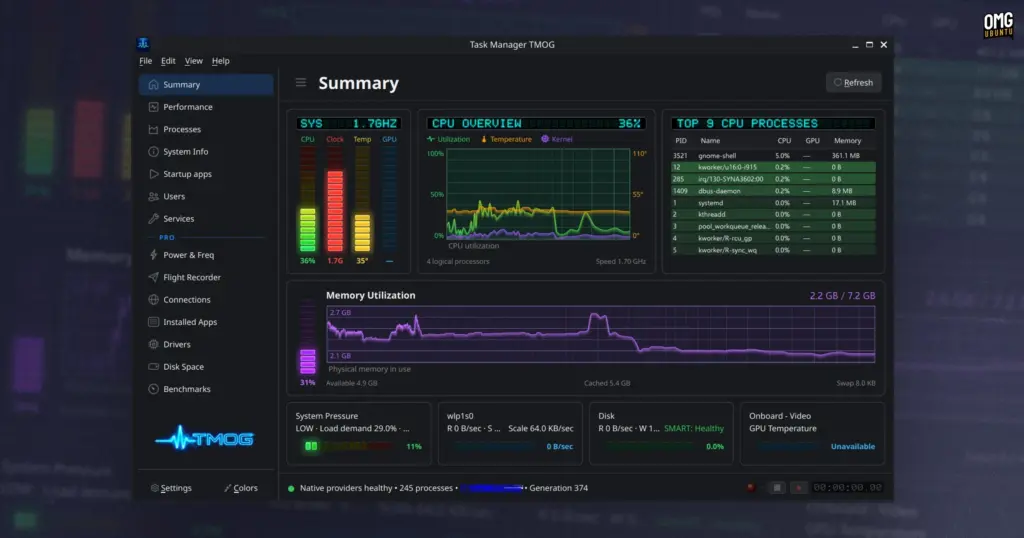
To resolve this visibility gap, TMOG introduces an integrated Flight Recorder mechanism. Functioning much like an aircraft’s data recorder, this feature continuously captures system performance metrics over a rolling period, enabling users to rewind system activity to the exact millisecond a disruption occurred. By scrolling back in time, administrators and power users can inspect the state of system memory, thread allocation, and processor usage immediately preceding a system hang or application crash. This continuous retrospective telemetry provides a deterministic window into intermittent system problems that traditional real-time monitors routinely miss.
While TMOG provides its core real-time monitoring features free of charge, Plummer has structured advanced analytical capabilities under a commercial license. Access to the Flight Recorder rewind functionality, along with dedicated hardware benchmarking routines such as a built-in CPU benchmark tool, requires an upgrade to a paid Pro tier priced at $39.95. This freemium approach allows general users to utilize the application for everyday process inspection while providing professional developers, power users, and system administrators with specialized forensic capabilities through a commercial purchase.
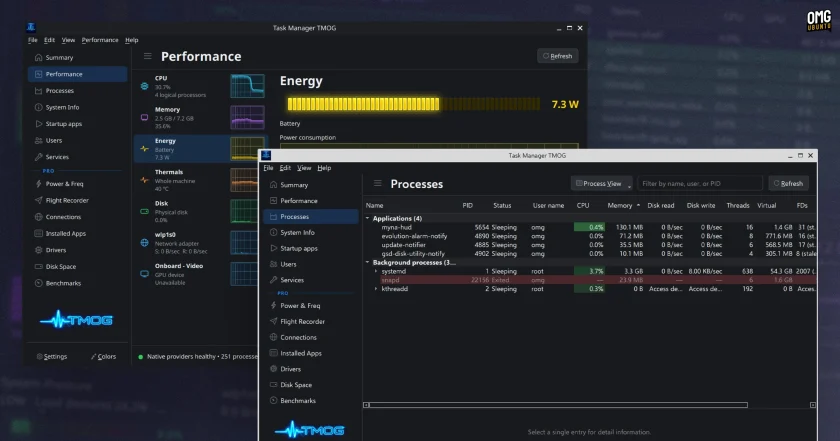
The application has entered open beta, allowing developers and enthusiasts to evaluate its performance and stability across varied hardware and software configurations. On Linux distributions, including Ubuntu, TMOG has been packaged in multiple formats to accommodate different system configurations, including standard Debian package installers (.deb), portable self-contained AppImages, and standalone binary executables. The software is compiled with support for both 64-bit x86 architectures (Intel and AMD) as well as 64-bit ARM hardware (AArch64), ensuring compatibility with modern desktops, workstations, and low-power single-board or ARM-based computing platforms.
Because TMOG remains in active beta testing, Plummer and early adopters continue to monitor for software bugs and interface quirks across different desktop managers and platform implementations. By uniting nostalgia-driven design with rigorous modern systems engineering and AI-assisted workflows, TMOG offers an intriguing perspective on how desktop diagnostic tools can evolve, bridging the gap between legacy computing culture and modern multi-platform operating systems.
 Linux & Open Source Solutions
Ubuntu 26.10 Introduces Restricted Media Codec Installation to App Center’s Add-Ons Hub
Ubuntu 26.10 has expanded the functionality of its modern App Center by...
 Linux & Open Source Solutions
ONLYOFFICE Desktop Editors 10.0 Released as Fully Rebuilt App With Decoupled AI Tools and Over 1,000 Bug Fixes
The developers behind ONLYOFFICE have officially released version 10.0 of ONLYOFFICE Desktop...
 Linux & Open Source Solutions
Ubuntu 26.10 Flavour Lineup Arrives with Updated Desktops, Wayland Advances, and the Return of Ubuntu MATE
Alongside the debut of the primary distribution, the wider Ubuntu ecosystem has...





