
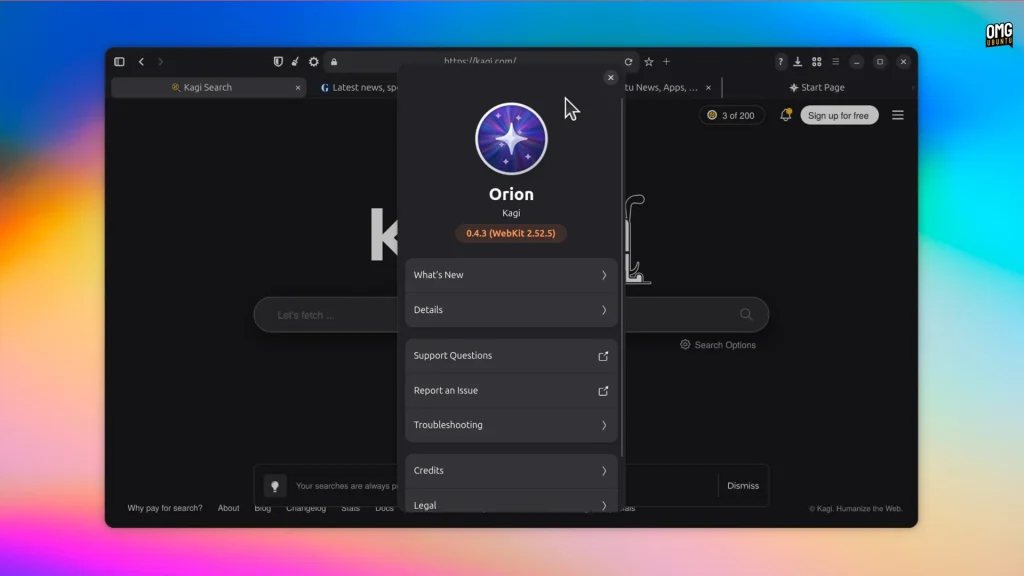
Kagi has officially announced that it is ending the internal development of its Orion web browser for Linux, marking an abrupt conclusion to one of the most closely watched independent browser initiatives in recent years. Alongside the discontinuation of the Linux build, the company confirmed that its work-in-progress port of Orion for Windows has also been halted.
The native GTK port of Orion for Linux was originally announced in 2025, sparking significant interest across the desktop Linux community. Following months of early testing, Kagi launched a public beta earlier this year, setting an ambitious target: achieving complete feature parity with the established macOS build of Orion. Subsequent beta milestones steadily added missing capabilities, refined the graphical interface, and brought the application closer to that stated objective. However, closing the remaining gap between the platforms proved to be an insurmountable hurdle for the boutique software house, and official development has now reached its final stop.
While internal development by Kagi’s core team is ending, the project will not simply vanish behind closed doors. Kagi revealed that it plans to release the source code for both the Linux version and the in-development Windows port to the public. By releasing the underlying code to the free and open-source software (FOSS) community, Kagi hopes to give outside contributors and independent developers an opportunity to pick up where the company left off and carry the projects forward.
Even so, the company was candid about the sheer difficulty of the road ahead, acknowledging the extraordinary resource demands required to build, maintain, and secure a competitive cross-platform web browser in the modern era.
The Formidable Task of Independent Browser Development
Developing a web browser has historically ranked among the most complex undertakings in personal computing. The modern web platform is governed by tens of thousands of evolving specifications, ranging from cascading style sheets and JavaScript standards to audio-visual decoders, sandboxing architectures, and network protocols. Consequently, virtually all mainstream desktop web browsers today are backed by multi-billion-dollar technology conglomerates or expansive global foundations.
Kagi addressed these realities directly when explaining its decision to step back from multi-platform browser maintenance. In a public statement regarding the change in roadmap, the company laid out the structural challenges facing smaller development operations:
“Building a cross-platform browser is something usually done by companies backed by venture capital or by large open-source communities.”
Kagi noted that it fits into neither of those categories. Instead, the company operates as an independent business powered by a compact engineering team. Rather than chasing venture funding, monetizing private user telemetry, or relying on lucrative default search engine placement deals, Kagi sustains its operations almost entirely on subscription revenues derived from its paid, ad-free search engine.
 Linux & Open Source Solutions
Canonical Releases Official Ubuntu Desktop Images for RISC-V Hardware Ahead of Ubuntu 26.10
Installing Ubuntu on RISC-V hardware is poised to become significantly more straightforward...
 Linux & Open Source Solutions
OpenShot Video Editor Arrives on the Canonical Snap Store, Bringing Version 4.0 to Ubuntu Users
In a major milestone for open-source desktop multimedia production, the popular Qt-based...
 Linux & Open Source Solutions
Ubuntu 26.10 Arrives with Rust Coreutils, Passkey Authentication, and Smarter Window Snapping
Canonical has officially announced the release of Ubuntu 26.10, codenamed "Stonking Stingray."...







