
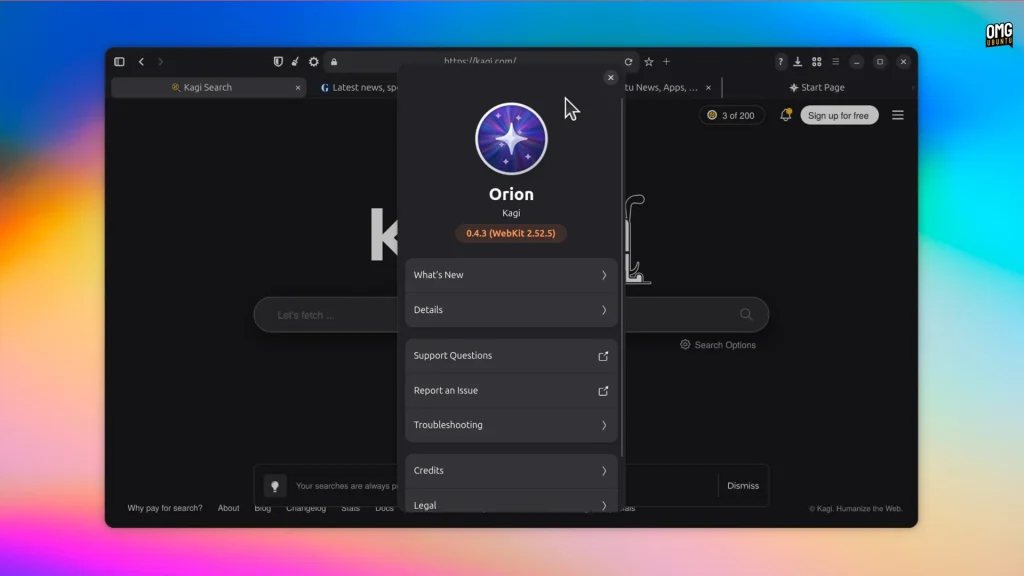
Yet that very same business model is ultimately what necessitates the retreat from Linux and Windows. With resources directly tied to customer subscriptions, Kagi must focus its engineering firepower where its active paying subscribers actually reside. For Orion, the overwhelming majority of that active user base is concentrated within Apple’s hardware ecosystem—specifically on macOS and iOS.
By scaling back its multi-platform ambitions, Kagi aims to protect and polish the user experience on its strongest platforms rather than spreading its limited development personnel thin across three fundamentally different desktop environments. Kagi confirmed that ongoing development for Orion on macOS and iOS remains entirely unaffected by the cancellation of the Linux and Windows ports.
The impending open-source release offers a valuable starting point for third-party developers, independent teams, or existing open-source organizations interested in WebKit-based desktop applications. The source code for both the GTK-based Linux implementation and the nascent Windows port could potentially be forked, maintained by a dedicated community collective, or integrated into complementary open-source desktop efforts.
However, community members seeking to take up the mantle will face the same demanding realities that led to Kagi’s departure. Independent open-source browser maintenance requires ongoing vigilance to track upstream WebKit updates, resolve regressions caused by desktop toolkit updates, and handle platform packaging across varied Linux distributions. Whether an organized community forms to build upon Kagi’s foundations remains to be seen.
For existing testers who have the Orion beta installed on Linux distributions, the software will not abruptly stop working. Users are technically free to keep launching the application on their local systems. However, Kagi explicitly advised against using the Linux beta as a daily driver moving forward.
Because official development has ceased, the Linux build will receive no further stability updates, bug fixes, or critical security patches. Web browsers serve as the primary gateway to untrusted remote code across the internet; relying on an unmaintained browser engine without regular security updates exposes users to significant vulnerabilities as new exploits are discovered.
Kagi announced that it plans to publish further details regarding the open-sourcing process, repository availability, and licensing frameworks in the coming month. Until then, the release marks the end of official Linux support for one of the platform’s most promising non-Chromium browser projects.
 Linux & Open Source Solutions
Ubuntu 26.10 Introduces Restricted Media Codec Installation to App Center’s Add-Ons Hub
Ubuntu 26.10 has expanded the functionality of its modern App Center by...
 Linux & Open Source Solutions
Canonical Releases Official Ubuntu Desktop Images for RISC-V Hardware Ahead of Ubuntu 26.10
Installing Ubuntu on RISC-V hardware is poised to become significantly more straightforward...
 Linux & Open Source Solutions
GNOME Shell Weather Extensions Bring Dynamic Visuals to the Desktop Panel
While dedicated desktop applications for checking the weather have long enjoyed a...







