
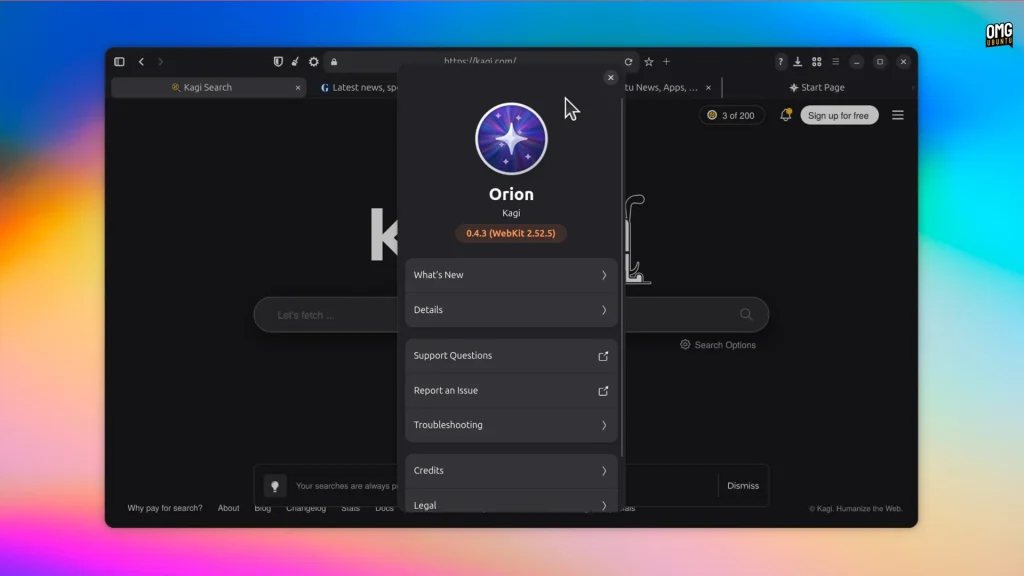
Kagi has officially announced that it is ending the internal development of its Orion web browser for Linux, marking an abrupt conclusion to one of the most closely watched independent browser initiatives in recent years. Alongside the discontinuation of the Linux build, the company confirmed that its work-in-progress port of Orion for Windows has also been halted.
The native GTK port of Orion for Linux was originally announced in 2025, sparking significant interest across the desktop Linux community. Following months of early testing, Kagi launched a public beta earlier this year, setting an ambitious target: achieving complete feature parity with the established macOS build of Orion. Subsequent beta milestones steadily added missing capabilities, refined the graphical interface, and brought the application closer to that stated objective. However, closing the remaining gap between the platforms proved to be an insurmountable hurdle for the boutique software house, and official development has now reached its final stop.
While internal development by Kagi’s core team is ending, the project will not simply vanish behind closed doors. Kagi revealed that it plans to release the source code for both the Linux version and the in-development Windows port to the public. By releasing the underlying code to the free and open-source software (FOSS) community, Kagi hopes to give outside contributors and independent developers an opportunity to pick up where the company left off and carry the projects forward.
Even so, the company was candid about the sheer difficulty of the road ahead, acknowledging the extraordinary resource demands required to build, maintain, and secure a competitive cross-platform web browser in the modern era.
The Formidable Task of Independent Browser Development
Developing a web browser has historically ranked among the most complex undertakings in personal computing. The modern web platform is governed by tens of thousands of evolving specifications, ranging from cascading style sheets and JavaScript standards to audio-visual decoders, sandboxing architectures, and network protocols. Consequently, virtually all mainstream desktop web browsers today are backed by multi-billion-dollar technology conglomerates or expansive global foundations.
Kagi addressed these realities directly when explaining its decision to step back from multi-platform browser maintenance. In a public statement regarding the change in roadmap, the company laid out the structural challenges facing smaller development operations:
“Building a cross-platform browser is something usually done by companies backed by venture capital or by large open-source communities.”
Kagi noted that it fits into neither of those categories. Instead, the company operates as an independent business powered by a compact engineering team. Rather than chasing venture funding, monetizing private user telemetry, or relying on lucrative default search engine placement deals, Kagi sustains its operations almost entirely on subscription revenues derived from its paid, ad-free search engine.
That modest, user-funded structure creates hard engineering limits. When allocating engineering hours, small companies must weigh the long-term cost of continuous cross-platform maintenance against the immediate needs of their core user base. Maintaining a desktop browser requires not only initial software architecture and user-interface design, but also continuous upstream engine updates, security patching, platform-specific bug remediation, and integration with dynamic desktop environments.
These challenges were amplified by Kagi’s refusal to take standard technological shortcuts. Most emerging browsers that enter the market today choose to build on top of Google’s open-source Chromium platform. Leveraging Chromium significantly simplifies cross-platform deployments because the engine already accounts for platform-specific graphics pipelines, audio stacks, memory allocators, and operating system integrations across Windows, macOS, and Linux distributions.
Kagi intentionally avoided that path. From the project’s inception, the company articulated a foundational belief that the web ecosystem needs more than one engine to stay healthy, competitive, and decentralized. Left unchecked, a monoculture around a single dominant browser engine risks centralizing control over the future of web standards in the hands of a single corporation.
By designing Orion around WebKit—the browser engine that originally powered Safari and shares roots with early open-source initiatives—Kagi sought to prove that a lean, fast, alternative engine could succeed beyond the confines of Apple’s walled garden. Yet translating a WebKit-centric architecture to desktop Linux using native GTK interfaces demanded substantial bespoke development, requiring Kagi to solve platform-level edge cases that Chromium-based competitors could largely bypass.
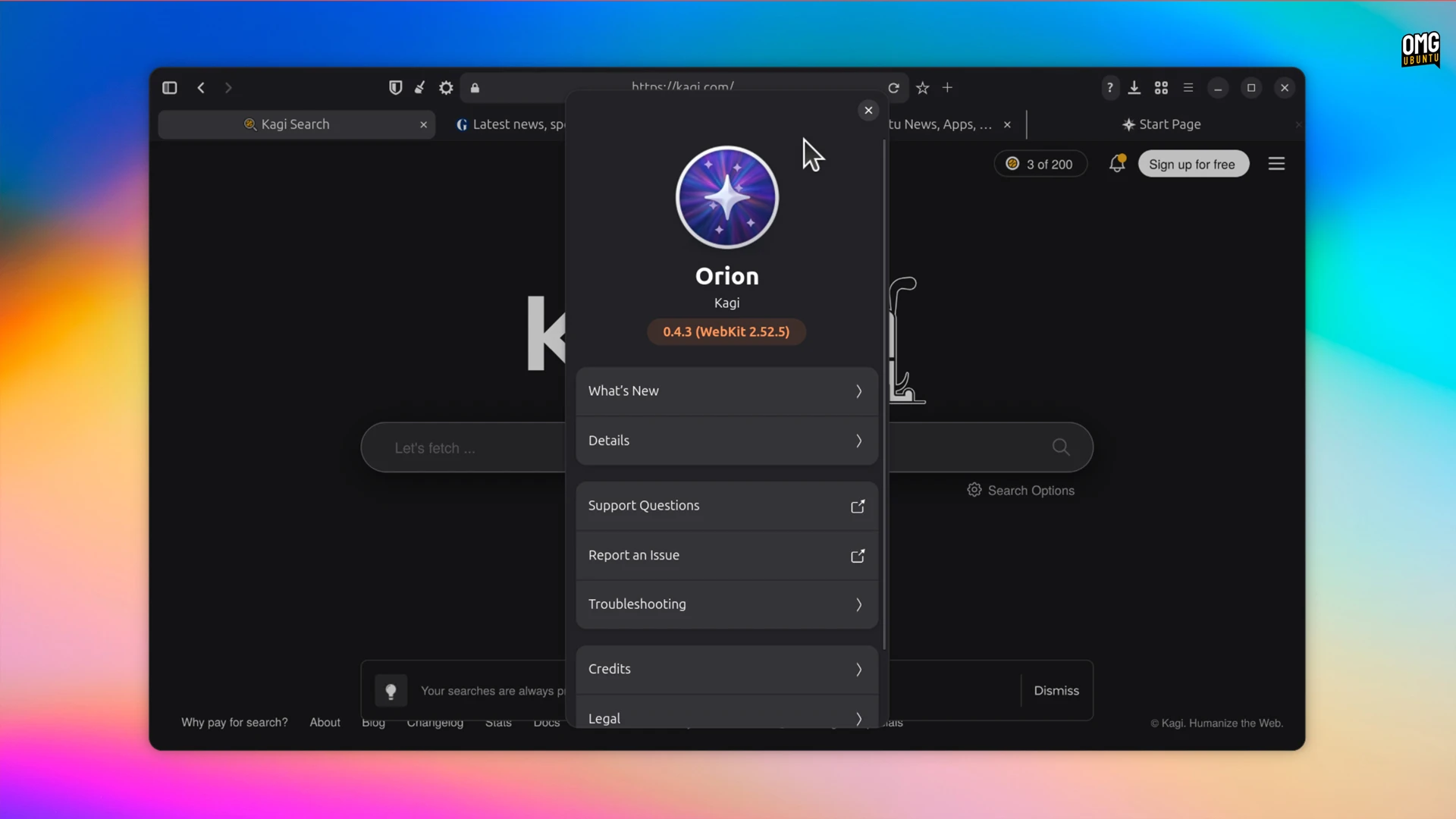
On macOS, Orion earned a reputation as a genuinely solid and capable daily driver, earning praise from power users for its performance, low memory footprint, and native design ethos. The initial promise of bringing those same lightweight, highly customizable WebKit experiences to the Linux desktop attracted considerable attention from enthusiasts who were eager to see a modern, non-Chromium alternative that respected native desktop design principles. Despite the engineering momentum demonstrated during the initial beta releases, sustaining that velocity across disparate desktop platforms ultimately exceeded the capacity of Kagi’s compact workforce.
Orion for Linux Is Finally Going Open Source
The transition away from active in-house development comes with a significant silver lining: Orion for Linux is finally going open source.
When Orion was first announced, the browser was proprietary software, a detail that dampened enthusiasm among portions of the Linux and broader open-source communities. In desktop Linux ecosystems, where software transparency, community auditing, and software freedom are fundamental priorities, closed-source web browsers frequently encounter skepticism. For developers and power users who were previously reluctant to invest their time in a proprietary product, the news that the codebase will be made open source represents a welcome, if bittersweet, turn of events.
Kagi’s overarching business model was explicitly designed to keep incentives aligned with end users. Because the company does not rely on advertising impressions, behavioral tracking, or data-broker relationships, it faced none of the perverse incentives that frequently mar modern browsing experiences. An independent Orion meant a browser free from artificial interface bloat, sponsored tiles, aggressive crypto-wallet integrations, or unwanted background promotions. The software could focus solely on navigation, speed, utility, and user control.
Yet that very same business model is ultimately what necessitates the retreat from Linux and Windows. With resources directly tied to customer subscriptions, Kagi must focus its engineering firepower where its active paying subscribers actually reside. For Orion, the overwhelming majority of that active user base is concentrated within Apple’s hardware ecosystem—specifically on macOS and iOS.
By scaling back its multi-platform ambitions, Kagi aims to protect and polish the user experience on its strongest platforms rather than spreading its limited development personnel thin across three fundamentally different desktop environments. Kagi confirmed that ongoing development for Orion on macOS and iOS remains entirely unaffected by the cancellation of the Linux and Windows ports.
The impending open-source release offers a valuable starting point for third-party developers, independent teams, or existing open-source organizations interested in WebKit-based desktop applications. The source code for both the GTK-based Linux implementation and the nascent Windows port could potentially be forked, maintained by a dedicated community collective, or integrated into complementary open-source desktop efforts.
However, community members seeking to take up the mantle will face the same demanding realities that led to Kagi’s departure. Independent open-source browser maintenance requires ongoing vigilance to track upstream WebKit updates, resolve regressions caused by desktop toolkit updates, and handle platform packaging across varied Linux distributions. Whether an organized community forms to build upon Kagi’s foundations remains to be seen.
For existing testers who have the Orion beta installed on Linux distributions, the software will not abruptly stop working. Users are technically free to keep launching the application on their local systems. However, Kagi explicitly advised against using the Linux beta as a daily driver moving forward.
Because official development has ceased, the Linux build will receive no further stability updates, bug fixes, or critical security patches. Web browsers serve as the primary gateway to untrusted remote code across the internet; relying on an unmaintained browser engine without regular security updates exposes users to significant vulnerabilities as new exploits are discovered.
Kagi announced that it plans to publish further details regarding the open-sourcing process, repository availability, and licensing frameworks in the coming month. Until then, the release marks the end of official Linux support for one of the platform’s most promising non-Chromium browser projects.
 Linux & Open Source Solutions
Hylki Brings Modern Rust Engineering and Deep Customization to the GNOME Desktop
For years, the Linux desktop has maintained a complicated relationship with the...
 Linux & Open Source Solutions
OpenShot Video Editor Arrives on the Canonical Snap Store, Bringing Version 4.0 to Ubuntu Users
In a major milestone for open-source desktop multimedia production, the popular Qt-based...
 Linux & Open Source Solutions
Ubuntu 26.10 Introduces Top-Screen Layout Picker to Streamline Window Tiling
Ubuntu 26.10 is introducing a new way for users to organize their...







