
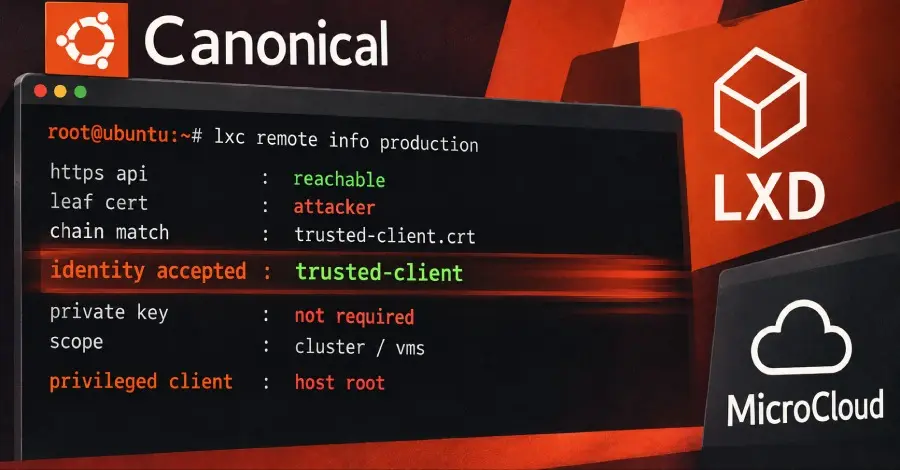
In a significant security development for the Linux container and cloud orchestration ecosystem, Canonical has disclosed a critical vulnerability affecting its LXD and MicroCloud products. The flaw, which has been assigned the highest possible severity rating, could potentially allow a remote attacker to bypass authentication mechanisms and gain full control over host machines. Identified as CVE-2026-112816, the vulnerability carries a maximum CVSS score of 10.0, highlighting the extreme risk it poses to cloud environments and virtualization infrastructure that rely on these technologies.
The vulnerability centers on a failure in how identity is verified during the authentication process. Specifically, the flaw allows an attacker to log into a system as a trusted client without ever possessing that client’s private key. Under normal security protocols, the possession of a private key is the fundamental proof of identity in a cryptographic exchange. By circumventing this requirement, the vulnerability effectively breaks the trust model upon which LXD and MicroCloud rely for secure remote management.
LXD, a powerful system container and virtual machine manager, and MicroCloud, a tool designed to automate the deployment of small-scale clouds, are both widely used in data centers and edge computing environments. Because these tools often manage sensitive workloads and provide deep access to underlying hardware, a vulnerability of this magnitude represents a tier-one security threat for enterprises and developers alike.
How the Flaw Works
To understand the mechanics of CVE-2026-112816, one must look at the implementation of mutual TLS (mTLS) within LXD and MicroCloud. In a standard secure connection, such as a browser visiting a website, the server provides a certificate to prove its identity to the client. In a mutual TLS setup, the process is bidirectional: the client must also present a certificate to the server to prove its identity before access is granted.
LXD and MicroCloud use this mTLS framework to manage remote client access to their APIs. When a client attempts to connect, it presents a certificate chain. The server then checks this certificate against its internal "trust store"—a list of identities and certificates that the administrator has explicitly authorized. If a match is found, the server assumes the client is who they claim to be and grants the appropriate permissions.
The critical failure discovered in these products involves the specific logic used to validate the certificate chain. In a legitimate mTLS handshake, the server must verify that the client owns the private key corresponding to the "leaf" certificate—the very first certificate in the chain. While a client can attach multiple certificates to a chain to show a path of trust back to a root authority, the cryptographic proof of ownership only applies to that initial leaf certificate.
The vulnerability stems from the fact that the affected versions of LXD and MicroCloud were designed to compare every certificate provided in the chain against the trust store. Crucially, the server did not sufficiently verify that the client actually held the private keys for the subsequent certificates in that chain. An attacker could therefore craft a connection where they present their own certificate as the leaf, but then append the public certificate of a highly privileged, trusted client further down the chain.

Because public certificates are, by their nature, not secret information, an attacker could easily obtain the public certificate of a known administrator or a trusted cluster member. By simply attaching this public certificate to their own connection attempt, the attacker could trick the server’s validation logic. The server, seeing a trusted certificate anywhere in the chain, would incorrectly validate the entire connection and treat the attacker as the trusted entity.
The Impact of Impersonation
The consequences of this flaw are severe. Once an attacker successfully impersonates a trusted client, they inherit all the permissions and access rights associated with that identity. In the context of LXD and MicroCloud, this means the attacker gains the ability to manage the entire cluster, manipulate virtual machines, and access sensitive data stored within containers.
The level of access depends on the privileges of the account being impersonated. If the attacker manages to impersonate a client with administrative or "privileged" status, the breach extends beyond the virtualization layer. Canonical has warned that in such scenarios, an attacker could gain root access to the host machine itself. Root access is the highest level of permission on a Linux system, allowing an intruder to modify the operating system, install persistent malware, intercept network traffic, or move laterally through the internal network to compromise other systems.
In a MicroCloud environment, the risk is compounded by the integrated nature of the cluster. MicroCloud is designed to tie several machines running LXD into a single, cohesive unit. Canonical noted a specific weak point in how new members join these clusters. If an attacker is positioned to capture a member’s public certificate as it is being exchanged during the initial cluster joining process, they can immediately use that certificate to log in as a legitimate member of the cloud infrastructure.
Discovery and Affected Versions
The origins of this bug were not found within Canonical’s internal development team, but rather through the broader open-source ecosystem. The Incus project, which began as a community-led fork of LXD following Canonical’s decision to change the project’s licensing and governance, originally discovered and reported the issue. Upon receiving the report, Canonical investigated its own codebase and confirmed that the vulnerability was present in LXD and MicroCloud.
This cross-project discovery highlights the interconnected nature of modern software development. Because Incus and LXD share a common ancestral codebase, security researchers working on the community fork were able to identify a deep-seated logic error that had persisted in both versions of the software.
The vulnerability affects several long-term support (LTS) and feature releases of LXD. Specifically, the CVE record identifies LXD versions 4.0.14, 5.0.10, 5.21.8, and 6.9 as being vulnerable. For MicroCloud, the flaw was present in versions prior to the latest security updates. Canonical has moved quickly to release fixed versions across all supported branches to ensure that users can secure their environments regardless of which specific release track they are following.
For users running LXD via the Snap packaging system, which is the standard distribution method for the software on Ubuntu and other Linux distributions, the following fixed versions have been made available:

- LXD 6.10.1 (on the 6/stable channel)
- LXD 5.21.9 (on the 5.21/stable channel)
- LXD 5.0.11 (on the 5.0/stable channel)
- LXD 4.0.15 (on the 4.0/stable channel)
MicroCloud users must update to version 3.4.1 or 2.1.5, depending on their current stable channel. Meanwhile, the Incus project has addressed the flaw in its version 7.6.0 release, which notably included fixes for seventeen other security-related issues alongside this critical vulnerability.
Current Threat Landscape and Mitigation
Despite the critical nature of CVE-2026-112816 and its maximum severity score, there is currently no evidence to suggest that the flaw has been exploited in the wild. A recent assessment by the U.S. Cybersecurity and Infrastructure Security Agency (CISA) indicated that the vulnerability is not known to have been used by threat actors as of late October. Furthermore, no functional, public exploit code has been released, which provides a narrow window of opportunity for administrators to patch their systems before automated attacks begin.
However, the lack of current exploitation should not lead to complacency. Given the high value of cloud infrastructure as a target for ransomware and espionage, the publication of the vulnerability details often serves as a roadmap for attackers to develop their own exploits.
The primary and most effective mitigation is to update LXD and MicroCloud to the latest fixed versions immediately. For systems using Snap, this can be accomplished through the standard refresh commands. Canonical has advised administrators to verify the version number of their software after performing an update, as the rollout of fixed point releases from the candidate channels to the stable channels may take time to propagate across all global mirrors.
For organizations that cannot apply patches immediately, the risk can be partially mitigated by restricting network access. The vulnerability requires the attacker to be able to reach the HTTPS API of the LXD or MicroCloud instance over the network. By default, a standalone LXD server does not expose this API to the network; it listens only on a local Unix socket. The risk only arises if an administrator has explicitly enabled network access by configuring the "core.https_address" setting.
Both Canonical and the Incus project have emphasized that there is no configuration-based workaround that can fully resolve the flaw without a software update. The only temporary defensive measure is to use firewalls or network access control lists (ACLs) to ensure that only known, trusted IP addresses can reach the API listener. This "defense-in-depth" approach can limit the exposure, but it does not fix the underlying logic error in the certificate validation process.
As cloud-native technologies continue to underpin modern digital services, the security of the orchestration layer remains paramount. The disclosure of CVE-2026-112816 serves as a reminder of the complexities involved in implementing robust authentication protocols and the vital role that community collaboration plays in identifying and resolving critical security defects before they can be weaponized. Owners of LXD and MicroCloud deployments are urged to prioritize these updates to safeguard their infrastructure from potential unauthorized access.
 Cybersecurity Basics & Security News
LiteLLM Supply Chain Breach: How a Leaked Master Key Led to the Distribution of Malicious Python Packages
The cybersecurity landscape has been served a stark reminder of the long-tail...
 Cybersecurity Basics & Security News
Bridging the Security Gap: Why Modern Enterprises are Moving Beyond Traditional Vulnerability Management
In the rapidly evolving landscape of cybersecurity, a critical finding can traverse...
 Cybersecurity Basics & Security News
Trezor Issues Urgent Warning Over Hardware Implants Found in Wallets Sold by Southeast Asian Reseller
The cryptocurrency security landscape is facing a significant new challenge as Trezor,...







