
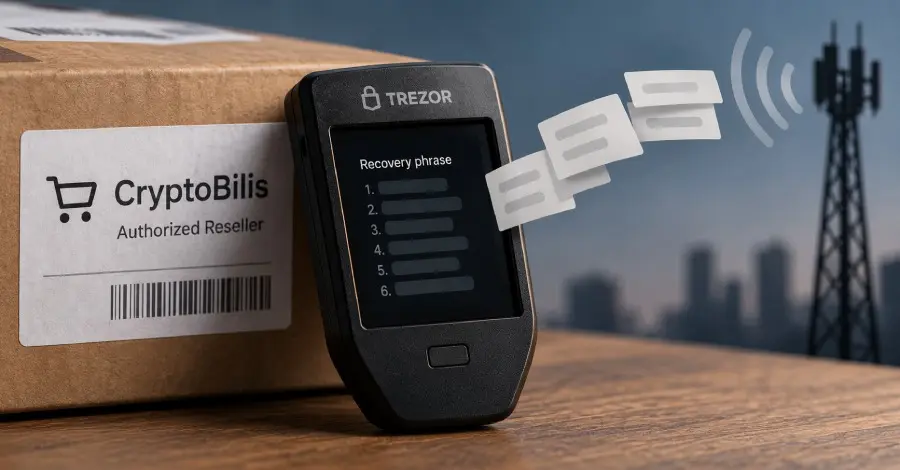
The cryptocurrency security landscape is facing a significant new challenge as Trezor, one of the world’s leading manufacturers of hardware wallets, has officially warned customers of a sophisticated supply chain attack. The company recently confirmed reports of a Trezor Safe 5 device that had been physically tampered with, containing an unauthorized internal component designed to steal sensitive user data. The discovery has sent shockwaves through the digital asset community, highlighting the persistent vulnerabilities inherent in the global distribution and reselling of specialized security hardware.
According to a detailed report released by Trezor, the compromised device—a Trezor Safe 5—was purchased through CryptoBilis, a prominent third-party reseller operating in Southeast Asia. The tampering involves a highly advanced hardware implant that allows the device to broadcast a user’s recovery phrase over a mobile network, effectively neutralizing the "cold storage" protections that hardware wallets are designed to provide.
Discovery of the Malicious Implant
The investigation began on October 28, 2026, when a customer in Indonesia reported suspicious physical characteristics in a newly purchased Trezor Safe 5. The user had acquired the device in August through Tokopedia, a major Indonesian e-commerce marketplace, where CryptoBilis maintained an active storefront. Unlike many victims of such attacks, the customer in question possessed a high degree of technical awareness. Before transferring any significant funds to the wallet, they noticed a slight discrepancy in the device’s weight and decided to investigate further.
Upon closer inspection, the user discovered an additional, unauthorized circuit board nested within the device’s internal housing. Trezor’s preliminary analysis of the customer’s photos and descriptions, supplemented by a video interview with the victim, confirmed the presence of a malicious hardware modification. The rogue board was strategically placed between the wallet’s primary logic board and its display screen.
This specific placement is critical to the implant’s function. By sitting between the processor and the screen, the malicious component is capable of "reading" the information displayed to the user. In the context of a hardware wallet, the most sensitive information shown on the screen is the recovery phrase—a sequence of 12 to 24 words that acts as the master key to the user’s private keys. Trezor refers to this as the "wallet backup."
Technical Sophistication of the Attack
The reported implant is remarkably sophisticated, featuring its own cellular module and an integrated antenna. According to the customer’s report, the device is designed to activate whenever it is plugged into a power source, such as a computer or a wall charger. Once powered, the cellular module connects to a local mobile network and transmits the captured recovery phrase to a remote server controlled by the attackers.

This method of exfiltration is particularly dangerous because it bypasses the security of the user’s computer. Traditional hardware wallets are designed to keep private keys and recovery phrases entirely offline, ensuring that even if a computer is infected with malware, the assets remain safe. However, by adding a secondary communication channel—cellular data—the attackers created a "backdoor" that does not rely on the host computer’s internet connection or USB data lines.
 Cybersecurity Basics & Security News
Critical Remote Code Execution Vulnerability Discovered in GitLab AI Gateway
GitLab has issued an urgent security advisory regarding a critical vulnerability discovered...
 Cybersecurity Basics & Security News
Critical Linux Kernel TCP Vulnerability Triggers Urgent Patching Cycle Across Enterprise Distributions
A severe security flaw residing within the Linux kernel’s networking stack has...
 Cybersecurity Basics & Security News
OpenAI Dismisses Safety Researchers Following Leak of Confidential Infrastructure Data Amid Growing Security Concerns
OpenAI has terminated the employment of three prominent members of its safety...







