

- LXD 6.10.1 (on the 6/stable channel)
- LXD 5.21.9 (on the 5.21/stable channel)
- LXD 5.0.11 (on the 5.0/stable channel)
- LXD 4.0.15 (on the 4.0/stable channel)
MicroCloud users must update to version 3.4.1 or 2.1.5, depending on their current stable channel. Meanwhile, the Incus project has addressed the flaw in its version 7.6.0 release, which notably included fixes for seventeen other security-related issues alongside this critical vulnerability.
Current Threat Landscape and Mitigation
Despite the critical nature of CVE-2026-112816 and its maximum severity score, there is currently no evidence to suggest that the flaw has been exploited in the wild. A recent assessment by the U.S. Cybersecurity and Infrastructure Security Agency (CISA) indicated that the vulnerability is not known to have been used by threat actors as of late October. Furthermore, no functional, public exploit code has been released, which provides a narrow window of opportunity for administrators to patch their systems before automated attacks begin.
However, the lack of current exploitation should not lead to complacency. Given the high value of cloud infrastructure as a target for ransomware and espionage, the publication of the vulnerability details often serves as a roadmap for attackers to develop their own exploits.
The primary and most effective mitigation is to update LXD and MicroCloud to the latest fixed versions immediately. For systems using Snap, this can be accomplished through the standard refresh commands. Canonical has advised administrators to verify the version number of their software after performing an update, as the rollout of fixed point releases from the candidate channels to the stable channels may take time to propagate across all global mirrors.
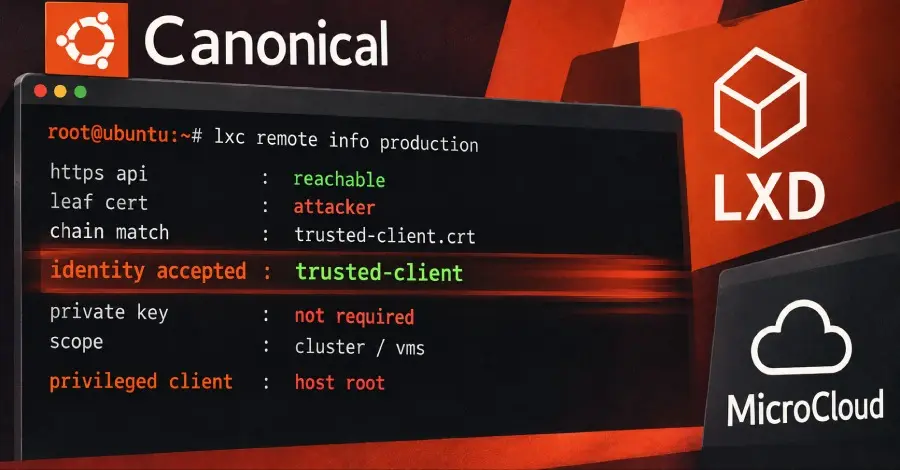
For organizations that cannot apply patches immediately, the risk can be partially mitigated by restricting network access. The vulnerability requires the attacker to be able to reach the HTTPS API of the LXD or MicroCloud instance over the network. By default, a standalone LXD server does not expose this API to the network; it listens only on a local Unix socket. The risk only arises if an administrator has explicitly enabled network access by configuring the "core.https_address" setting.
Both Canonical and the Incus project have emphasized that there is no configuration-based workaround that can fully resolve the flaw without a software update. The only temporary defensive measure is to use firewalls or network access control lists (ACLs) to ensure that only known, trusted IP addresses can reach the API listener. This "defense-in-depth" approach can limit the exposure, but it does not fix the underlying logic error in the certificate validation process.
As cloud-native technologies continue to underpin modern digital services, the security of the orchestration layer remains paramount. The disclosure of CVE-2026-112816 serves as a reminder of the complexities involved in implementing robust authentication protocols and the vital role that community collaboration plays in identifying and resolving critical security defects before they can be weaponized. Owners of LXD and MicroCloud deployments are urged to prioritize these updates to safeguard their infrastructure from potential unauthorized access.
 Cybersecurity Basics & Security News
Google Cloud Issues Security Update for AMD Turin-Based VMs Following Discovery of New CPU Side-Channel Vulnerabilities
In a recent security advisory that highlights the persistent challenges of securing...
 Cybersecurity Basics & Security News
Critical Vulnerability in Elementor Plugin Leaves Two Million WordPress Sites Open to Full Takeover
A high-severity security flaw has been identified in Elementor, the most widely...
 Cybersecurity Basics & Security News
ShinyHunters Suspect Rey Reportedly Detained in Jordan, Helping FBI Identify Group Members
Khader, who also operated under the moniker ReyXBF, is far from an...







