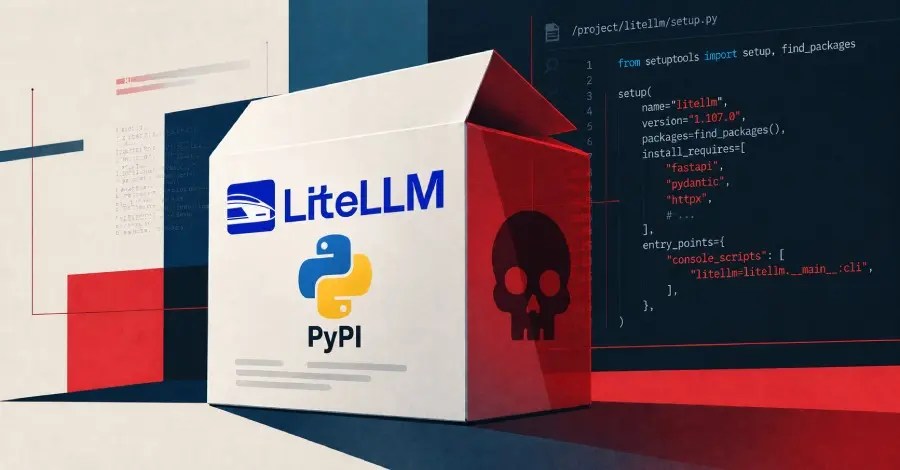
The cybersecurity landscape has been served a stark reminder of the long-tail risks associated with secret mismanagement following a sophisticated supply chain attack targeting LiteLLM. On Friday, the developers behind the popular open-source large language model (LLM) gateway revealed a complex attack chain that culminated in the distribution of a compromised version of their Python package. The incident, which traces its roots back to a configuration error in May 2026, highlights the devastating efficiency with which threat actors can exploit unrevoked credentials to subvert automated build systems.
The breach centered on LiteLLM version 1.107.0, which was found to contain malicious code designed to harvest sensitive credentials and establish persistent backdoors on developer systems. According to LiteLLM’s leadership, the point of failure was not a sophisticated zero-day exploit, but rather a neglected administrative credential that remained active long after it was believed to have been neutralized.
The Genesis of the Breach: A Failure in Secret Revocation
The technical timeline of the incident began on May 27, 2026. During a routine development cycle, a configuration file was inadvertently committed to the public LiteLLM-Labs/lite-harness repository. This file contained the master key for a deployment of the LiteLLM Agent Platform, a tool used by the team for orchestrating various autonomous agents.
LiteLLM’s Oliver Jensen and Mateo Wang admitted that while the error was identified almost immediately, the remediation steps were incomplete. The team performed a "force-push" to overwrite the repository history, a common but often insufficient method for removing sensitive data from GitHub, as the data can often still be accessed via direct commit hashes or cached views. Critically, while the team identified that the exposed keys required revocation, the master key for the Agent Platform was overlooked during the cleanup process.

For nearly five months, this master key remained active and valid, sitting as a "sleeping" vulnerability within the organization’s infrastructure. It was not until October 10, 2026, that an unknown threat actor, operating from the IP address 69.48.229[.]143, utilized the unrevoked key to gain unauthorized access to the Agent Platform.
Once inside the platform, the attacker moved to escalate their privileges. They targeted and successfully extracted a GitHub CLI OAuth token. This specific token was configured to allow the service’s self-hosted cloud agents to file pull requests. However, the developers noted a critical security oversight: the token was "not scoped down." Instead of being limited to specific tasks or repositories, it was associated with the account of the GitHub organization’s owner. This gave the attacker owner-level permissions across the entire LiteLLM GitHub organization.
Exploiting Relaxed Security Protocols
The possession of an owner-level token allowed the threat actor to bypass several layers of traditional security. In a typical operational environment, LiteLLM maintained a rigorous release process. Building and publishing a new version of the software normally required an authorized engineer to initiate the process, followed by an approval from a "special account" that was physically locked to a hardware device located in the company’s office.
 Cybersecurity Basics & Security News
The Rise of the Personal AI Agent: Navigating the Shift from BYOD to BYOAI in the Corporate Security Landscape
The rollout of personal artificial intelligence agents is proving to be a...
 Cybersecurity Basics & Security News
Critical CVSS 10 Vulnerability in Canonical LXD and MicroCloud Allows Unauthorized Host Access
In a significant security development for the Linux container and cloud orchestration...
 Cybersecurity Basics & Security News
Bridging the Security Gap: Why Modern Enterprises are Moving Beyond Traditional Vulnerability Management
In the rapidly evolving landscape of cybersecurity, a critical finding can traverse...