
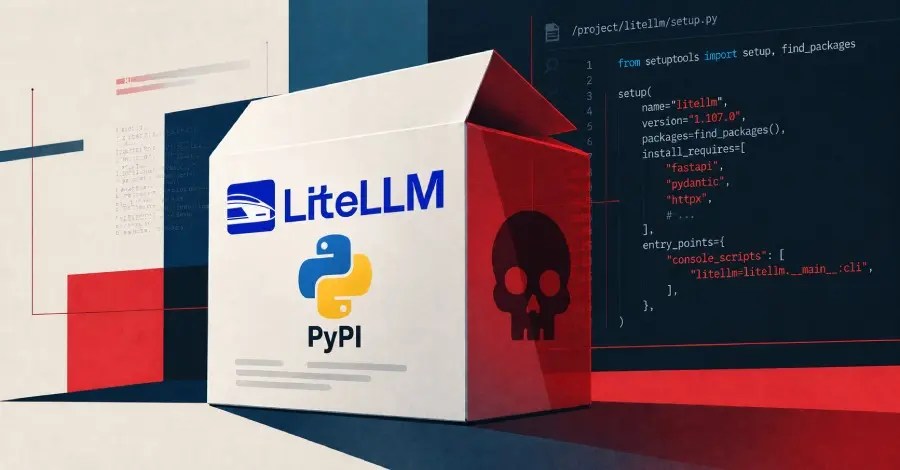

The malware contained within the package featured two primary execution paths. The first was a comprehensive credential harvester. Unlike many malicious packages that only activate when a specific function is called, this malware was engineered to execute automatically as soon as Python started. This was achieved through the use of Python startup hooks. Because these hooks reside outside the standard LiteLLM application directory, simply deleting the LiteLLM package might not be enough to remove the infection; the malicious startup components could remain persistent on the host system.
The second path was a Unix-oriented backdoor. This background process was designed to "phone home" every hour to fetch and execute arbitrary code provided by the attacker. This established a persistent foothold on any system where the compromised package was installed, allowing for long-term surveillance or further exploitation.
The range of data targeted by the stealer was exhaustive. It collected system information, environment variables, SSH files, and tokens for a wide array of developer tools and package managers, including npm, PyPI, Yarn, Maven, and Cargo. All gathered data was compressed and exfiltrated via HTTP POST requests to a health-check endpoint on "litellm[.]dev," a domain the attacker had registered on October 13, 2026, to mimic official infrastructure.
Response and Remediation
In the wake of the discovery, LiteLLM has moved aggressively to contain the damage. The company is currently in the process of revoking every token and credential associated with their internal systems and third-party vendor platforms. They have also worked to correct earlier misconceptions about the attack; initial theories suggested the GitHub tokens might have been leaked through internal logs, but the discovery of the unrevoked May master key has clarified the actual entry point.
"The investigation was a process in which we continually learned additional information," acknowledged Oliver Jensen. He noted that as the team uncovered the depth of the workflow manipulation, they had to revise their understanding of the attacker’s capabilities and the extent of the data theft.

Security researchers emphasize that users who may have installed LiteLLM version 1.107.0 should do more than just update the package. Because the malware utilizes startup hooks that persist independently of the library, a thorough audit of the Python environment and a rotation of all potentially exposed secrets—including cloud provider keys, Git credentials, and AI API tokens—is considered essential.
This incident serves as a high-profile case study in the risks of the "move fast and break things" mentality often found in the rapidly evolving AI development space. The combination of a forgotten secret, a non-scoped token, and a temporary relaxation of security protocols provided a perfect environment for a supply chain compromise that has now impacted a broad segment of the developer community.
 Cybersecurity Basics & Security News
Unmasking Lunex: The Rapid Expansion of a Sophisticated Malware-as-a-Service Platform Targeting Ukraine
The cybersecurity landscape is witnessing the emergence of a highly sophisticated Malware-as-a-Service...
 Cybersecurity Basics & Security News
CERT-UA Issues Urgent Warning Over Massive Compromise of Dahua Video Surveillance Systems via P2P Vulnerabilities
The Computer Emergency Response Team of Ukraine (CERT-UA) has issued a critical...
 Cybersecurity Basics & Security News
CISA Alerts Federal Agencies to Exploited VMware ESX Vulnerability Following Targeted Cyber Espionage Campaign
The United States Cybersecurity and Infrastructure Security Agency (CISA) has formally expanded...







