
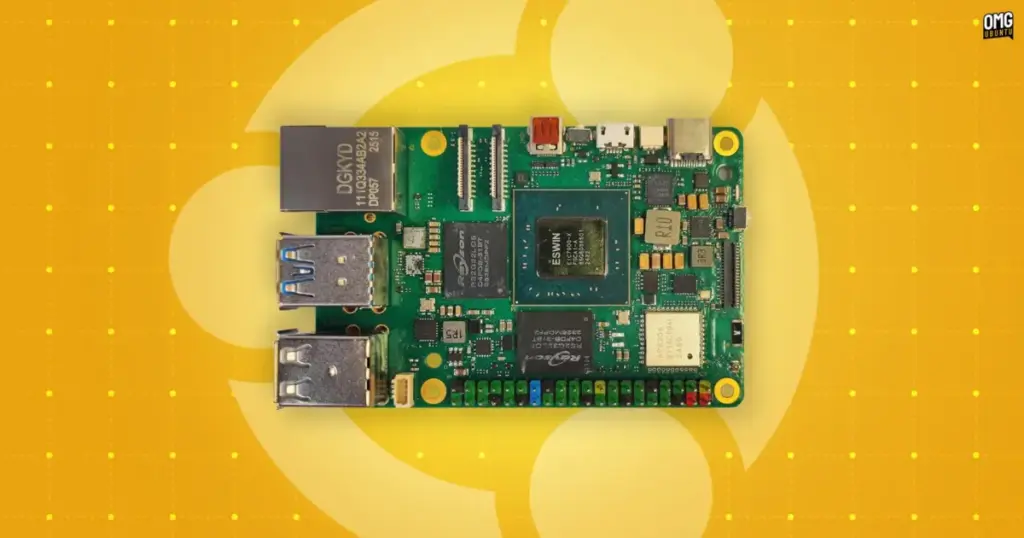
Installing Ubuntu on RISC-V hardware is poised to become significantly more straightforward with the arrival of Ubuntu 26.10, as Canonical has begun producing official 64-bit RISC-V (riscv64) desktop installation media. The initiative represents an important milestone for the open-source instruction set architecture, bridging the gap between specialized developer boards and mainstream desktop computing.
Experimental versions of the desktop images for the upcoming Ubuntu 26.10 release have been published for public testing on the SpacemiT K3, a development board that Canonical has been working closely on alongside hardware designer SpacemiT. Rather than offering a single catch-all installer, Canonical has produced two distinct ISO options: one shipping with the flagship Ubuntu desktop powered by the GNOME desktop environment, and another built around a minimal Xubuntu profile utilizing Xfce.
Announcing the initiative on the Ubuntu Discourse community platform, Canonical software engineer Valentin Haudiquet emphasized that the desktop media currently sits in an early phase of its lifecycle. Haudiquet explained that both of the published ISOs are firmly categorized as experimental and carry no official enterprise support at this stage.
Because of their testing status, early adopters and community developers should not expect an entirely seamless, bug-free experience. The software exhibits several known issues and functional limitations that Canonical’s desktop and foundation teams intend to address before the platform reaches general availability. The final release of Ubuntu 26.10 is currently scheduled to arrive on October 15, 2026.
Why are there two images?
The decision to deliver two divergent desktop images—one based on GNOME and the other on the lightweight Xubuntu environment—is rooted directly in the current state of RISC-V hardware availability, software emulation, and computing constraints.
Silicon that adheres to the contemporary RISC-V RVA23 baseline profile remains relatively fresh on the market. Consequently, a broad segment of software engineers, package maintainers, and open-source enthusiasts who want to test the RISC-V software ecosystem lack physical access to bare-metal boards. To circumvent this lack of physical silicon, developers rely heavily on virtualized environments using QEMU to emulate the instruction set on x86 or Arm host workstations.
While software emulation allows code execution without specialized hardware, it introduces substantial performance overhead. In an emulated QEMU environment running without hardware virtualization acceleration, a resource-intensive modern desktop environment like standard GNOME can take up to 30 minutes just to complete its boot sequence and present a responsive graphical session. For developers attempting to quickly test package updates, evaluate user-space applications, or diagnose installer scripts, such delays render continuous iteration impractical.
The minimal Xubuntu image was engineered precisely to alleviate this development friction. By pairing an efficient Xfce-derived framework with a stripped-down minimal system package set, virtualized instances boot in a fraction of the time, providing a practical, nimble workbench for software testing.
When deployed directly to compatible physical hardware, the situation is noticeably different. On real silicon, the standard GNOME installation image is reported to deliver a pleasant and performant desktop experience. With recent advances in hardware design closing the performance gap across modern RISC-V boards, running the standard, visually rich GNOME desktop shell has transitioned from an unworkable novelty into a practical reality on modern boards.
Achieving this level of desktop parity has required systematic foundational engineering across Canonical’s software stack. One major technical milestone was Canonical’s project to implement RISC-V architecture support within the Flutter framework. Flutter has become an integral pillar of the contemporary Ubuntu desktop experience, serving as the programming foundation for critical first-party applications, including the modern Ubuntu desktop installation wizard. Without a native Flutter engine capable of compiling and rendering properly on riscv64, delivering the standard Ubuntu installation workflow would have been virtually impossible.

Even with these milestones reached, the desktop ecosystem is not entirely complete on the architecture. Canonical has noted that a number of its standard desktop snap packages are not yet fully ported and validated for RISC-V. Most notably, the modern Ubuntu App Center remains among the software components that are still awaiting full riscv64 readiness.
Beyond application-level frameworks, building the newly minted desktop images required foundational revisions to core Ubuntu operating system tooling. Canonical’s engineers had to implement targeted changes to livecd-rootfs—the suite of tools responsible for generating official live media and system roots—specifically to ensure proper parsing, storage, and application of hardware-specific device trees. Furthermore, Canonical had to reconfigure its automated build pipelines and release machinery to continuously generate, package, and test bootable riscv64 ISOs alongside long-established architecture targets.
But weren’t RISC-V tablets sold with Ubuntu on?
The debut of desktop-specific ISOs might seem unexpected to observers who recall that commercial RISC-V computing hardware running Ubuntu has already surfaced in consumer and developer markets over the past several years.
Ubuntu has supported the architecture for an extended period through headless server installations. Historically, users seeking a graphical interface were required to install a base RISC-V server image and manually assemble a window manager, display manager, and graphical desktop environment through post-installation terminal commands. This workflow predated Canonical’s formal decision to raise the platform’s architectural baseline profile to RVA23, a standard established to focus active distribution support on more powerful, modern board designs.
While hardware vendors have managed to bring commercial devices to market—including pre-assembled RISC-V tablets, laptops, and developer-oriented single-board computers running Ubuntu—those deployments did not rely on standard, official desktop ISOs directly published by Canonical.
Instead, equipment manufacturers and hardware vendors collaborating with Canonical on early platform enablement were routinely tasked with engineering, maintaining, and distributing their own bespoke recovery images and operating system builds. Because Canonical did not build unified, pre-configured desktop installation media for the architecture, vendors had to bridge the gap independently if they wished to ship devices with an out-of-the-box graphical desktop environment.
The new experimental release fundamentally resolves this fragmentation. By integrating riscv64 desktop media directly into Canonical’s core infrastructure, 64-bit RISC-V hardware built to the RVA23 standard (or higher) is now treated as a first-class citizen alongside mainstream Intel/AMD (amd64) and Arm64 architectures. Users and original equipment manufacturers can obtain clean, standardized desktop installation media straight from the same distribution servers that host Ubuntu’s mainstream editions.
For users who prefer an operating system release governed by Canonical’s Long Term Support cycle rather than an interim release, an Ubuntu 26.04.1 LTS riscv64 desktop ISO is also available. While that specific LTS desktop image currently lacks out-of-the-box hardware enablement for the SpacemiT K3 development board, Haudiquet indicated that support for the K3 platform will be brought to the LTS release track in the near future.
Early adopters, testing engineers, and developers interested in evaluating the state of desktop computing on open hardware can inspect and download the preliminary test files directly. The experimental Ubuntu 26.10 desktop RISC-V build is accessible through the daily live build directory on Canonical’s primary image server at cdimage.ubuntu.com, while the corresponding lightweight Xubuntu 26.10 RISC-V build has been made available via the official Xubuntu daily minimal build directory.
 Linux & Open Source Solutions
Ex-Microsoft dev builds a new task manager for Linux
For millions of personal computer users over the past three decades, Plummer’s...
 Linux & Open Source Solutions
NexPhone Multi-OS Smartphone Delayed to March 2027 as Hardware Challenges and Price Adjustments Emerge
The NexPhone, an ambitious multi-operating system smartphone designed to bridge the divide...
 Linux & Open Source Solutions
The Document Foundation Unveils New Visual Identity to Establish Distinct Institutional Profile Apart from LibreOffice
The Document Foundation, the charitable non-profit entity responsible for overseeing the development...







