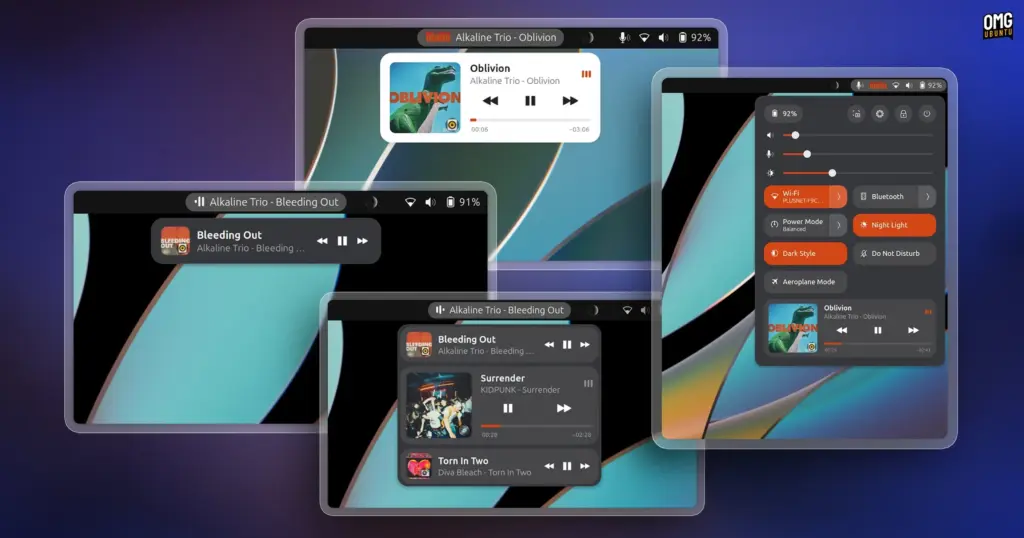
In the standard GNOME Shell environment, media playback has long been relegated to the notification and calendar pop-over menu attached to the central clock. While that native controller performs adequately when a user is listening to a single, continuous stream—such as an uninterrupted local album or a dedicated streaming session—its utility degrades rapidly as workflows become more complex. Modern computing routines rarely adhere to a single media pipeline. Throughout an ordinary workday, users frequently move between native streaming clients like Spotify, dedicated podcast players, local audio libraries, and various web browser tabs handling everything from video lectures and conference calls to short clips on video sharing platforms.
Under standard conditions, activating audio in one application often displaces or entirely dismisses the controls of another within the desktop environment’s MPRIS (Media Player Remote Interfacing Specification) interface. When a listener pauses an hour-long podcast or a curated music playlist to quickly watch a video embedded in a web browser, the original player frequently disappears from view. Resuming the paused content typically requires hunting down the specific minimized window, unminimizing the application, or navigating through dozens of open browser tabs.
Now Playing Card alters this workflow by maintaining persistent cards for every active media player detected across the system. Rather than discarding or overwriting suspended sessions, the extension retains them side by side in a singular, easily accessible interface. As a result, a paused Spotify track and a partially heard podcast episode remain anchored in place while a browser video plays, staying primed for immediate resumption the moment the secondary media concludes.
To keep this multi-source management from overwhelming the desktop interface, Now Playing Card introduces a distinct card-based architecture built around an interactive accordion layout. Displaying controls, cover art, and metadata for several independent players simultaneously could easily clutter the screen, especially within the constrained dimensions of the Quick Settings panel or a top-bar dropdown. The extension addresses this spatial constraint by actively managing the footprint of each player. Only a single player card is rendered in an expanded state at any given moment, presenting its complete suite of controls and artwork. All remaining detected media streams are compressed into compact, unobtrusive strips stacked alongside it. When a user clicks on any of the minimized strips, the accordion dynamically shifts, smoothly expanding the selected player into full view while collapsing the previously focused card.
 Linux & Open Source Solutions
ONLYOFFICE Desktop Editors 10.0 Released as Fully Rebuilt App With Decoupled AI Tools and Over 1,000 Bug Fixes
The developers behind ONLYOFFICE have officially released version 10.0 of ONLYOFFICE Desktop...
 Linux & Open Source Solutions
Banshee Music Player Returns to Modern Linux Desktops as a Snap Package
A familiar name from the golden era of the Linux desktop has...
 Linux & Open Source Solutions
KDE Plasma 6.8 Released on Project’s 30th Anniversary, Dropping X11 Sessions and Expanding Core Features
The KDE community has officially released KDE Plasma 6.8, marking a historic...