
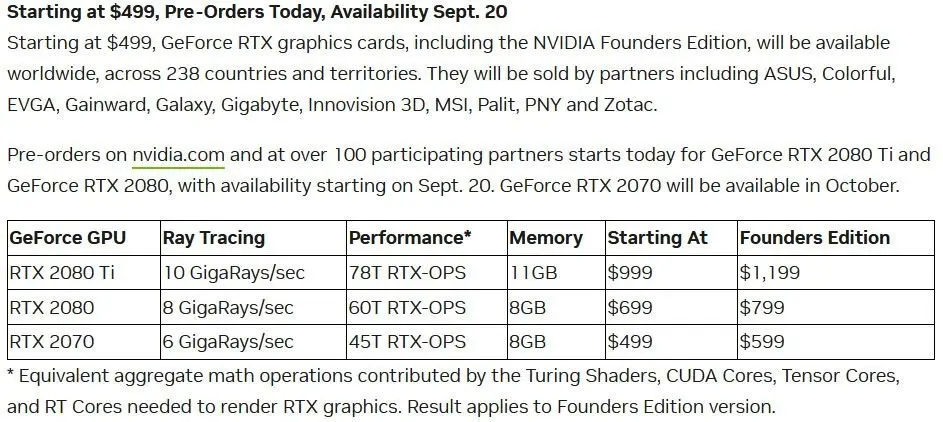
The debut of the GeForce 20 series was spearheaded by the release of the GeForce RTX 2080 and the ultra-high-end RTX 2080 Ti. These cards were the first to bring Nvidia’s Turing architecture into the hands of enthusiasts, promising a shift in visual fidelity that the company described as being "20 years in the making." While the more mainstream-oriented RTX 2070 was announced alongside its more powerful siblings, it would not hit store shelves until the following October, leaving early adopters to focus their attention on the raw power and high entry price of the top-tier models.
The hype surrounding the launch was bolstered by the immense confidence of Nvidia’s leadership. In a blog post published a month prior to the release, Nvidia CEO Jensen Huang framed the arrival of Turing as a historical milestone for the medium of PC gaming. Huang heralded the architecture as the catalyst for a "new golden age of gaming," asserting that the realism provided by ray tracing would fundamentally change the expectations of players worldwide. His claim was bold and uncompromising: "Once you see an RTX game, you can’t go back." At the time, such statements were met with a mixture of awe and skepticism, as the industry grappled with the hardware requirements necessary to simulate the complex behavior of light in real-time.
To understand the magnitude of the Turing launch, one must look at the technical gamble Nvidia took with the silicon itself. For decades, GPU performance was measured almost exclusively by how quickly a card could handle rasterization—the process of converting 3D shapes into 2D pixels on a screen. With Turing, Nvidia dedicated a significant portion of the GPU’s die area to entirely new types of hardware: RT Cores and Tensor Cores. The RT Cores were specialized engines designed specifically to accelerate the calculation of how light rays intersect with geometry in a 3D environment, while the Tensor Cores were intended to handle artificial intelligence and deep learning tasks.
This architectural shift was a massive departure from the highly successful Pascal architecture that preceded it. The GeForce GTX 1080 and 1080 Ti had become legendary for their efficiency and raw performance, leaving Turing with a difficult act to follow. Because so much of the Turing chip was dedicated to these new, specialized cores, the initial performance gains in traditional, non-ray-traced games were not as massive as some enthusiasts had hoped for, especially when considering the significant increase in launch prices. This created a complex narrative at launch, where the value of the cards was tied not just to what they could do on day one, but to a promise of a future where ray tracing would become the standard.
Nvidia’s vision of "hybrid graphics" was the solution to the immense computational cost of full ray tracing. Rather than attempting to ray-trace every single pixel—a feat that even today’s most powerful hardware struggles to do at high resolutions without assistance—Turing used a combination of traditional rasterization for the bulk of the scene and ray tracing for the most impactful visual elements, such as reflections, shadows, and global illumination. This hybrid approach was the "magic" that allowed real-time ray tracing to exist on a consumer desktop in 2018, rather than in the late 2020s as many researchers had previously predicted.
The initial reception from the gaming community was defined by a tension between technological wonder and practical concerns. When the RTX 2080 and RTX 2080 Ti arrived, there were very few titles available that actually supported the headline features. Early showcases, such as those for Battlefield V and Shadow of the Tomb Raider, demonstrated the potential of realistic reflections on water and more accurate shadowing in dense jungles, but the performance hit was substantial. Gamers were forced to decide if the visual upgrade was worth a lower frame rate, a dilemma that sparked endless debates on hardware forums and in review sections.
Parallel to the ray tracing push was the introduction of Deep Learning Super Sampling, or DLSS. Powered by the aforementioned Tensor Cores, DLSS was Nvidia’s answer to the performance tax imposed by ray tracing. By using AI to upscale images from a lower internal resolution to a higher output resolution, Nvidia aimed to provide the "best of both worlds": high-fidelity visuals with a manageable impact on frame rates. While the first iteration of DLSS saw a rocky start with some blurring and artifacting issues, it represented the first major step toward AI-driven rendering, a field that has since become perhaps the most influential legacy of the Turing architecture.
As the weeks passed following the initial September launch, the market prepared for the arrival of the RTX 2070 in October. This card was tasked with bringing the RTX features to a slightly broader audience, though it still sat firmly in the high-end segment of the market. The rollout of the 20 series continued to face scrutiny over pricing, as the RTX 2080 Ti pushed the boundaries of what a flagship consumer GPU could cost, effectively creating a new "ultra-enthusiast" tier that had previously been reserved for the Titan series of cards.
Despite the early hurdles, the eight years since that launch have largely vindicated the direction Nvidia took with Turing. The "golden age" that Jensen Huang spoke of did not arrive overnight, but the foundations laid by the 20 series eventually permeated the entire industry. Today, ray tracing is no longer a niche feature reserved for those with the most expensive hardware; it is integrated into the latest generation of home consoles and is a standard toggle in almost every major AAA video game release. The transition from "GTX" to "RTX" turned out to be more than a marketing gimmick; it was a signal that the era of purely rasterized graphics was coming to a close.
Looking back, the Turing launch stands as a testament to the risks inherent in pushing technological boundaries. Nvidia chose to sacrifice some of the traditional performance metrics that gamers had relied on for years in order to force an evolution in visual fidelity. If the company had played it safe and released a refined version of Pascal, the adoption of ray tracing and AI in gaming might have been delayed by half a decade or more. Instead, Turing forced the hand of the industry, prompting game developers and competing hardware manufacturers to invest in the future of light simulation and machine learning.
The legacy of the RTX 2080 and 2080 Ti is visible in every subsequent generation of GPUs. The Ampere and Ada Lovelace architectures that followed Turing were built directly upon the hybrid rendering model established eight years ago. Each generation has seen the RT and Tensor cores become more efficient and more powerful, but the fundamental logic remains the same: the future of graphics is not just about drawing more triangles, but about using intelligence and physics-based simulation to create a more believable world.
As enthusiasts reflect on this anniversary, the RTX 20 series is remembered as a bold, expensive, and ultimately transformative chapter in the history of the PC. It was the moment when real-time ray tracing ceased to be a dream of the distant future and became a tangible, albeit demanding, reality. While the price of entry was high and the initial library of games was small, the Turing architecture succeeded in its primary mission: it changed the conversation about what a graphics card should be, ensuring that the "golden age" of realism would eventually become the standard for everyone.
 Hardware Reviews & PC Building
US Video Game Hardware Sales Experience Historic Decline as PlayStation and Xbox Reach Multi-Year Lows
The United States video game industry is currently grappling with a significant...
 Hardware Reviews & PC Building
Intel Shifts Strategic Focus to Trust Domain Extensions as Software Guard Extensions Era Nears its Conclusion
In a significant realignment of its long-term data center security roadmap, Intel...
 Hardware Reviews & PC Building
Acer Predator QD-OLED monitor now 36% off — 500 Hz refresh rate and True Black 500 certification slashed to…
The latest development in this space comes from a significant price adjustment...







