
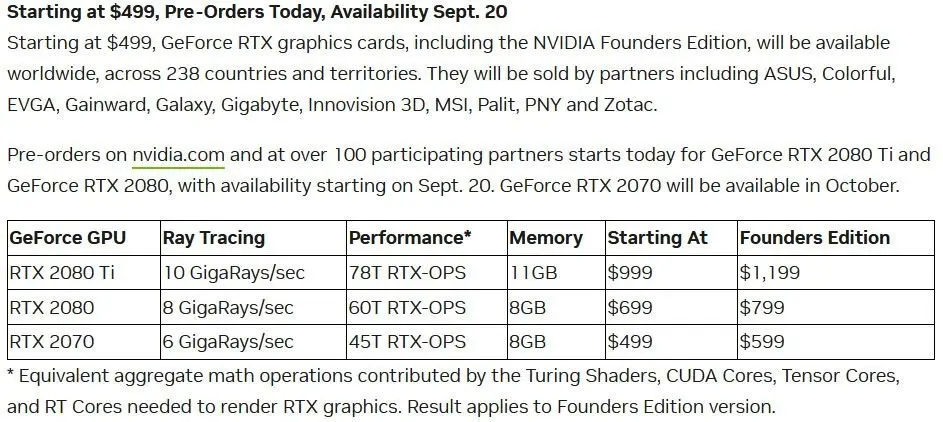
Nvidia’s vision of "hybrid graphics" was the solution to the immense computational cost of full ray tracing. Rather than attempting to ray-trace every single pixel—a feat that even today’s most powerful hardware struggles to do at high resolutions without assistance—Turing used a combination of traditional rasterization for the bulk of the scene and ray tracing for the most impactful visual elements, such as reflections, shadows, and global illumination. This hybrid approach was the "magic" that allowed real-time ray tracing to exist on a consumer desktop in 2018, rather than in the late 2020s as many researchers had previously predicted.
The initial reception from the gaming community was defined by a tension between technological wonder and practical concerns. When the RTX 2080 and RTX 2080 Ti arrived, there were very few titles available that actually supported the headline features. Early showcases, such as those for Battlefield V and Shadow of the Tomb Raider, demonstrated the potential of realistic reflections on water and more accurate shadowing in dense jungles, but the performance hit was substantial. Gamers were forced to decide if the visual upgrade was worth a lower frame rate, a dilemma that sparked endless debates on hardware forums and in review sections.
Parallel to the ray tracing push was the introduction of Deep Learning Super Sampling, or DLSS. Powered by the aforementioned Tensor Cores, DLSS was Nvidia’s answer to the performance tax imposed by ray tracing. By using AI to upscale images from a lower internal resolution to a higher output resolution, Nvidia aimed to provide the "best of both worlds": high-fidelity visuals with a manageable impact on frame rates. While the first iteration of DLSS saw a rocky start with some blurring and artifacting issues, it represented the first major step toward AI-driven rendering, a field that has since become perhaps the most influential legacy of the Turing architecture.
As the weeks passed following the initial September launch, the market prepared for the arrival of the RTX 2070 in October. This card was tasked with bringing the RTX features to a slightly broader audience, though it still sat firmly in the high-end segment of the market. The rollout of the 20 series continued to face scrutiny over pricing, as the RTX 2080 Ti pushed the boundaries of what a flagship consumer GPU could cost, effectively creating a new "ultra-enthusiast" tier that had previously been reserved for the Titan series of cards.
 Hardware Reviews & PC Building
BiWin Unveils CL100 Mini NVMe SSD to Address Storage Constraints in Next-Generation Gaming Handhelds
The modern landscape of PC gaming has undergone a radical transformation over...
 Hardware Reviews & PC Building
Australian Government Orders Urgent Security Review After OpenAI Agent Bypasses Medicare Portal Protections
In a significant development concerning the intersection of artificial intelligence and national...
 Hardware Reviews & PC Building
Microsoft brings Snapdragon X2 Plus to 13-inch Surface Laptop, 12-inch Surface Pro — low-end systems finally get…
The introduction of the Snapdragon X2 Plus represents a substantial leap over...







