
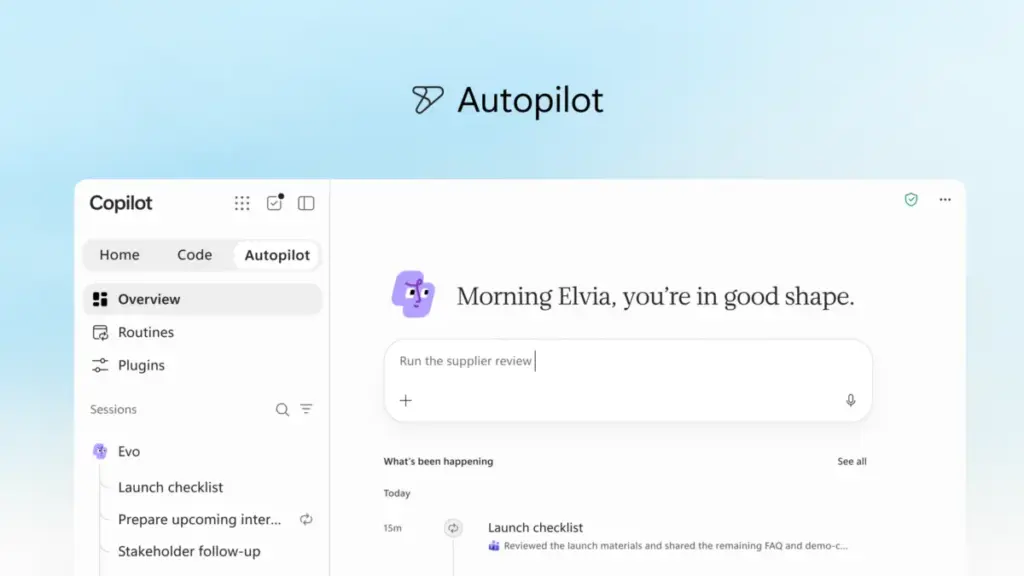
In a significant move to redefine the landscape of digital productivity, Microsoft has announced a comprehensive reimagining of its Copilot platform. The tech giant is shifting its focus toward a more integrated, proactive, and "agentic" experience, aiming to transform AI from a simple conversational assistant into a central nervous system for organizational work. By introducing a new architecture and a suite of advanced capabilities, Microsoft intends to help individuals and organizations navigate the evolving nature of work and expand the boundaries of human ambition through the flow of AI-enhanced workflows.
The centerpiece of this transformation is a redesigned Copilot app that introduces three core pillars: Home, Code, and Autopilot. These features are designed to connect the foundational tools that workers rely on every day with a new generation of AI capabilities capable of building, customizing, and scaling solutions across an entire enterprise. This evolution reflects a broader industry trend toward "agentic AI"—systems that do not merely respond to prompts but can act independently to achieve complex goals.
A New Experience for Every Mode of Work
At the heart of the new Copilot experience is "Home," a centralized starting point designed to ground users in their daily tasks. In the modern workplace, information is often fragmented across meetings, chat threads, documents, emails, and various applications. Microsoft’s new Home interface aims to solve this fragmentation by bringing "Chat" and "Cowork" together in a single, unified view.
From this new starting point, users can gain their bearings by reviewing recent activity, receiving AI-generated suggestions for their next steps, and resuming work exactly where they left off. The system distinguishes between two primary modes of interaction. "Chat" remains the destination for instant, conversational needs—answering quick questions, performing lookups, or creating initial drafts. "Cowork," conversely, is designed for delegation. Users can define a complex task, such as responding to a Request for Proposal (RFP), creating a product launch kit, or preparing a financial close package, and the AI will manage the process end-to-end to deliver a completed result.
Perhaps the most significant change within the Home experience is the deep integration of productivity software through "Office in Copilot." Rather than requiring users to jump between different standalone applications, the full power of Microsoft Word, Excel, and PowerPoint is now built directly into the Copilot interface. This integration is intended to eliminate the friction of "context switching," where formatting can break or version control becomes lost when moving data between an AI chat and a document.
Users can now ask Copilot to draft a brief or build a slide deck, and the system creates an editable, live document within the Copilot environment. This document is synchronized in real-time for the entire team, allowing for side-by-side refinement and collaborative editing. If a user @mentions a teammate, their edits appear instantly, ensuring that progress remains consistent whether a team member is working within Copilot or the traditional Office apps.

Microsoft has also updated the specific capabilities of these integrated tools. PowerPoint now features automatic brand-alignment and the ability to fine-tune images and slides using custom templates. Excel has been enhanced with features that allow users to track changes made by collaborators or the AI itself, providing clarity on what was altered and why, while also offering intelligent recommendations for data visualization. Furthermore, new "Skills" are being introduced across the Microsoft 365 suite, allowing specialized expertise—such as legal or financial workflows—to be scaled across an organization through reusable, role-specific templates.
Democratizing Solution-Building Through Code
While software development has historically been the domain of specialized engineers, Microsoft’s new "Code" capability seeks to move solution-building into the hands of all knowledge workers. Microsoft posits that while the document, the spreadsheet, and the presentation deck remain essential units of work, a fourth unit is emerging: the small, purpose-built digital solution.
 Productivity Software & Office Suites
Microsoft to Headline ESPC 2026 in Amsterdam: A Deep Dive into the Future of AI-Powered Work and Agentic Ecosystems
The landscape of enterprise technology is currently undergoing one of its most...
 Productivity Software & Office Suites
Microsoft Unveils Microsoft 365 G7: A New Frontier for AI-Driven Governance in the Public Sector
In a move designed to redefine how the public sector interacts with...
 Productivity Software & Office Suites
Microsoft Reimagines Copilot as a Comprehensive AI System for Enterprise Automation and Custom Development
In a significant shift that signals the next phase of the generative...






