
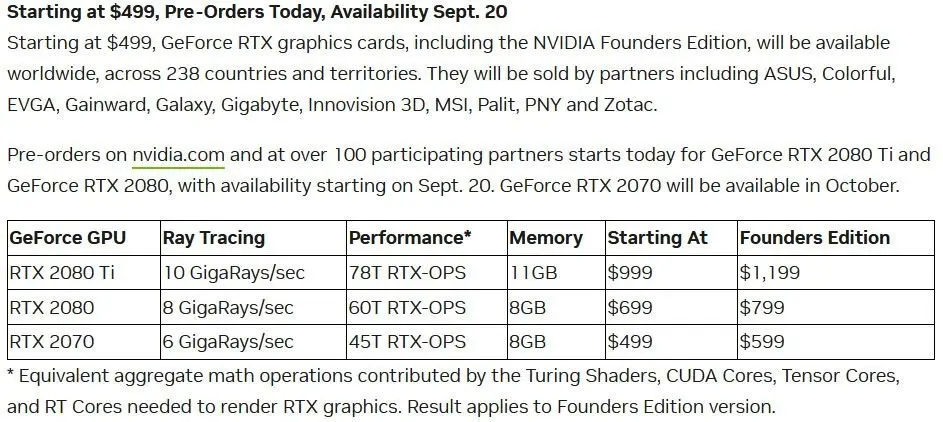
The debut of the GeForce 20 series was spearheaded by the release of the GeForce RTX 2080 and the ultra-high-end RTX 2080 Ti. These cards were the first to bring Nvidia’s Turing architecture into the hands of enthusiasts, promising a shift in visual fidelity that the company described as being "20 years in the making." While the more mainstream-oriented RTX 2070 was announced alongside its more powerful siblings, it would not hit store shelves until the following October, leaving early adopters to focus their attention on the raw power and high entry price of the top-tier models.
The hype surrounding the launch was bolstered by the immense confidence of Nvidia’s leadership. In a blog post published a month prior to the release, Nvidia CEO Jensen Huang framed the arrival of Turing as a historical milestone for the medium of PC gaming. Huang heralded the architecture as the catalyst for a "new golden age of gaming," asserting that the realism provided by ray tracing would fundamentally change the expectations of players worldwide. His claim was bold and uncompromising: "Once you see an RTX game, you can’t go back." At the time, such statements were met with a mixture of awe and skepticism, as the industry grappled with the hardware requirements necessary to simulate the complex behavior of light in real-time.
To understand the magnitude of the Turing launch, one must look at the technical gamble Nvidia took with the silicon itself. For decades, GPU performance was measured almost exclusively by how quickly a card could handle rasterization—the process of converting 3D shapes into 2D pixels on a screen. With Turing, Nvidia dedicated a significant portion of the GPU’s die area to entirely new types of hardware: RT Cores and Tensor Cores. The RT Cores were specialized engines designed specifically to accelerate the calculation of how light rays intersect with geometry in a 3D environment, while the Tensor Cores were intended to handle artificial intelligence and deep learning tasks.
This architectural shift was a massive departure from the highly successful Pascal architecture that preceded it. The GeForce GTX 1080 and 1080 Ti had become legendary for their efficiency and raw performance, leaving Turing with a difficult act to follow. Because so much of the Turing chip was dedicated to these new, specialized cores, the initial performance gains in traditional, non-ray-traced games were not as massive as some enthusiasts had hoped for, especially when considering the significant increase in launch prices. This created a complex narrative at launch, where the value of the cards was tied not just to what they could do on day one, but to a promise of a future where ray tracing would become the standard.
 Hardware Reviews & PC Building
Unofficial Grand Theft Auto V Browser Port Faces Swift Takedown Following Viral Technical Demonstration
The landscape of modern gaming is often defined by the boundaries of...
 Hardware Reviews & PC Building
Tom’s Hardware Expands Digital Reach with Launch of Official Mobile Application for Android and iOS
The landscape of technology journalism has undergone a profound transformation over the...
 Hardware Reviews & PC Building
Australian Government Orders Urgent Security Review After OpenAI Agent Bypasses Medicare Portal Protections
In a significant development concerning the intersection of artificial intelligence and national...






