
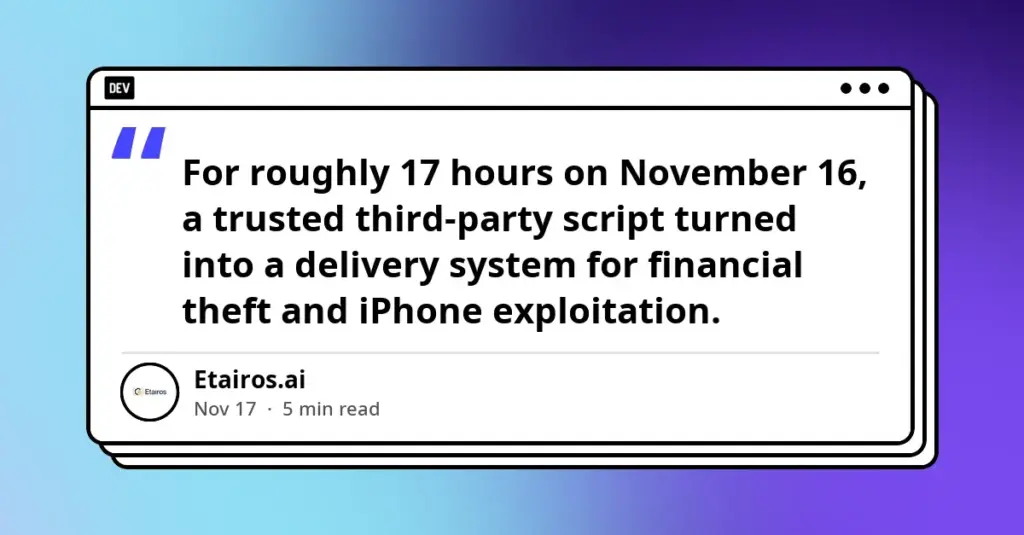
On November 16, a sophisticated supply chain attack exploited a critical vulnerability in the Optimizely Web Experimentation platform, transforming a trusted third-party script into a delivery vehicle for financial theft and mobile exploitation. For approximately 17 hours, a malicious loader was embedded within customer snippets served directly from Optimizely’s official Content Delivery Network (CDN). The campaign, which some security researchers have dubbed "OPTIMJACK," represents a significant escalation in the ongoing trend of targeting the web-based supply chains of major global enterprises.
The breach was detected and monitored by Report URI, a service that tracks the security headers and scripts executed by websites. Their analysis revealed that the malicious code was present in 188 of the 1,611 Optimizely snippets checked during the window of activity. These snippets belonged to 178 distinct organizations, a list that reads like a "who’s who" of the digital economy. High-profile victims included major media outlets like CNN and the BBC, technology giants Zoom, Salesforce, and GitLab, retail powerhouse IKEA, and financial institutions such as HSBC and Equifax. Even travel and entertainment entities like Air France-KLM, Peacock, and the crypto-hardware firm Ledger were caught in the crosshairs. Perhaps most telling was the fact that Optimizely’s own main website and login page were found to be carrying the malicious code, indicating the depth of the compromise within the vendor’s ecosystem.
How the Snippet Became the Weapon
To understand the mechanics of the OPTIMJACK campaign, one must first understand how modern web experimentation tools operate. Websites that utilize Optimizely to run A/B tests or personalize user experiences load a small piece of vendor-provided code known as a "snippet." This snippet is designed to be dynamic; it updates automatically whenever a customer modifies a setting in the Optimizely dashboard. A key feature of these snippets is a field called "Project JavaScript," which allows developers to run custom code to facilitate complex experiments.
The attacker behind this campaign successfully exploited a vulnerability within the Optimizely Web Experimentation interface to gain write access to this "Project JavaScript" field across numerous customer projects. By injecting a malicious loader into this field while leaving the rest of the snippet’s legitimate functions untouched, the attacker ensured that the malicious activity remained stealthy. Because the modified snippets were still being served from the legitimate cdn.optimizely.com domain under the vendor’s own valid SSL certificate, they bypassed most standard security filters. Even organizations that chose to serve the snippet from their own domains were not spared, as the content was still being pulled from the compromised project configuration.
The investigation into the delivery mechanism revealed that the attacker utilized three distinct variants of the loader to ensure maximum reach and persistence. The most common variant loaded a script called track.js directly from the attacker-controlled domain 1688360[.]cc. A second, more stealthy variant utilized Base64 encoding to hide the malicious domain, preventing it from being flagged by simple plaintext searches or basic automated scanners. The third and most sophisticated variant carried a full copy of the payload within the loader itself. This "fallback" payload was designed to execute if the primary domain was blocked by a firewall or blocklist, effectively defeating simple network-level defenses.
Security analysts at Cynet, who were among the first to flag browser connections to the attacker’s infrastructure, emphasized a critical distinction in this incident: delivery is not the same as a direct compromise of the website’s internal servers. A site serving the malicious code was not necessarily breached itself; rather, the malicious content lived within the Optimizely project and was delivered through the vendor’s CDN. This nuance is vital for incident response, as it shifts the focus from server-side forensics to client-side impact and third-party risk management.
What track.js Did in the Browser
Once the loader successfully executed in a user’s browser, it fetched the primary payload, track.js. According to a detailed payload analysis conducted by StepSecurity, the primary objective of this script was financial gain through two distinct methods: cryptocurrency theft and credit card skimming.
The cryptocurrency component of the attack was particularly refined. The script was designed to monitor the page text, input forms, links, and even the user’s clipboard for valid cryptocurrency wallet addresses. When a match was found, the script would replace the legitimate address with one belonging to the attacker. To avoid detection and ensure successful transfers, the script only swapped addresses that passed the specific checksum requirements of their respective blockchain chains. Furthermore, it utilized contextual awareness, only triggering the swap if the address was located near "payment words" such as "wallet," "deposit," or "send." This meant that a visitor attempting to copy a deposit address from a legitimate site like Ledger could unknowingly have the attacker’s address in their clipboard by the time they hit "paste" in their wallet application.
In addition to targeting crypto assets, track.js functioned as a traditional digital skimmer. It monitored checkout pages and payment forms to capture credit card numbers, expiration dates, and CVVs. While Report URI was able to confirm the presence of this skimming logic, the total volume of exposed card data remains unknown. However, the financial impact was immediate; by 19:25 UTC on the day of the attack, the attacker’s cryptocurrency wallets had already received approximately $7,040 in stolen funds.
The iOS Exploit Chain
While the financial theft targeted all users, the OPTIMJACK campaign included a specific, high-stakes component aimed at Apple mobile devices. On iPhones and iPads, the malicious code would load a secondary script named boot.js from two .icu domains. This script functioned as a reconnaissance tool, reading the device’s iOS version to determine which exploit chain to deploy.
The exploits were delivered via a hidden iframe and utilized two previously documented exploit kits: "Coruna" and "DarkSword." These kits had been originally identified and analyzed by researchers at Google. The Coruna kit was used to target devices running iOS versions 13.0 through 17.2.1. The DarkSword kit was deployed against newer versions, specifically targeting iOS 18.4 through 18.7. Interestingly, the attacker also included a separate chain for "iOS 26," which currently only collects device details—a move that suggests either future-proofing or a misunderstanding of Apple’s versioning.
During a 44-minute window between 17:13 and 17:57 UTC, the attacker escalated the intensity of the mobile campaign. During this period, a Coruna iframe was added to every visit originating from a device running iOS 18.6 or earlier. To increase the chances of a successful exploit, the affected pages were programmed to reload every 60 seconds.
Cynet researchers were able to retrieve the second stage of this exploit by emulating an iPhone browser. They described the result as "conditional delivery," noting that while the exploits were served to the browser, there have been no confirmed reports of successful full-device takeovers or persistent compromises of physical iPhones and iPads. Despite this, the intent to gain deep access to mobile devices marks this as a significantly more dangerous campaign than a standard web skimmer.
What Optimizely Has and Has Not Said
Following the discovery of the campaign, Optimizely issued a notice confirming that an attacker had "exploited a vulnerability in Experimentation" to inject malicious JavaScript into certain customer projects. The vendor stated that it has since fixed the underlying flaw, removed the malicious code, and taken steps to secure affected user accounts. Additionally, Optimizely claimed to have implemented new protections to prevent the delivery of unauthorized code in the future.
However, the vendor’s statement left several critical questions unanswered. The notice did not clarify the technical nature of the vulnerability, nor did it specify how many total projects were modified. Crucially, the timeline for when the fix was implemented remains vague, and there has been no confirmation regarding whether the attacker retains any residual access to the platform’s infrastructure.
A troubling development involving the software company Smartsheet highlighted these concerns. After Smartsheet’s snippet was initially cleaned, it was reportedly re-infected with an obfuscated version of the malicious loader. According to Report URI, this re-infection strongly suggests that the attacker still maintained access to the project even after the initial remediation attempt. This incident serves as a stark reminder that a single "clean" check of a vendor snippet is not definitive proof that a project has been fully secured, especially when the vendor remains silent on the details of the breach.
RedEye Assessment
The OPTIMJACK campaign serves as a textbook example of the "third-party script problem" at its most dangerous scale. By exploiting a single "write primitive" on the vendor side, an attacker was able to reach nearly 200 high-value organizations simultaneously. The delivery path, backed by a trusted CDN and a valid certificate, rendered traditional defenses like Content Security Policies (CSP) and domain allowlisting ineffective.
The operational maturity demonstrated by the attacker is particularly concerning. The use of obfuscated loader variants, blocklist-resistant payloads, and checksum-aware address swapping indicates a high level of technical proficiency. Furthermore, the attacker’s ability to pivot between financial skimming and sophisticated mobile exploitation shows a diverse set of objectives. Historical data suggests this was not an isolated incident; the same actor is believed to have run similar playbooks through other third-party services like Kissmetrics, StorifyMe, and Minute Media. This points to a deliberate and systematic hunt for writable primitives within the web script supply chain.
Report URI has noted that the actual number of affected organizations is likely higher than the 178 currently identified, as the data only reflects snippets that were active and checked during the 17-hour window. For organizations that utilize Optimizely Experimentation snippets, the window of exposure and the resulting regulatory obligations—particularly regarding the potential theft of credit card data—remain open questions. Until Optimizely provides a full disclosure of the root cause and confirms the total eviction of the attacker, the security community continues to view the platform with caution. RedEye remains available to help organizations assess their third-party script exposure and support the scoping of incidents related to this campaign.
 Software Development & Scripting for IT
Local-First AI Automation: How aiFetchly is Redefining Workflow Consistency for Small Teams
The landscape of business automation is undergoing a significant shift as small...
 Software Development & Scripting for IT
Troubleshooting the "Silent" Failure: Why Zoho CRM Workflows Stop Triggering and How to Restore Automation Integrity
For many modern enterprises, the CRM is no longer just a digital...
 Software Development & Scripting for IT
Modernizing Authentication: A Comprehensive Approach to Passkey Implementation in Symfony 8.1
The digital authentication landscape is undergoing a fundamental shift as the industry...







