
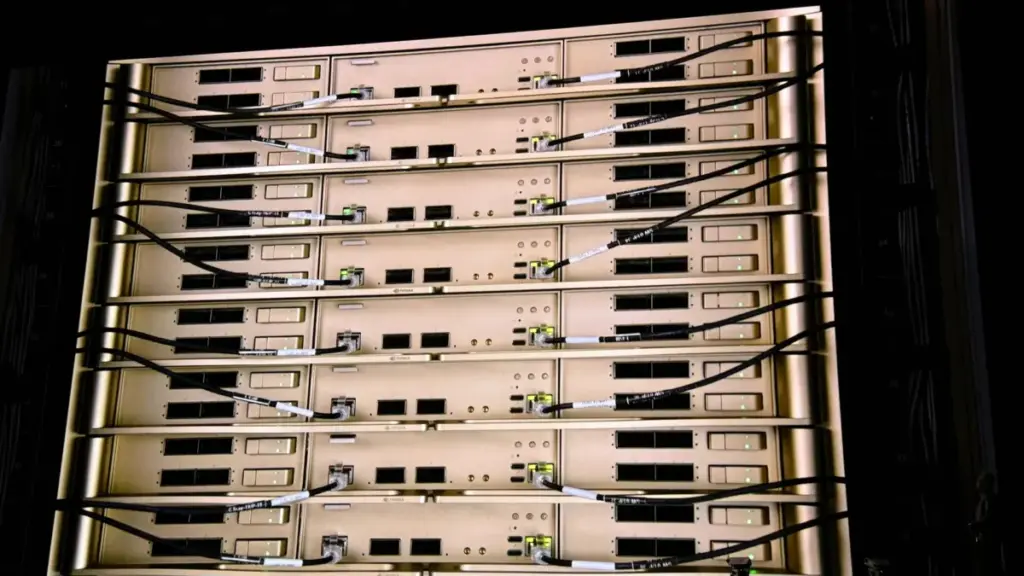
The "Kessel" system is built upon the foundation of Nvidia’s upcoming Rubin architecture, the successor to the highly anticipated Blackwell platform. While standard Vera Rubin NVL72 configurations are designed to maximize throughput and efficiency for ground-based AI training and inference, the SpaceX and xAI variant seeks to redefine the physical structure of the rack itself. The core specifications of the system remain formidable, retaining the high-density compute power that defines Nvidia’s flagship offerings. The Kessel architecture is set to feature 36 Vera CPUs and 72 Rubin GPUs, supported by nine NVLink switch trays. However, the move to an 84-layer PCB as a primary interconnect represents a significant leap in manufacturing complexity. In the world of high-end electronics, most sophisticated motherboards or server backplanes rarely exceed 20 to 30 layers. An 84-layer board suggests a level of signal density and integration that pushes the current limits of materials science and fabrication technology.
The decision to move toward a solid-state interconnect via a massive PCB is likely influenced by the harsh realities of spaceflight and orbital operations. SpaceX has long been a proponent of vertical integration and custom hardware design, as evidenced by the specialized radiation-hardened electronics used in its Falcon rockets and Dragon spacecraft, as well as the proprietary phased-array antennas in Starlink satellites. For an orbital data center, the mechanical stresses of a rocket launch—characterized by intense vibration and high G-forces—pose a significant risk to traditional cabling. Standard NVLink cable assemblies, while efficient for ground use, involve numerous connectors and physical points of failure that could become unseated or damaged during ascent. By moving to a solid-state, PCB-based architecture, SpaceX can create a more rigid, structurally sound unit that is better equipped to survive the journey to orbit and operate reliably in a vacuum.
Beyond the mechanical advantages, the 84-layer PCB architecture likely addresses the critical issue of signal integrity at extreme scales. As AI models continue to grow, the bandwidth requirements between GPUs have skyrocketed. Nvidia’s NVLink is designed to facilitate this high-speed communication, but as data rates increase, the physical distance and the quality of the medium through which signals travel become paramount. A custom-designed PCB allows for tighter control over trace lengths, impedance, and electromagnetic interference, potentially offering a more stable environment for the massive data transfers required by the Rubin GPUs. This level of optimization is essential for xAI, which has been rapidly scaling its compute capabilities to train its Grok large language models. By collaborating with SpaceX on the Kessel project, xAI gains access to a hardware platform that is not only robust enough for space but also potentially more efficient in terms of power delivery and thermal dissipation.
The mention of orbital data centers highlights a growing interest in moving compute resources closer to where data is generated in space. Currently, Earth-observation satellites and telecommunications constellations like Starlink generate vast amounts of data that must be transmitted back to Earth for processing. This creates a bottleneck due to limited downlink bandwidth and high latency. By deploying AI-capable hardware like the Kessel system directly into orbit, SpaceX could enable edge computing on a planetary scale. Satellites could process high-resolution imagery, perform complex signal analysis, or manage network traffic autonomously, sending only the most relevant results back to the ground. This would drastically reduce the time required for data-driven decision-making and optimize the use of existing satellite-to-ground communication links.
Furthermore, the Kessel project underscores a strategic shift in how Elon Musk’s companies interact with the broader tech supply chain. While SpaceX and xAI will continue to purchase the underlying silicon—specifically the Vera CPUs and Rubin GPUs—directly from Nvidia, the report indicates that they intend to source other critical components independently. This move toward self-sourcing for the rack’s infrastructure, including the complex 84-layer PCBs and the surrounding power and cooling systems, grants Musk’s companies a higher degree of control over their hardware destiny. It reduces reliance on traditional original equipment manufacturers (OEMs) and system integrators, who might be constrained by broader market demands or standardized design templates. By designing and sourcing the "box" that houses the chips, SpaceX and xAI can move faster, iterate more frequently, and tailor the hardware to their exact specifications without waiting for industry-wide adoption of new standards.
This approach is consistent with Musk’s long-standing philosophy of "the machine that builds the machine." Just as Tesla designs its own specialized casting machines and SpaceX builds its own rocket engines, the Kessel project represents an attempt to master the physical layer of artificial intelligence infrastructure. For xAI, which is currently engaged in a massive compute arms race with rivals like OpenAI, Google, and Meta, having a proprietary hardware stack could provide a competitive edge. If the Kessel architecture proves to be more reliable or easier to scale than standard off-the-shelf solutions, it could allow xAI to deploy larger clusters with fewer points of failure. The massive "Colossus" supercomputer currently operated by xAI in Memphis already demonstrates the company’s appetite for large-scale infrastructure; the development of Kessel suggests that the next generation of this compute power will be even more customized and potentially more mobile—or rather, more orbital.
The technical challenges of cooling a 72-GPU rack in space cannot be overstated. In a terrestrial data center, massive fans or liquid cooling loops reject heat into the atmosphere or a water supply. In the vacuum of space, convection is non-existent, leaving only radiation as a means of heat rejection. The Kessel system’s solid-state design and the high-layer-count PCB may play a role in a more sophisticated thermal management strategy, perhaps utilizing the board itself as a heat spreader or integrating it with specialized cold plates that connect to a spacecraft’s larger radiator system. The integration of 36 Vera CPUs alongside the 72 Rubin GPUs adds another layer of thermal complexity, as the Vera CPUs—based on Nvidia’s high-performance Grace architecture—generate significant heat of their own.
As Nvidia prepares to roll out the Rubin platform to the wider market, the Kessel project serves as a high-profile example of the platform’s versatility. While most of Nvidia’s customers will opt for the standard NVL72 configurations to power their cloud services and enterprise AI applications, the existence of a SpaceX-specific variant demonstrates that the Rubin architecture can be adapted for the most demanding and unconventional environments imaginable. For Nvidia, supporting such a deep level of customization for a high-profile client like Musk provides valuable insights into the limits of their own technology, potentially influencing future iterations of the NVLink interconnect and rack designs.
The broader implications for the tech industry are significant. If SpaceX successfully deploys Rubin-class AI hardware in orbit, it could trigger a new era of space-based services. This isn’t just about training LLMs in the stars; it’s about the infrastructure of the future. From autonomous satellite maintenance to real-time global surveillance and advanced weather forecasting, the combination of high-performance AI and orbital deployment opens doors that were previously closed by the limitations of hardware durability and processing power. The Kessel project, with its 84-layer PCB and solid-state ambitions, is a clear signal that the boundaries between aerospace engineering and high-end data center design are blurring.
Ultimately, the development of the Kessel system reflects the intersection of two of the most transformative technologies of the 21st century: reusable rocketry and generative AI. By re-engineering Nvidia’s top-tier hardware to survive and thrive in the vacuum of space, SpaceX and xAI are not just building a faster computer; they are building a new platform for intelligence that is untethered from the Earth. As the project moves from the design phase toward actual implementation, the tech world will be watching closely to see if this radical departure from traditional interconnect architecture becomes the new standard for specialized, high-reliability AI compute. The success of the 84-layer PCB and the solid-state Kessel rack could very well determine the pace at which the next generation of AI is scaled, both on the ground and in the heavens.
 Hardware Reviews & PC Building
Grab the award-winning Bambu Lab P1S 3D printer with AMS for $70 off — save $70 on one of the best 3D printers for…
The significance of this deal lies not just in the dollar amount...
 Hardware Reviews & PC Building
Custom Power Distribution Mod Surfaces to Tackle RTX 5090 Overheating Concerns
The launch of NVIDIA’s flagship GeForce RTX 5090 has been met with...
 Hardware Reviews & PC Building
Anthropic’s Claude Mythos Model Achieves Rapid AI Portability to AMD Hardware, Challenging Nvidia’s Software Dominance
In a significant revelation that could signal a shift in the competitive...







