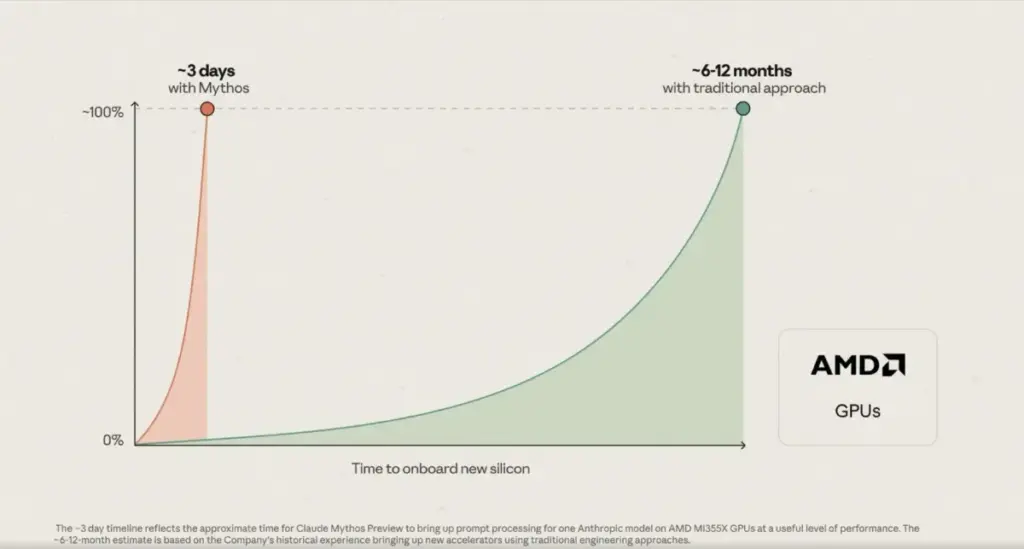
In a significant revelation that could signal a shift in the competitive landscape of the artificial intelligence industry, Anthropic has informed potential investors that its latest internal AI model, Claude Mythos Preview, has successfully automated the complex process of porting its software to run on AMD’s high-performance graphics processing units (GPUs). During a presentation to IPO investors, the company detailed how the model managed to perform the intricate software engineering required to get its AI architecture operational on AMD hardware in approximately three days. This feat, according to Anthropic, was achieved with almost no human intervention, representing a radical departure from the traditional engineering timelines that typically span six to twelve months.
The implications of this breakthrough extend far beyond a simple speed increase in software deployment. For years, the AI hardware market has been dominated by Nvidia, largely due to its proprietary CUDA software platform. CUDA acts as a "moat," a technical and ecosystem-driven barrier that makes it difficult for developers to move their AI models from Nvidia hardware to competing chips. By demonstrating that an AI model can autonomously write the low-level code necessary to bridge different hardware architectures, Anthropic is suggesting that this long-standing competitive advantage may be rapidly eroding.
Tom Brown, Anthropic’s co-founder and chief compute officer, provided a stark comparison to illustrate the scale of this achievement. In his address to investors, Brown noted that the task of porting a sophisticated AI model to a new chip architecture traditionally required a dedicated team of dozens of engineers working for nearly a year. The "Mythos" model’s ability to compress this timeline into a single long weekend—while writing "almost 100%" of the necessary kernels—marks a fundamental change in how AI companies might manage their infrastructure in the future.
Kernels are the specialized, low-level programs that manage how a processor handles specific mathematical operations. They are the essential "glue" that allows an AI model to interact with the underlying hardware of a chip. Historically, writing these kernels for a new architecture, such as AMD’s MI355X GPUs, was a painstaking manual process. Each chip architecture has its own unique way of handling memory, data flow, and parallel processing, meaning that code optimized for Nvidia’s H100s cannot simply be "copied and pasted" onto AMD’s latest silicon. The fact that Claude Mythos was able to port these kernels at a "useful level of performance" suggests that AI is becoming capable of understanding and manipulating the most granular levels of computer architecture.
This development validates a long-term strategic decision made by Anthropic’s leadership. Unlike many AI startups that have tethered their fortunes exclusively to Nvidia’s ecosystem to ensure speed to market, Anthropic has pursued a strategy of hardware agnosticism. Brown described the company’s early decision to build for multiple types of chips as an "unconventional bet." In an industry where the sheer scarcity of Nvidia GPUs has often dictated the pace of progress, Anthropic chose to invest in the software abstraction necessary to treat its entire hardware fleet as a "one fungible pool of compute."
Currently, Anthropic’s models are operational across a diverse array of hardware. This includes the industry-standard Nvidia GPUs, AMD’s competing offerings, Google’s custom-designed Tensor Processing Units (TPUs), and Amazon Web Services’ (AWS) specialized Trainium chips. By maintaining this flexibility, Anthropic has insulated itself against supply chain bottlenecks and localized hardware shortages. If one provider’s chips are unavailable or if another provider offers a better price-to-performance ratio, Anthropic’s architecture allows it to shift workloads with minimal friction.
 Hardware Reviews & PC Building
BiWin Unveils CL100 Mini NVMe SSD to Address Storage Constraints in Next-Generation Gaming Handhelds
The modern landscape of PC gaming has undergone a radical transformation over...
 Hardware Reviews & PC Building
UPERFECT GR14BU Review: A High-Performance 3K OLED Contender Enters the Portable Monitor Market
The portable monitor industry has undergone a radical transformation over the last...
 Hardware Reviews & PC Building
Team Vitality Paris Headquarters Looted and Vandalized Amid Widespread Civil Unrest
In a distressing development for the European esports community, Team Vitality, the...