
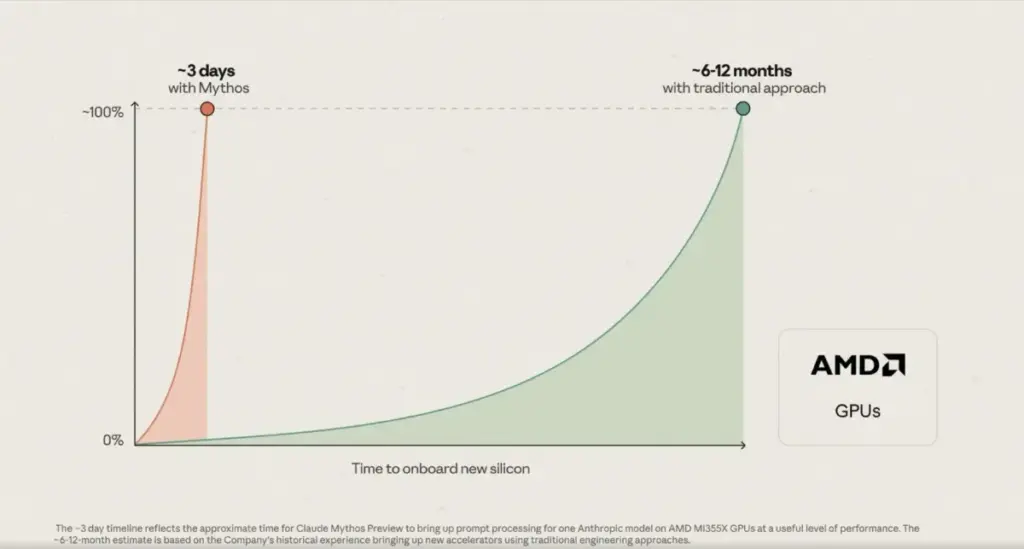
The success of the Claude Mythos Preview in porting code to the AMD MI355X is particularly timely. The MI355X is AMD’s latest attempt to challenge Nvidia’s flagship products in the data center. While AMD has often been praised for the raw performance and memory capacity of its hardware, it has historically struggled to gain market share because of the software overhead required to make its chips compatible with the most popular AI frameworks. If AI models can now handle that software overhead themselves, the primary barrier to AMD adoption—and the adoption of other alternative silicon—could vanish.
This trend of increasing hardware portability is mirrored elsewhere in the tech giant ecosystem. Anthropic’s move comes as other major players are also finding ways to bypass traditional hardware constraints. Google’s TPUs, for instance, have recently gained the ability to natively run AI models built in PyTorch, one of the most widely used open-source machine learning libraries. This development has already seen real-world application, with Meta now utilizing Google’s TPUs in its production environments. These shifts indicate a broader industry movement toward a more commoditized hardware market, where the software layer is no longer a permanent lock-in mechanism.
The technical specifics shared with investors highlight that the three-day window specifically covered prompt processing for one of Anthropic’s models on the AMD MI355X GPUs. Prompt processing is a critical phase of AI inference, where the model interprets the user’s input before generating a response. Achieving a "useful level of performance" in such a short timeframe indicates that the AI-generated code was not just functional, but optimized enough to be viable for actual production workloads.
For investors, the narrative of "AI writing AI" is a compelling efficiency story. The reduction in human labor from "dozens of engineers" to "basically no human intervention" represents a massive decrease in operational expenditure and a significant increase in organizational agility. In the high-stakes race to develop and deploy Large Language Models (LLMs), the ability to deploy on any available hardware within days gives a company a distinct tactical advantage. It allows for more aggressive scaling and better negotiation leverage with cloud service providers and chip manufacturers.
However, the broader implications for the engineering profession are also noteworthy. The task of writing low-level kernels has long been considered one of the most difficult and specialized forms of software engineering, requiring a deep understanding of both mathematics and hardware physics. If LLMs like Claude Mythos can perform this work with near-total autonomy, the role of the hardware engineer may shift from writing code to auditing and refining the output of AI models.
 Hardware Reviews & PC Building
Malaysia to Introduce Mandatory GPU Disclosure and Power Usage Penalties for Data Center Operators
In a significant move to tighten oversight of its burgeoning digital infrastructure...
 Hardware Reviews & PC Building
VAST Data Warns of Critical Reliability Threshold as Petabyte-Scale SSDs Outpace Traditional RAID Capabilities
As the global demand for data storage continues to skyrocket, driven largely...
 Hardware Reviews & PC Building
Nvidia Unveils Rubin HPC Architecture at Supercomputing 2026 to Power Next-Generation Scientific Simulation and Agentic Workflows
The Supercomputing 2026 conference has officially opened its doors, serving as the...







