
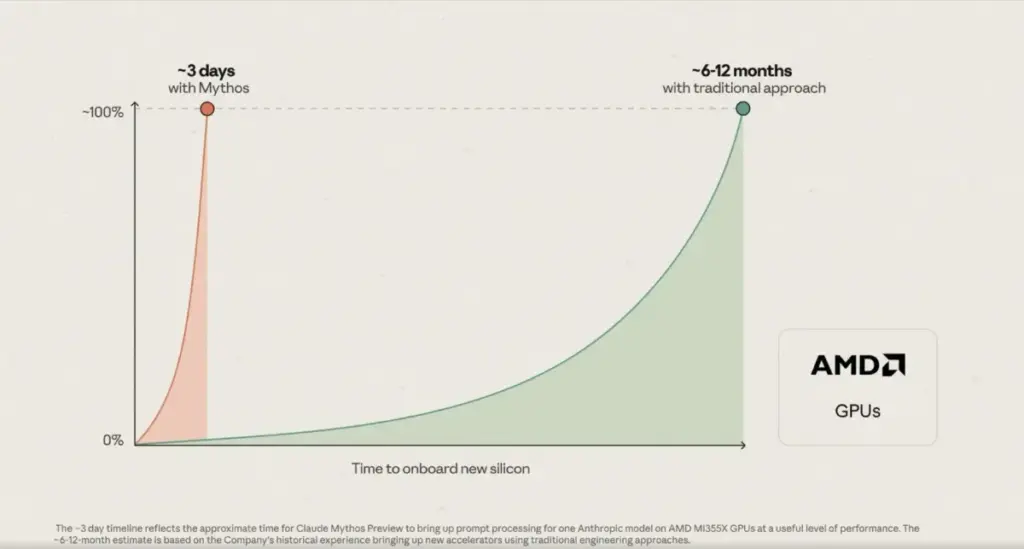
In a significant revelation that could signal a shift in the competitive landscape of the artificial intelligence industry, Anthropic has informed potential investors that its latest internal AI model, Claude Mythos Preview, has successfully automated the complex process of porting its software to run on AMD’s high-performance graphics processing units (GPUs). During a presentation to IPO investors, the company detailed how the model managed to perform the intricate software engineering required to get its AI architecture operational on AMD hardware in approximately three days. This feat, according to Anthropic, was achieved with almost no human intervention, representing a radical departure from the traditional engineering timelines that typically span six to twelve months.
The implications of this breakthrough extend far beyond a simple speed increase in software deployment. For years, the AI hardware market has been dominated by Nvidia, largely due to its proprietary CUDA software platform. CUDA acts as a "moat," a technical and ecosystem-driven barrier that makes it difficult for developers to move their AI models from Nvidia hardware to competing chips. By demonstrating that an AI model can autonomously write the low-level code necessary to bridge different hardware architectures, Anthropic is suggesting that this long-standing competitive advantage may be rapidly eroding.
Tom Brown, Anthropic’s co-founder and chief compute officer, provided a stark comparison to illustrate the scale of this achievement. In his address to investors, Brown noted that the task of porting a sophisticated AI model to a new chip architecture traditionally required a dedicated team of dozens of engineers working for nearly a year. The "Mythos" model’s ability to compress this timeline into a single long weekend—while writing "almost 100%" of the necessary kernels—marks a fundamental change in how AI companies might manage their infrastructure in the future.
Kernels are the specialized, low-level programs that manage how a processor handles specific mathematical operations. They are the essential "glue" that allows an AI model to interact with the underlying hardware of a chip. Historically, writing these kernels for a new architecture, such as AMD’s MI355X GPUs, was a painstaking manual process. Each chip architecture has its own unique way of handling memory, data flow, and parallel processing, meaning that code optimized for Nvidia’s H100s cannot simply be "copied and pasted" onto AMD’s latest silicon. The fact that Claude Mythos was able to port these kernels at a "useful level of performance" suggests that AI is becoming capable of understanding and manipulating the most granular levels of computer architecture.
This development validates a long-term strategic decision made by Anthropic’s leadership. Unlike many AI startups that have tethered their fortunes exclusively to Nvidia’s ecosystem to ensure speed to market, Anthropic has pursued a strategy of hardware agnosticism. Brown described the company’s early decision to build for multiple types of chips as an "unconventional bet." In an industry where the sheer scarcity of Nvidia GPUs has often dictated the pace of progress, Anthropic chose to invest in the software abstraction necessary to treat its entire hardware fleet as a "one fungible pool of compute."
Currently, Anthropic’s models are operational across a diverse array of hardware. This includes the industry-standard Nvidia GPUs, AMD’s competing offerings, Google’s custom-designed Tensor Processing Units (TPUs), and Amazon Web Services’ (AWS) specialized Trainium chips. By maintaining this flexibility, Anthropic has insulated itself against supply chain bottlenecks and localized hardware shortages. If one provider’s chips are unavailable or if another provider offers a better price-to-performance ratio, Anthropic’s architecture allows it to shift workloads with minimal friction.
The success of the Claude Mythos Preview in porting code to the AMD MI355X is particularly timely. The MI355X is AMD’s latest attempt to challenge Nvidia’s flagship products in the data center. While AMD has often been praised for the raw performance and memory capacity of its hardware, it has historically struggled to gain market share because of the software overhead required to make its chips compatible with the most popular AI frameworks. If AI models can now handle that software overhead themselves, the primary barrier to AMD adoption—and the adoption of other alternative silicon—could vanish.
This trend of increasing hardware portability is mirrored elsewhere in the tech giant ecosystem. Anthropic’s move comes as other major players are also finding ways to bypass traditional hardware constraints. Google’s TPUs, for instance, have recently gained the ability to natively run AI models built in PyTorch, one of the most widely used open-source machine learning libraries. This development has already seen real-world application, with Meta now utilizing Google’s TPUs in its production environments. These shifts indicate a broader industry movement toward a more commoditized hardware market, where the software layer is no longer a permanent lock-in mechanism.
The technical specifics shared with investors highlight that the three-day window specifically covered prompt processing for one of Anthropic’s models on the AMD MI355X GPUs. Prompt processing is a critical phase of AI inference, where the model interprets the user’s input before generating a response. Achieving a "useful level of performance" in such a short timeframe indicates that the AI-generated code was not just functional, but optimized enough to be viable for actual production workloads.
For investors, the narrative of "AI writing AI" is a compelling efficiency story. The reduction in human labor from "dozens of engineers" to "basically no human intervention" represents a massive decrease in operational expenditure and a significant increase in organizational agility. In the high-stakes race to develop and deploy Large Language Models (LLMs), the ability to deploy on any available hardware within days gives a company a distinct tactical advantage. It allows for more aggressive scaling and better negotiation leverage with cloud service providers and chip manufacturers.
However, the broader implications for the engineering profession are also noteworthy. The task of writing low-level kernels has long been considered one of the most difficult and specialized forms of software engineering, requiring a deep understanding of both mathematics and hardware physics. If LLMs like Claude Mythos can perform this work with near-total autonomy, the role of the hardware engineer may shift from writing code to auditing and refining the output of AI models.
The "moat" that Nvidia has built over the last decade with CUDA is not just about the code itself, but the massive ecosystem of libraries, tools, and developer familiarity that surrounds it. Breaking that moat requires more than just functional code; it requires a way to make alternative hardware just as easy to use as Nvidia’s. Anthropic’s approach suggests that the "ease of use" problem is being solved by the models themselves. If the model can translate its own requirements into the native language of any chip it encounters, the developer’s familiarity with a specific hardware ecosystem becomes less relevant.
As Anthropic prepares for its future as a public company or seeks further private funding, its ability to demonstrate such high levels of technical efficiency will likely be a cornerstone of its valuation. The company is positioning itself not just as a creator of intelligent chatbots, but as a sophisticated systems engineering firm that can optimize the very infrastructure upon which AI is built.
The move toward a "fungible pool of compute" also aligns with the interests of major cloud providers like Amazon and Google, both of whom are investors in Anthropic and are eager to promote their own custom AI silicon. By proving that models can be ported quickly to non-Nvidia hardware, Anthropic provides a blueprint for how the industry might move away from a monoculture of silicon.
While the Claude Mythos Preview model is still an internal tool, its performance on the AMD porting project serves as a proof of concept for the next era of AI development. In this era, the constraints of hardware may no longer be defined by how many human hours it takes to write a driver or a kernel, but by how quickly an AI can understand the architecture of a new piece of silicon. For the chip industry, this could trigger a new wave of innovation, as manufacturers focus more on raw hardware performance and less on the software barriers that have historically protected the market leader.
As the AI industry continues to evolve, the distinction between software and hardware engineering is becoming increasingly blurred. Anthropic’s achievement with the AMD MI355X is a clear indicator that the future of AI infrastructure is one of high-speed automation, hardware diversity, and the steady dismantling of the technical moats that have defined the first decade of the AI revolution. The "unconventional bet" on multi-chip compatibility appears to be paying off, providing Anthropic with a level of flexibility that could be crucial in an increasingly competitive and resource-constrained market.
 Hardware Reviews & PC Building
Microsoft brings Snapdragon X2 Plus to 13-inch Surface Laptop, 12-inch Surface Pro — low-end systems finally get…
The introduction of the Snapdragon X2 Plus represents a substantial leap over...
 Hardware Reviews & PC Building
Nvidia CEO Jensen Huang admits to an affair with a suspected Chinese spy — Jensen apologizes in letter to staff,…
The revelation came to light after a series of reports suggested that...
 Hardware Reviews & PC Building
Judge denies motion to dismiss DRAM price-fixing lawsuit against Micron, Samsung, and SK hynix — says chipmakers…
The core of the defendants’ argument for dismissal rested on the claim...







