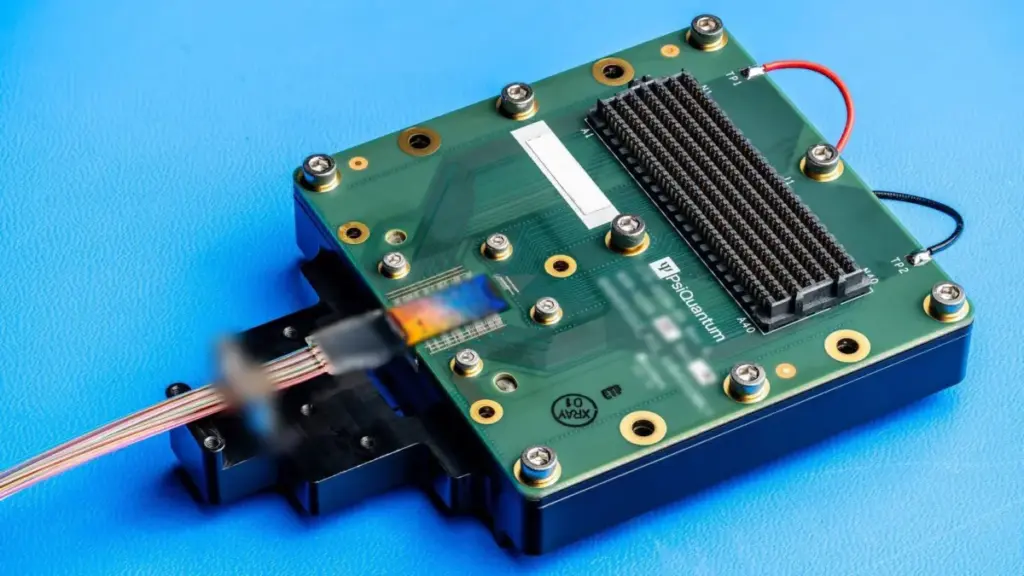
In a strategic move that highlights the growing convergence between quantum computing research and classical high-performance computing infrastructure, PsiQuantum has announced a significant breakthrough in optical networking. The company, primarily known for its ambitious efforts to build the world’s first large-scale, fault-tolerant quantum computer, revealed this week that it has successfully adapted its proprietary low-loss silicon photonics technology into a high-performance optical circuit switch (OCS). This new device is specifically engineered to address the escalating bandwidth and power challenges currently facing artificial intelligence data centers.
The announcement marks a pivotal moment for the industry, as the infrastructure required to train and deploy massive large language models (LLMs) begins to hit the physical limits of traditional electrical networking. By pivoting technology originally developed to manage fragile quantum states, PsiQuantum is offering a solution to one of the most pressing bottlenecks in modern AI: the efficient movement of data between thousands of interconnected GPUs.
The Challenge of Signal Loss in Optical Networking
At the heart of PsiQuantum’s new technology is the management of light. In any optical networking environment, the primary enemy is "loss"—the gradual dissipation of signal strength as light travels through fibers, connectors, and switches. In the world of data center optics, this loss is measured in decibels (dB). A loss of 3 dB represents a 50% reduction in signal power, meaning half of the light entering a device never makes it to the other side.
Current industry standards for data center optics typically tolerate this 3 dB threshold. However, as data centers grow in scale and complexity, these losses accumulate, necessitating the use of expensive, power-hungry optical amplifiers to boost the signal back to usable levels. PsiQuantum’s prototype optical switch has demonstrated a significantly higher level of efficiency, recording a signal loss of only 1.2 dB in laboratory tests. This represents a loss of roughly only a quarter of the light, a marked improvement over existing commercial solutions.
The ability to maintain signal integrity at such high levels is a direct byproduct of PsiQuantum’s work in quantum computing. In a photonic quantum computer, information is carried by individual photons. Because quantum states are incredibly delicate, losing even a single photon can result in the total failure of a calculation. Consequently, PsiQuantum has spent years perfecting a "low-loss" silicon photonics platform where every component—from the waveguides etched into the silicon to the junctions where fibers connect—is optimized to keep as much light as possible within the system.
Understanding the Optical Circuit Switch (OCS)
To appreciate the impact of PsiQuantum’s announcement, it is necessary to distinguish between traditional packet switches and the Optical Circuit Switch (OCS). Most contemporary data centers rely on packet switches that perform an "Electrical-Optical-Electrical" (EOE) conversion. When a signal arrives at a switch via fiber optic cable, it is converted into an electrical signal, processed by a silicon chip to determine its destination, and then converted back into light to be sent on its way.
 Hardware Reviews & PC Building
Apple Unveils First Touchscreen MacBook Pro Models with OLED XDR Displays and M5 Series Silicon
In a move that marks one of the most significant architectural and...
 Hardware Reviews & PC Building
Save $250 on this award-winning Elegoo resin 3D printer with an integrated heater and 16K resolution — 39%…
The Saturn 4 Ultra is currently positioned as a flagship offering within...
 Hardware Reviews & PC Building
TSMC reportedly weighs 20% CoWoS price increase as Nvidia Blackwell and Rubin chips put pressure on packaging capacity…
The reported price adjustment reflects a complex interplay of market forces, including...