
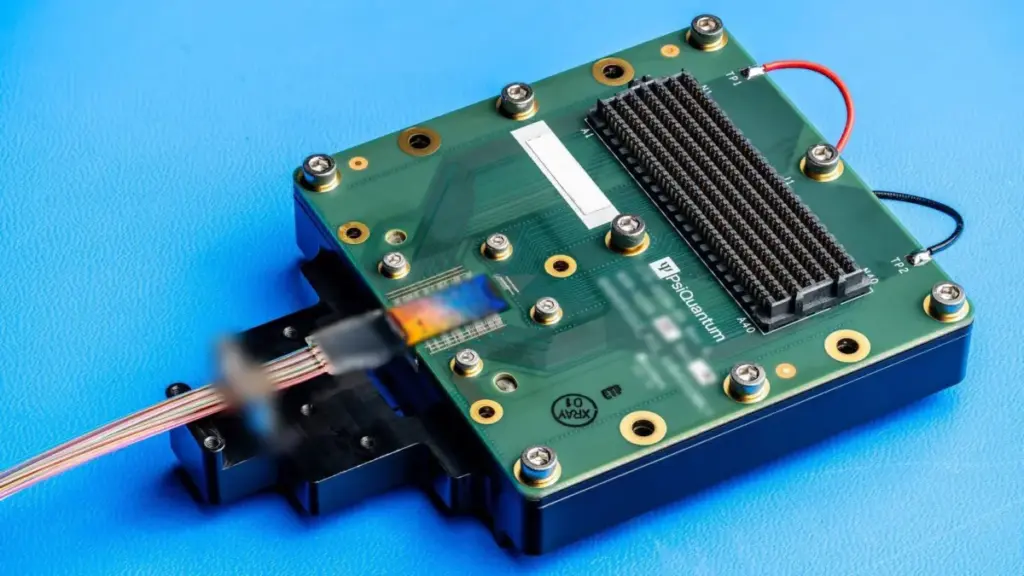
In a strategic move that highlights the growing convergence between quantum computing research and classical high-performance computing infrastructure, PsiQuantum has announced a significant breakthrough in optical networking. The company, primarily known for its ambitious efforts to build the world’s first large-scale, fault-tolerant quantum computer, revealed this week that it has successfully adapted its proprietary low-loss silicon photonics technology into a high-performance optical circuit switch (OCS). This new device is specifically engineered to address the escalating bandwidth and power challenges currently facing artificial intelligence data centers.
The announcement marks a pivotal moment for the industry, as the infrastructure required to train and deploy massive large language models (LLMs) begins to hit the physical limits of traditional electrical networking. By pivoting technology originally developed to manage fragile quantum states, PsiQuantum is offering a solution to one of the most pressing bottlenecks in modern AI: the efficient movement of data between thousands of interconnected GPUs.
The Challenge of Signal Loss in Optical Networking
At the heart of PsiQuantum’s new technology is the management of light. In any optical networking environment, the primary enemy is "loss"—the gradual dissipation of signal strength as light travels through fibers, connectors, and switches. In the world of data center optics, this loss is measured in decibels (dB). A loss of 3 dB represents a 50% reduction in signal power, meaning half of the light entering a device never makes it to the other side.
Current industry standards for data center optics typically tolerate this 3 dB threshold. However, as data centers grow in scale and complexity, these losses accumulate, necessitating the use of expensive, power-hungry optical amplifiers to boost the signal back to usable levels. PsiQuantum’s prototype optical switch has demonstrated a significantly higher level of efficiency, recording a signal loss of only 1.2 dB in laboratory tests. This represents a loss of roughly only a quarter of the light, a marked improvement over existing commercial solutions.
The ability to maintain signal integrity at such high levels is a direct byproduct of PsiQuantum’s work in quantum computing. In a photonic quantum computer, information is carried by individual photons. Because quantum states are incredibly delicate, losing even a single photon can result in the total failure of a calculation. Consequently, PsiQuantum has spent years perfecting a "low-loss" silicon photonics platform where every component—from the waveguides etched into the silicon to the junctions where fibers connect—is optimized to keep as much light as possible within the system.
Understanding the Optical Circuit Switch (OCS)
To appreciate the impact of PsiQuantum’s announcement, it is necessary to distinguish between traditional packet switches and the Optical Circuit Switch (OCS). Most contemporary data centers rely on packet switches that perform an "Electrical-Optical-Electrical" (EOE) conversion. When a signal arrives at a switch via fiber optic cable, it is converted into an electrical signal, processed by a silicon chip to determine its destination, and then converted back into light to be sent on its way.
While this process allows for granular control over individual data packets, it comes with a heavy price. The conversion process consumes a massive amount of electricity and generates significant heat. Furthermore, each conversion adds "latency"—a tiny delay that, when multiplied across thousands of switches in a massive AI cluster, can noticeably slow down the training of a model.
An Optical Circuit Switch, by contrast, operates entirely in the optical domain. It passes light straight through from fiber to fiber without ever converting it into electricity. This "all-optical" approach eliminates the power consumption associated with EOE conversion and reduces latency to near-zero. Instead of processing individual packets on the fly, an OCS establishes a fixed light path—a dedicated "pipe"—between two points and maintains that path until the network architecture requires a reconfiguration.
Silicon Photonics vs. Moving Mirrors
The technical implementation of PsiQuantum’s switch also sets it apart from current market leaders. Existing OCS solutions, such as those deployed by Google in its "Apollo" fabric or manufactured by companies like Lumentum, typically rely on Micro-Electro-Mechanical Systems (MEMS). These systems use thousands of microscopic, steerable mirrors to physically reflect light from an input fiber to a specific output fiber.
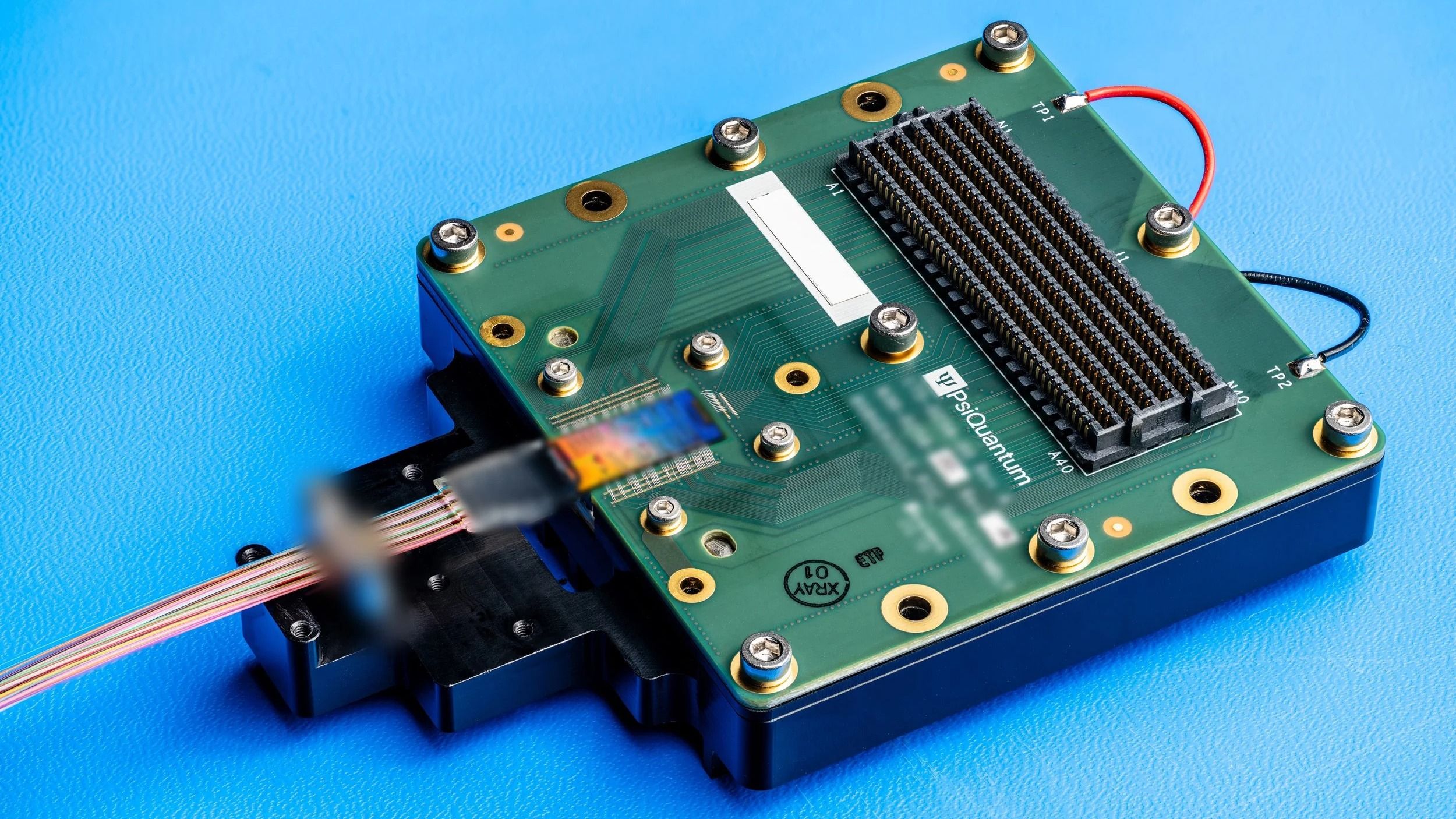
While MEMS technology is proven and effective, it involves moving parts, which can introduce complexities in terms of switching speed and long-term mechanical reliability. PsiQuantum’s approach utilizes a solid-state design. The switch consists of optical circuits etched directly onto a silicon chip using standard semiconductor manufacturing processes. Because there are no moving parts, the switch is potentially more robust and can be manufactured using the same high-volume fabrication techniques used for traditional computer chips.
The use of silicon photonics also allows for a higher degree of integration. By leveraging the existing infrastructure of the silicon chip industry, PsiQuantum can theoretically scale the production of these switches more rapidly than specialized MEMS-based hardware.
Scaling for the AI Era
Despite the impressive efficiency gains, PsiQuantum’s current prototype is relatively small in scale. The demo unit features an 8×8 configuration, meaning it has eight input ports and eight output ports. In the context of a modern data center, this is a modest beginning. Competitors in the space currently offer switches ranging from 32×32 to as many as 300×300 ports, which are necessary to manage the massive "spine" and "leaf" architectures of hyperscale facilities.
PsiQuantum has acknowledged this gap but remains optimistic about the future. The company stated that larger devices are already in active development. The transition from an 8×8 prototype to a high-port-count commercial product is a significant engineering hurdle, but PsiQuantum believes its silicon-based approach provides a clearer path to scaling than mechanical alternatives.
The intended use case for this technology is not to replace traditional packet switches entirely but to work alongside them. In a hybrid networking environment, the OCS handles the "heavy lifting"—the massive, sustained data flows between GPU clusters—while traditional packet switches handle the more complex, bursty traffic that requires individual packet routing. This division of labor can drastically reduce the total power envelope of a data center, a critical factor at a time when energy availability is becoming a primary constraint on AI expansion.
The Broader Impact on the Tech Industry
The move into the data center market represents a pragmatic diversification for PsiQuantum. While the quest for a functional quantum computer remains a long-term goal with high capital requirements, the demand for more efficient AI infrastructure is immediate and lucrative. By commercializing the "sub-components" of its quantum research, PsiQuantum is positioning itself as a vital player in the classical computing supply chain.
For data center operators, the promise of a 1.2 dB loss switch is a compelling proposition. Lower signal loss means that data centers can be designed with longer fiber runs or more complex topologies without the need for signal amplification. It also provides more "link budget"—the total amount of allowable signal loss in a connection—which gives engineers more flexibility when designing the physical layout of massive server farms.
As AI models continue to grow in size, the infrastructure supporting them must evolve. The transition from electrical to optical switching is increasingly seen not as an option, but as a necessity. PsiQuantum’s entry into this space, armed with technology honed in the unforgiving environment of quantum physics, suggests that the next generation of AI may well be powered by the very tools designed to unlock the quantum frontier.
The company has not yet provided a specific timeline for the commercial availability of its larger-scale switches, but the successful demonstration of the 8×8 low-loss prototype serves as a proof of concept that silicon photonics can meet the rigorous demands of the modern data center. As the industry watches closely, the focus now shifts to how quickly PsiQuantum can scale its etched-silicon designs to meet the massive port requirements of the world’s largest AI clusters.
 Hardware Reviews & PC Building
Anthropic’s Claude Mythos Model Achieves Rapid AI Portability to AMD Hardware, Challenging Nvidia’s Software Dominance
In a significant revelation that could signal a shift in the competitive...
 Hardware Reviews & PC Building
BiWin Unveils CL100 Mini NVMe SSD to Address Storage Constraints in Next-Generation Gaming Handhelds
The modern landscape of PC gaming has undergone a radical transformation over...
 Hardware Reviews & PC Building
35-year-old SNES runs ChatGPT, accelerated with a Super FX 2 chip — 21 MHz of RISC muscle speeds 2.2M parameter…
The initiative is the work of Benj Edwards, a prominent journalist and...







