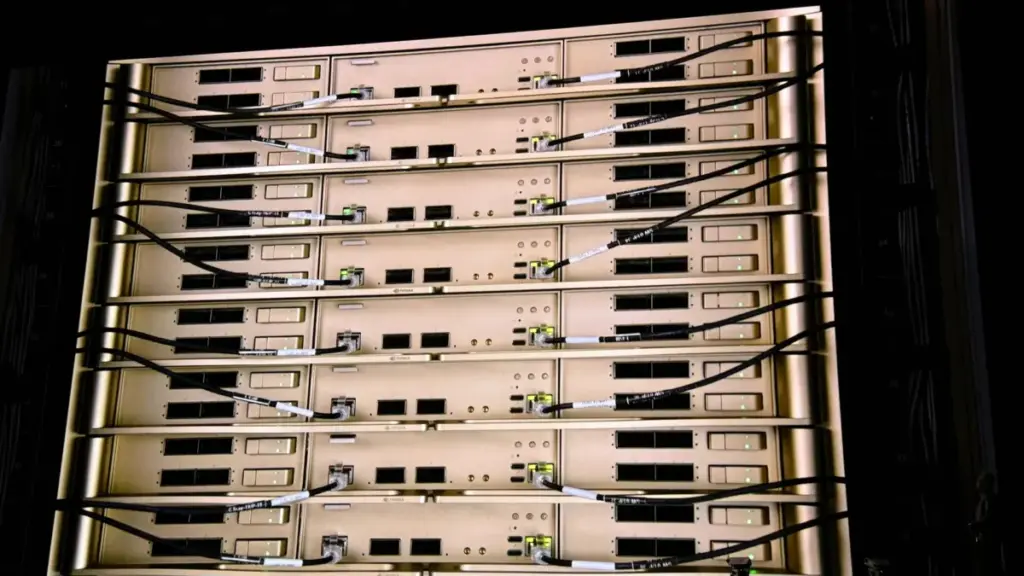
Furthermore, the Kessel project underscores a strategic shift in how Elon Musk’s companies interact with the broader tech supply chain. While SpaceX and xAI will continue to purchase the underlying silicon—specifically the Vera CPUs and Rubin GPUs—directly from Nvidia, the report indicates that they intend to source other critical components independently. This move toward self-sourcing for the rack’s infrastructure, including the complex 84-layer PCBs and the surrounding power and cooling systems, grants Musk’s companies a higher degree of control over their hardware destiny. It reduces reliance on traditional original equipment manufacturers (OEMs) and system integrators, who might be constrained by broader market demands or standardized design templates. By designing and sourcing the "box" that houses the chips, SpaceX and xAI can move faster, iterate more frequently, and tailor the hardware to their exact specifications without waiting for industry-wide adoption of new standards.
This approach is consistent with Musk’s long-standing philosophy of "the machine that builds the machine." Just as Tesla designs its own specialized casting machines and SpaceX builds its own rocket engines, the Kessel project represents an attempt to master the physical layer of artificial intelligence infrastructure. For xAI, which is currently engaged in a massive compute arms race with rivals like OpenAI, Google, and Meta, having a proprietary hardware stack could provide a competitive edge. If the Kessel architecture proves to be more reliable or easier to scale than standard off-the-shelf solutions, it could allow xAI to deploy larger clusters with fewer points of failure. The massive "Colossus" supercomputer currently operated by xAI in Memphis already demonstrates the company’s appetite for large-scale infrastructure; the development of Kessel suggests that the next generation of this compute power will be even more customized and potentially more mobile—or rather, more orbital.
The technical challenges of cooling a 72-GPU rack in space cannot be overstated. In a terrestrial data center, massive fans or liquid cooling loops reject heat into the atmosphere or a water supply. In the vacuum of space, convection is non-existent, leaving only radiation as a means of heat rejection. The Kessel system’s solid-state design and the high-layer-count PCB may play a role in a more sophisticated thermal management strategy, perhaps utilizing the board itself as a heat spreader or integrating it with specialized cold plates that connect to a spacecraft’s larger radiator system. The integration of 36 Vera CPUs alongside the 72 Rubin GPUs adds another layer of thermal complexity, as the Vera CPUs—based on Nvidia’s high-performance Grace architecture—generate significant heat of their own.
 Hardware Reviews & PC Building
Cinebench world record that stood for 12 years gets toppled — OC expert scores 10.8cb in Cinebench R11.5 using an…
The achievement is not merely a personal victory for Luumi but a...
 Hardware Reviews & PC Building
US Video Game Hardware Sales Experience Historic Decline as PlayStation and Xbox Reach Multi-Year Lows
The United States video game industry is currently grappling with a significant...
 Hardware Reviews & PC Building
Privacy Concerns Surface for Meta’s Muse AI as Reports Suggest Unauthorized Access to Personal Messages
The rapid evolution of artificial intelligence has brought with it a wave...