
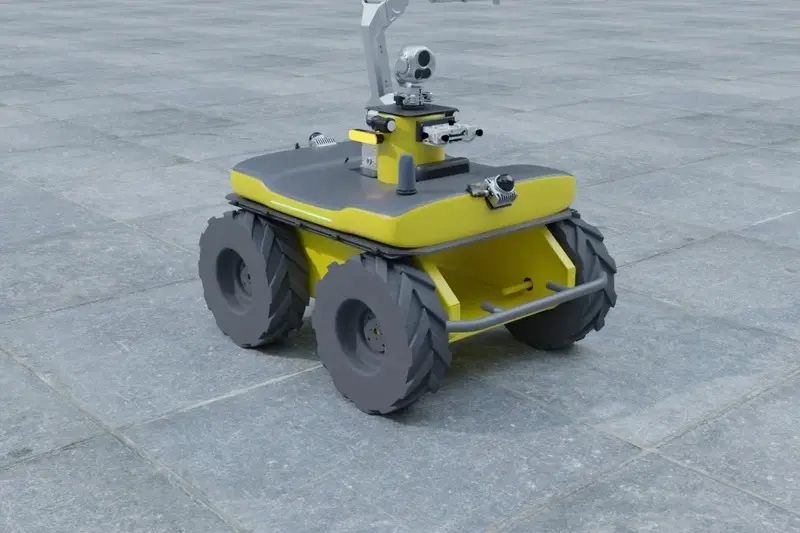
In the rapidly evolving landscape of industrial automation, the deployment of autonomous robots for routine inspections has transitioned from a futuristic concept to a standard operational requirement. However, as facilities move toward unattended rounds, a fundamental engineering dilemma persists: should the sensor payload be carried by a wheeled or tracked Unmanned Ground Vehicle (UGV), or does the environment demand the agility of a legged quadruped?
The engineering team at YUANZHI ROBOTICS, a firm specializing in the design and construction of sensor payloads for robot dogs, UGVs, and drones, recently addressed this pivotal question. Drawing from extensive field experience and a platform-agnostic perspective, the team has outlined the critical factors that determine the success of a robotic inspection project. According to their analysis, the decision rarely rests on a preference for one technology over another, but rather on a cold assessment of the site’s physical constraints and the mission’s specific requirements.
The Route as the Primary Decision Matrix
The selection process for any robotic platform begins long before a single bolt is tightened. It starts with a literal walkthrough of the intended inspection route. Engineers emphasize that the physical layout of a facility is the single most significant factor in narrowing down the choice.
When evaluating a site, engineers look for "showstoppers" for wheeled vehicles. These include traditional stairs, steep steps at doorways, bulkheads, high kerbs, and floor obstructions such as exposed pipes or cable trays. In many legacy industrial environments, the presence of even a single flight of stairs that the robot must traverse to complete its round immediately settles the debate in favor of a quadruped. While tracks can handle shallow steps or kerbs, and custom ramps can be installed for minor elevation changes, a standard staircase remains the exclusive domain of legged systems.
Conversely, if the route is characterized by continuous, flat surfaces—such as the paved walkways of an outdoor substation, the expansive rows of a solar plant, or the paved roads of a tank farm—the UGV becomes the primary contender. In many large-scale operations, such as production halls or perimeter fences, the UGV often emerges as the superior choice due to its stability and efficiency on flat ground. It is not uncommon for complex sites to employ a hybrid fleet: a UGV for yard patrols and a quadruped for indoor switchgear rounds where space is tight and floors are uneven.

Navigating Terrain, Obstacles, and the Risk of Recovery
The mechanical differences between quadrupeds and UGVs dictate how they interact with their environment and, perhaps more importantly, what happens when things go wrong. A quadruped offers unparalleled mobility; it can navigate gravel, slopes, and gaps in floor grating with ease. Its ability to turn in place within a narrow passage and crouch under low-hanging equipment makes it ideal for dense industrial environments.
However, this mobility comes with the inherent risk of instability. On surfaces like wet steel, ice, or loose cables, a quadruped may lose its footing. While modern industrial quadrupeds are increasingly capable of self-righting after a fall, the impact poses a significant threat to the sensitive sensor payloads they carry. To mitigate this, engineers at YUANZHI ROBOTICS design specialized protection for these platforms, often incorporating roll cages or recessed sensor heads to ensure that a slip does not result in a total loss of the vision or gas-sensing equipment.
In contrast, UGVs offer a much higher degree of inherent stability. A wheeled or tracked vehicle is unlikely to tip over on a well-planned route. A wheeled UGV is optimized for paved and relatively smooth surfaces, while tracked versions excel in mud, snow, and rougher outdoor terrain. The limitation of the UGV is its binary nature regarding obstacles: if it encounters a pipe or a step it cannot drive over, it stops. In critical areas like doorways, a stalled UGV becomes a physical obstruction, requiring manual intervention to clear the path.
The Engineering Constraints of Payload Mass and Mounting
The capacity to carry equipment is where the two platforms diverge most sharply. Quadrupeds are highly sensitive to weight and balance. For smaller models like the Unitree Go2 EDU, the payload capacity is limited to a modest 2 to 3 kilograms. Larger industrial models, such as the Unitree B2 or the DEEP Robotics X30, can carry a complete inspection suite weighing between 8 and 12 kilograms.
However, weight is only half the story; placement is equally vital. To maintain the robot’s gait and stair-climbing capabilities, the mass must be kept low and balanced over the hips. This engineering constraint effectively rules out the use of tall masts or heavy, high-torque pan-tilt units. It also limits the size of the onboard battery, which directly impacts mission duration.
UGVs, by comparison, are the "beasts of burden" in the robotic world. Platforms like the Clearpath Husky A200 can support up to 75 kilograms, while the AgileX Hunter 2.0 can carry as much as 150 kilograms. This massive capacity allows for significant hardware flexibility. A UGV can easily support a telescopic mast that lifts a camera head to a height of two meters, providing a bird’s-eye view over equipment. They can accommodate large secondary batteries for extended runtimes, robotic arms for manipulating valves, and multiple redundant sensor heads. On a UGV, the mounting is typically a simple deck plate, and wiring is far less constrained by the mechanics of the robot’s movement.

Operational Metrics: Speed, Runtime, and Efficiency
Efficiency in the field is often measured by how much ground a robot can cover between charges. A quadruped typically walks at a speed of about 1 meter per second during an inspection. While they can move faster on open ground, their runtime is limited by the energy-intensive nature of legged locomotion. Most quadrupeds provide between 1.5 and 2 hours of operation with a full payload before needing to return to a docking station or undergo a manual battery swap.
UGVs are significantly more efficient. While their top speeds are rarely utilized during the precise work of inspection, they can comfortably maintain 1 to 2 meters per second between points of interest. More importantly, their batteries can last anywhere from 4 to 8 hours, and even longer if the platform is equipped with an auxiliary power source. For a perimeter patrol spanning several kilometers, the UGV is the clear winner, covering more distance with fewer interruptions for charging. For short-range indoor rounds, the quadruped’s shorter runtime is often a non-factor.
Weather Resilience and Environmental Protection
Durability in harsh environments is a prerequisite for industrial robots. Most modern quadrupeds carry industrial-grade ingress protection (IP) ratings, allowing them to operate in rain and dusty conditions. Their primary weakness remains surface-level traction; they struggle significantly on slick or icy surfaces where their legs cannot find purchase.
UGVs generally offer a broader window of weather tolerance. Their lower center of gravity makes them less susceptible to high winds or steep lateral slopes, and tracked models are particularly adept at navigating through snow and deep mud. A significant gap exists, however, in specialized environments. For explosive atmospheres (ATEX/Ex zones), certified tracked robots are currently available on the market. Certified explosion-proof quadrupeds remain rare and carry a significantly higher price tag, making the UGV the standard choice for high-risk chemical or oil and gas facilities.
The Economic Reality: Cost and Long-term Upkeep
From a budgetary perspective, the UGV is almost always the more economical choice over the life of the robot. A quadruped is more expensive to purchase relative to its payload capacity, and its complexity leads to higher maintenance costs. A robot dog relies on twelve individual leg actuators, all of which are subject to wear and tear. Foot pads are considered consumables, and the risk of a fall adds a layer of potential repair costs for both the robot and the sensors.
The UGV, with its simpler frame and fewer moving parts—typically four to six motors—offers a much longer service interval. Tires and tracks are durable, and the spare parts list is relatively short. Engineers note that where both robots can technically perform the route, the UGV is the more cost-effective solution by a wide margin. The extra cost of a quadruped is only justified when the route’s complexity—specifically stairs—makes it the only tool capable of performing the task.

Adapting Sensor Payloads Across Platforms
Despite the physical differences in the vehicles, the core sensor technology remains remarkably consistent. Whether on legs or wheels, an inspection robot typically carries a radiometric thermal camera, a visible zoom camera on a pan-tilt head, LiDAR for localization, and various environmental sensors such as gas detectors or acoustic imagers.
The engineering challenge lies in the adaptation of these sensors to the specific platform. On a UGV, the payload is often characterized by its size; it may include a tall mast to overcome the vehicle’s low profile and a large battery to take advantage of the UGV’s high weight capacity. On a quadruped, the design must be compact and "low-profile," carefully balanced to ensure it does not interfere with the robot’s dynamic stability.
Interestingly, the software layer remains a point of convergence. Modern inspection software allows for the same operator interface to manage both types of robots. Routes, alarm thresholds, and reporting systems are identical, allowing a facility to run a mixed fleet of quadrupeds and UGVs without requiring separate training for the maintenance staff.
Ultimately, the choice between a robot dog and a UGV is a matter of matching the machine to the environment. As the engineering team at YUANZHI ROBOTICS suggests, the decision is rarely about which robot is "better" in a vacuum, but rather which one can reliably navigate the specific obstacles of a site while carrying the necessary tools for the job. For those managing complex industrial facilities, the path to automation begins with a simple question: does the mission require climbing stairs, or can it be accomplished on wheels?
 Software Development & Scripting for IT
Modernizing Authentication: A Comprehensive Approach to Passkey Implementation in Symfony 8.1
The digital authentication landscape is undergoing a fundamental shift as the industry...
 Software Development & Scripting for IT
Troubleshooting the "Silent" Failure: Why Zoho CRM Workflows Stop Triggering and How to Restore Automation Integrity
For many modern enterprises, the CRM is no longer just a digital...
 Software Development & Scripting for IT
The Truth in the Catalog: Lessons from a Mission-Critical Database Migration
In the modern landscape of web development, the promise of "managed backends"...







