
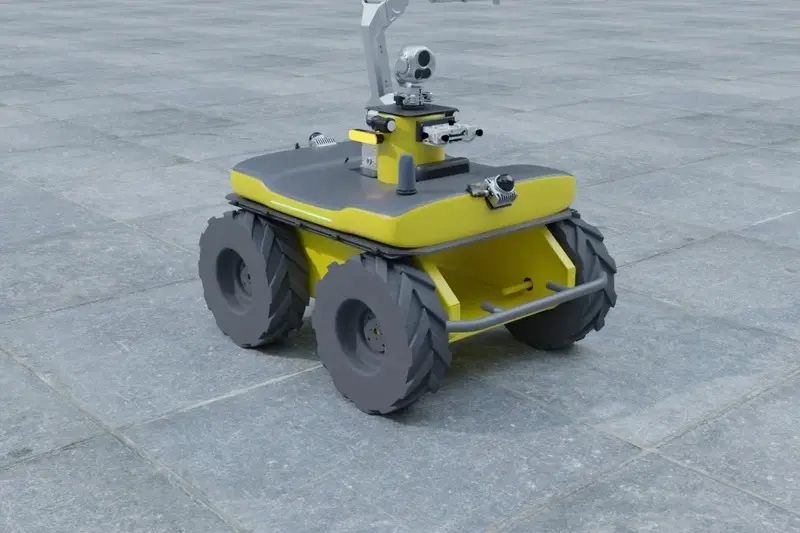
In contrast, UGVs offer a much higher degree of inherent stability. A wheeled or tracked vehicle is unlikely to tip over on a well-planned route. A wheeled UGV is optimized for paved and relatively smooth surfaces, while tracked versions excel in mud, snow, and rougher outdoor terrain. The limitation of the UGV is its binary nature regarding obstacles: if it encounters a pipe or a step it cannot drive over, it stops. In critical areas like doorways, a stalled UGV becomes a physical obstruction, requiring manual intervention to clear the path.
The Engineering Constraints of Payload Mass and Mounting
The capacity to carry equipment is where the two platforms diverge most sharply. Quadrupeds are highly sensitive to weight and balance. For smaller models like the Unitree Go2 EDU, the payload capacity is limited to a modest 2 to 3 kilograms. Larger industrial models, such as the Unitree B2 or the DEEP Robotics X30, can carry a complete inspection suite weighing between 8 and 12 kilograms.
However, weight is only half the story; placement is equally vital. To maintain the robot’s gait and stair-climbing capabilities, the mass must be kept low and balanced over the hips. This engineering constraint effectively rules out the use of tall masts or heavy, high-torque pan-tilt units. It also limits the size of the onboard battery, which directly impacts mission duration.
UGVs, by comparison, are the "beasts of burden" in the robotic world. Platforms like the Clearpath Husky A200 can support up to 75 kilograms, while the AgileX Hunter 2.0 can carry as much as 150 kilograms. This massive capacity allows for significant hardware flexibility. A UGV can easily support a telescopic mast that lifts a camera head to a height of two meters, providing a bird’s-eye view over equipment. They can accommodate large secondary batteries for extended runtimes, robotic arms for manipulating valves, and multiple redundant sensor heads. On a UGV, the mounting is typically a simple deck plate, and wiring is far less constrained by the mechanics of the robot’s movement.

Operational Metrics: Speed, Runtime, and Efficiency
Efficiency in the field is often measured by how much ground a robot can cover between charges. A quadruped typically walks at a speed of about 1 meter per second during an inspection. While they can move faster on open ground, their runtime is limited by the energy-intensive nature of legged locomotion. Most quadrupeds provide between 1.5 and 2 hours of operation with a full payload before needing to return to a docking station or undergo a manual battery swap.
UGVs are significantly more efficient. While their top speeds are rarely utilized during the precise work of inspection, they can comfortably maintain 1 to 2 meters per second between points of interest. More importantly, their batteries can last anywhere from 4 to 8 hours, and even longer if the platform is equipped with an auxiliary power source. For a perimeter patrol spanning several kilometers, the UGV is the clear winner, covering more distance with fewer interruptions for charging. For short-range indoor rounds, the quadruped’s shorter runtime is often a non-factor.
Weather Resilience and Environmental Protection
Durability in harsh environments is a prerequisite for industrial robots. Most modern quadrupeds carry industrial-grade ingress protection (IP) ratings, allowing them to operate in rain and dusty conditions. Their primary weakness remains surface-level traction; they struggle significantly on slick or icy surfaces where their legs cannot find purchase.
 Software Development & Scripting for IT
The Museum of Almost: Redefining Digital Narrative through Speculative Design and Technical Rigor
In the evolving landscape of digital art and web development, the boundary...
 Software Development & Scripting for IT
The Truth in the Catalog: Lessons from a Mission-Critical Database Migration
In the modern landscape of web development, the promise of "managed backends"...
 Software Development & Scripting for IT
The Connectivity Gap: Why Your Smart Lock Fails and the Technical Realities of the Three-Hop System
In the rapidly evolving landscape of the modern smart home, few devices...







