
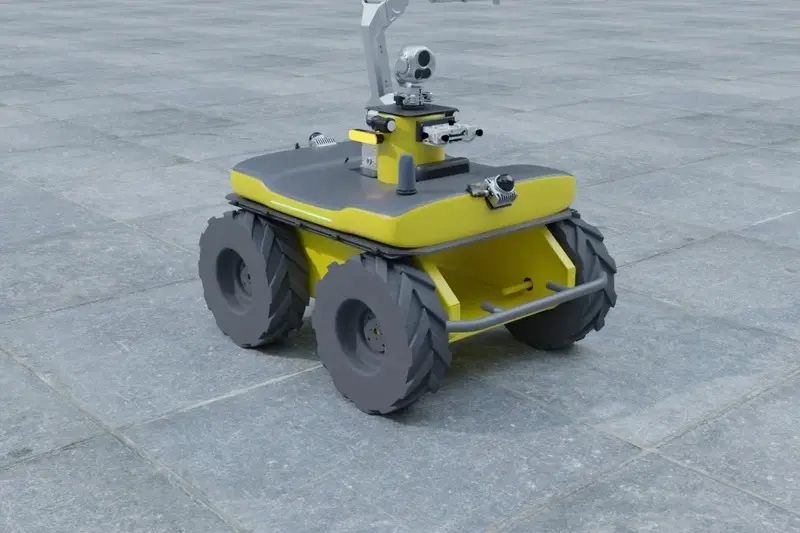
UGVs generally offer a broader window of weather tolerance. Their lower center of gravity makes them less susceptible to high winds or steep lateral slopes, and tracked models are particularly adept at navigating through snow and deep mud. A significant gap exists, however, in specialized environments. For explosive atmospheres (ATEX/Ex zones), certified tracked robots are currently available on the market. Certified explosion-proof quadrupeds remain rare and carry a significantly higher price tag, making the UGV the standard choice for high-risk chemical or oil and gas facilities.
The Economic Reality: Cost and Long-term Upkeep
From a budgetary perspective, the UGV is almost always the more economical choice over the life of the robot. A quadruped is more expensive to purchase relative to its payload capacity, and its complexity leads to higher maintenance costs. A robot dog relies on twelve individual leg actuators, all of which are subject to wear and tear. Foot pads are considered consumables, and the risk of a fall adds a layer of potential repair costs for both the robot and the sensors.
The UGV, with its simpler frame and fewer moving parts—typically four to six motors—offers a much longer service interval. Tires and tracks are durable, and the spare parts list is relatively short. Engineers note that where both robots can technically perform the route, the UGV is the more cost-effective solution by a wide margin. The extra cost of a quadruped is only justified when the route’s complexity—specifically stairs—makes it the only tool capable of performing the task.

Adapting Sensor Payloads Across Platforms
Despite the physical differences in the vehicles, the core sensor technology remains remarkably consistent. Whether on legs or wheels, an inspection robot typically carries a radiometric thermal camera, a visible zoom camera on a pan-tilt head, LiDAR for localization, and various environmental sensors such as gas detectors or acoustic imagers.
The engineering challenge lies in the adaptation of these sensors to the specific platform. On a UGV, the payload is often characterized by its size; it may include a tall mast to overcome the vehicle’s low profile and a large battery to take advantage of the UGV’s high weight capacity. On a quadruped, the design must be compact and "low-profile," carefully balanced to ensure it does not interfere with the robot’s dynamic stability.
Interestingly, the software layer remains a point of convergence. Modern inspection software allows for the same operator interface to manage both types of robots. Routes, alarm thresholds, and reporting systems are identical, allowing a facility to run a mixed fleet of quadrupeds and UGVs without requiring separate training for the maintenance staff.
Ultimately, the choice between a robot dog and a UGV is a matter of matching the machine to the environment. As the engineering team at YUANZHI ROBOTICS suggests, the decision is rarely about which robot is "better" in a vacuum, but rather which one can reliably navigate the specific obstacles of a site while carrying the necessary tools for the job. For those managing complex industrial facilities, the path to automation begins with a simple question: does the mission require climbing stairs, or can it be accomplished on wheels?
 Software Development & Scripting for IT
Re-evaluating the Enterprise Test Automation Stack: Why Past Decisions Require New Scrutiny in the Age of AI
In the fast-moving world of enterprise software, a test automation tool that...
 Software Development & Scripting for IT
Microsoft Unveils C# 15: A Deep Dive into Union Types, Enhanced Memory Safety, and Language Refinements
As the annual release cycle for the .NET ecosystem approaches, Microsoft has...
 Software Development & Scripting for IT
The Great Slim-Down: How One Developer Reduced Desktop App Sizes by 95% Using Tauri and Rust
In the modern landscape of software development, the Electron framework has long...







