

In its most recent earnings report, Microsoft announced a significant milestone in the adoption of generative artificial intelligence within the corporate world. Microsoft 365 Copilot has officially surpassed 30 million paid seats, with the company reporting that net seat additions more than doubled on a quarter-over-quarter basis. While the raw numbers highlight a rapid commercial expansion, Microsoft executives suggest the data points to a more profound structural shift in the global labor market: a transition where AI moves from a passive digital assistant to an active, autonomous participant in the professional environment.
This evolution marks the end of what Microsoft describes as the first phase of enterprise AI, which was largely defined by initial deployments, licensing agreements, and the pursuit of incremental time savings. According to company leadership, the market is now entering a "transformation" phase. In this new era, organizations are no longer merely layering AI on top of existing processes; they are redesigning their entire workflows around the capabilities of AI agents. These agents are increasingly being tasked with managing entire projects and complex processes, effectively expanding the agency of human employees and allowing them to focus on higher-level strategic objectives.
The current transformation is being driven by three distinct trends: the depth and breadth of AI integration into daily habits, the emergence of net-new capabilities that were previously impossible to achieve, and a move toward hyper-specialization where AI is tailored to specific professional roles rather than provided as a one-size-fits-all tool.
A Step Change in Innovation
The technological underpinnings of this shift involve a move toward "agentic" AI. Unlike earlier versions of generative models that required constant prompting for every small step, new products are designed with an agentic harness that allows the system to close its own feedback loop. This means the AI can plan a project, execute the necessary steps, test the results, and correct its own errors before delivering a finished product to the human user.
A primary example of this technology in action is Copilot Cowork, which reached general availability in June. Cowork is designed to handle multi-step work end-to-end. A user defines a high-level task, and the system utilizes a multi-model design to scale its capabilities based on the complexity of the work. Internal testing at Microsoft indicated that this multi-model approach was not only more efficient but also 30% to 40% more cost-effective than relying on a single, massive model for every task.
In tandem with Cowork, Microsoft introduced Microsoft Scout, an "autopilot" agent. Unlike a chat interface that waits for user input, Scout operates in the background with its own identity and permissions. It is designed to keep projects moving even when the human employee is focused elsewhere. Both tools are grounded in what Microsoft calls "Work IQ," a system that allows the AI to understand the specific context of an organization, including its internal hierarchies, project priorities, and institutional knowledge.
The speed at which these tools are being developed reflects a change in the software engineering process itself. The core team behind Copilot Cowork remained intentionally small, growing from just three engineers at the start to nine at the time of general availability. Despite this lean staffing, the product moved from inception to being utilized by half of the Fortune 500 within six months. This rapid speed-to-market was made possible by rebuilding the development process around agents, allowing a small group of human experts to achieve a level of scale and automation that would have traditionally required hundreds of engineers.

Omar Shahine, Corporate Vice President of Microsoft Scout, noted that the role of leadership is changing in this environment. In the past, scaling required coordinating large groups of people to move forward together. Now, the focus is on creating conditions where small, expert teams can use autonomous agents to experiment safely and capture learnings continuously, ensuring that each new project begins with a greater foundation of knowledge than the last.
Depth and Breadth of Use
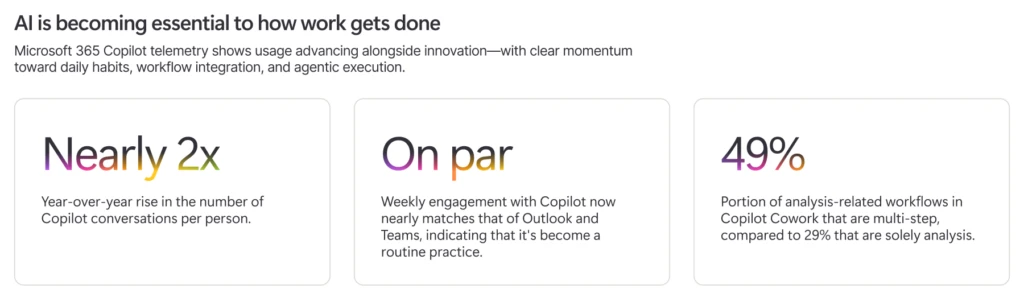
As the technology matures, the way employees interact with AI is also changing. Telemetry data from Microsoft 365 Copilot indicates that the number of conversations per user has nearly doubled over the past year. Furthermore, the number of users engaging with multiple Copilot features simultaneously has seen triple-digit growth. Perhaps most telling is the fact that average weekly engagement with Copilot is now on par with foundational productivity tools like Outlook and Teams, suggesting that AI has become a permanent fixture of the workday.
The nature of the requests being made to AI is also becoming more sophisticated. There has been a notable rise in requests that span multiple complex steps, such as analyzing a massive dataset and then drafting a contextualized email to stakeholders, or researching a technical problem and writing the corresponding code to solve it. When multi-step workflows are accounted for, analysis-related work now makes up 49% of all tasks, a significant jump from the 29% seen when analysis was performed as a standalone, isolated task. This suggests that users are increasingly trusting AI to manage entire chains of logic rather than just individual chores.
While early adopters were concentrated in the manufacturing, banking, and technology sectors, the data shows that agent adoption is spreading rapidly into other industries. Automotive and healthcare have emerged as some of the fastest-growing sectors for agent implementation. Large-scale deployments are also becoming the norm; the number of Microsoft customers with more than 50,000 seats has increased sevenfold year-over-year. Additionally, the time required for a company to reach "high usage"—defined as 80% monthly active usage across the workforce—has dropped from months to just a few days, indicating that the learning curve for these tools is flattening as they become more intuitive.
What AI Makes Possible
Beyond simple efficiency, organizations are discovering that AI can fundamentally change the nature of their work. Microsoft’s own Cloud Supply Chain team recently implemented a "lean before agents" strategy. By first mapping and simplifying six end-to-end workflows and establishing a shared data foundation, they deployed 70 purpose-built agents across sourcing, fulfillment, and logistics. This led to a 75% reduction in cycle time. The key takeaway from this internal initiative was the importance of simplifying a process before automating it, rather than applying AI to a broken or overly complex system.
In the manufacturing sector, the power management company Eaton is using an AI-powered "quality agent" to assist in root cause analysis. Historically, investigating manufacturing quality issues was a time-intensive process for human experts. The new AI agent reviews reports to surface potential trends and supplier insights, accelerating the analysis of over 5,000 reports to date. This allows Eaton’s engineers to identify risks and take preventative action much earlier in the production cycle.
Other organizations are empowering their frontline employees to build their own solutions. Premera Blue Cross, a health plan provider, integrated Microsoft 365 Copilot and Copilot Studio into their existing toolsets, allowing staff to build more than 900 custom agents to handle manual backlogs. One specific agent designed for processing contract exhibits reduced a workflow that previously took 45 minutes down to just three minutes. This reclaimed time allows employees to focus on more critical member services that require human empathy and judgment.
In some cases, AI is unlocking capabilities that were previously considered impossible due to the sheer volume of data involved. At Levi Strauss & Co., a finance agent was able to analyze 1,100 standard operating procedures and catalog 18,000 individual tasks in a single day. This provided the company with a detailed map of its financial operations that would have been impossible to quantify through traditional human audits. Similarly, the global consulting firm EY has piloted an Autonomous Sourcing Agent (ASA) that automates the procurement process for low-cost, low-risk transactions. The ASA can negotiate with multiple suppliers simultaneously on delivery timelines and warranties, handling hundreds of transactions with human oversight only for final validation.
Specialization at Scale
The most successful organizations are moving away from general-purpose AI deployments in favor of role-specific tailoring. S&P Global, for instance, used Copilot Agent Builder to create a specialized agent within Microsoft Teams that allows customers to interact directly with commodities research and market insights. This specialized tool delivers data extraction 95% faster and comparative analysis 98% faster than previous methods, turning vast amounts of market data into actionable intelligence.
Microsoft’s own sales organization has adopted a similar persona-based approach. They mapped distinct seller roles to dedicated agents, including a "Researcher," an "Analyst Agent," and a "Deal Agent." By offloading administrative and coordination tasks to these specialized agents, the time sellers spent in customer-facing activities doubled from 25% to 50%. The pilot group reported a 9.4% increase in revenue per head and a 20% faster deal closure rate.
In the realm of Human Resources, the marketing data firm Kantar developed a "people agent" to handle internal queries. This system, which consists of 10 interconnected agents, now resolves 40% of HR queries without human intervention. An employment verification letter that once took three days to process is now delivered in two minutes.
Microsoft’s People Operations team is taking this a step further by using "Frontier Tuning" to scale HR expertise. This process involves capturing the specific rubrics and standards of human practitioners and turning them into organizational capabilities. The resulting AI system has shown a fivefold improvement in successful task completion compared to general-purpose models. By automating routine interactions across more than 100 internal systems, HR experts are freed to focus on the nuanced, strategic decisions where human insight is most critical.
The Path Forward
As the technology continues to advance, the metrics used to judge the success of AI in the enterprise are shifting. Success is no longer measured simply by the number of licenses sold or the number of hours saved. Instead, the focus is moving toward the depth of use, the measurable redesign of workflows, and the emergence of net-new capabilities.
The rise of the "Frontier Firm" describes organizations where technology, operating models, and human agency evolve in tandem. For these companies, AI is no longer a tool to be used occasionally, but a core component of the organizational structure. As agents become more integrated into the fabric of daily work, the boundary between human effort and machine execution continues to blur, creating a new standard for productivity and innovation in the modern economy.
 Productivity Software & Office Suites
Microsoft Unveils Specialized AI Capabilities for Finance Professionals in Excel to Address Sector-Specific Complexity
The trajectory of transformative technology has followed a consistent, predictable rhythm for...
 Productivity Software & Office Suites
Microsoft Democratizes Software Development with Natural Language App Building in Copilot Studio
The landscape of software development is undergoing a fundamental transformation as artificial...
 Productivity Software & Office Suites
Microsoft Unveils Advanced AI ‘Skills’ and Data Connectors to Transform Excel for Finance Professionals
The evolution of modern computing has historically followed a predictable trajectory, moving...







