

Depth and Breadth of Use
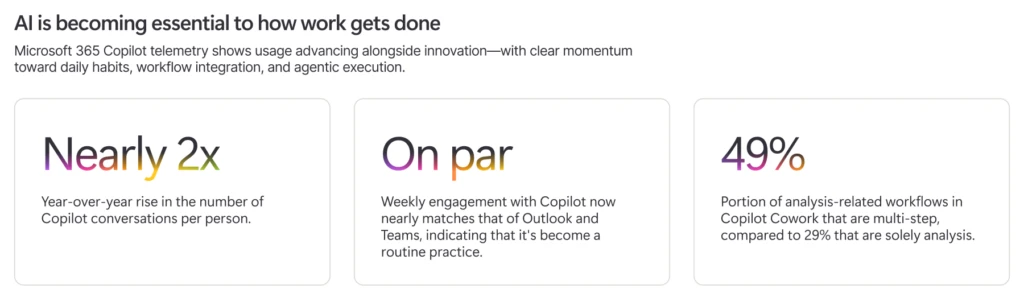
As the technology matures, the way employees interact with AI is also changing. Telemetry data from Microsoft 365 Copilot indicates that the number of conversations per user has nearly doubled over the past year. Furthermore, the number of users engaging with multiple Copilot features simultaneously has seen triple-digit growth. Perhaps most telling is the fact that average weekly engagement with Copilot is now on par with foundational productivity tools like Outlook and Teams, suggesting that AI has become a permanent fixture of the workday.
The nature of the requests being made to AI is also becoming more sophisticated. There has been a notable rise in requests that span multiple complex steps, such as analyzing a massive dataset and then drafting a contextualized email to stakeholders, or researching a technical problem and writing the corresponding code to solve it. When multi-step workflows are accounted for, analysis-related work now makes up 49% of all tasks, a significant jump from the 29% seen when analysis was performed as a standalone, isolated task. This suggests that users are increasingly trusting AI to manage entire chains of logic rather than just individual chores.
While early adopters were concentrated in the manufacturing, banking, and technology sectors, the data shows that agent adoption is spreading rapidly into other industries. Automotive and healthcare have emerged as some of the fastest-growing sectors for agent implementation. Large-scale deployments are also becoming the norm; the number of Microsoft customers with more than 50,000 seats has increased sevenfold year-over-year. Additionally, the time required for a company to reach "high usage"—defined as 80% monthly active usage across the workforce—has dropped from months to just a few days, indicating that the learning curve for these tools is flattening as they become more intuitive.
What AI Makes Possible
Beyond simple efficiency, organizations are discovering that AI can fundamentally change the nature of their work. Microsoft’s own Cloud Supply Chain team recently implemented a "lean before agents" strategy. By first mapping and simplifying six end-to-end workflows and establishing a shared data foundation, they deployed 70 purpose-built agents across sourcing, fulfillment, and logistics. This led to a 75% reduction in cycle time. The key takeaway from this internal initiative was the importance of simplifying a process before automating it, rather than applying AI to a broken or overly complex system.
In the manufacturing sector, the power management company Eaton is using an AI-powered "quality agent" to assist in root cause analysis. Historically, investigating manufacturing quality issues was a time-intensive process for human experts. The new AI agent reviews reports to surface potential trends and supplier insights, accelerating the analysis of over 5,000 reports to date. This allows Eaton’s engineers to identify risks and take preventative action much earlier in the production cycle.
Other organizations are empowering their frontline employees to build their own solutions. Premera Blue Cross, a health plan provider, integrated Microsoft 365 Copilot and Copilot Studio into their existing toolsets, allowing staff to build more than 900 custom agents to handle manual backlogs. One specific agent designed for processing contract exhibits reduced a workflow that previously took 45 minutes down to just three minutes. This reclaimed time allows employees to focus on more critical member services that require human empathy and judgment.
In some cases, AI is unlocking capabilities that were previously considered impossible due to the sheer volume of data involved. At Levi Strauss & Co., a finance agent was able to analyze 1,100 standard operating procedures and catalog 18,000 individual tasks in a single day. This provided the company with a detailed map of its financial operations that would have been impossible to quantify through traditional human audits. Similarly, the global consulting firm EY has piloted an Autonomous Sourcing Agent (ASA) that automates the procurement process for low-cost, low-risk transactions. The ASA can negotiate with multiple suppliers simultaneously on delivery timelines and warranties, handling hundreds of transactions with human oversight only for final validation.
 Productivity Software & Office Suites
Microsoft Reimagines Copilot as a Central Hub for Autonomous AI and Agentic Work
Microsoft has announced a significant evolution of its AI strategy, unveiling what...
 Productivity Software & Office Suites
Microsoft to Headline ESPC 2026 in Amsterdam as the European Tech Community Pivots Toward an Agentic AI Future
As the global landscape of work undergoes its most significant transformation since...
 Productivity Software & Office Suites
Microsoft Reimagines Copilot as a Comprehensive AI System for Enterprise Automation and Custom Development
In a significant shift that signals the next phase of the generative...







