
The Rise of the Persistent Digital Teammate
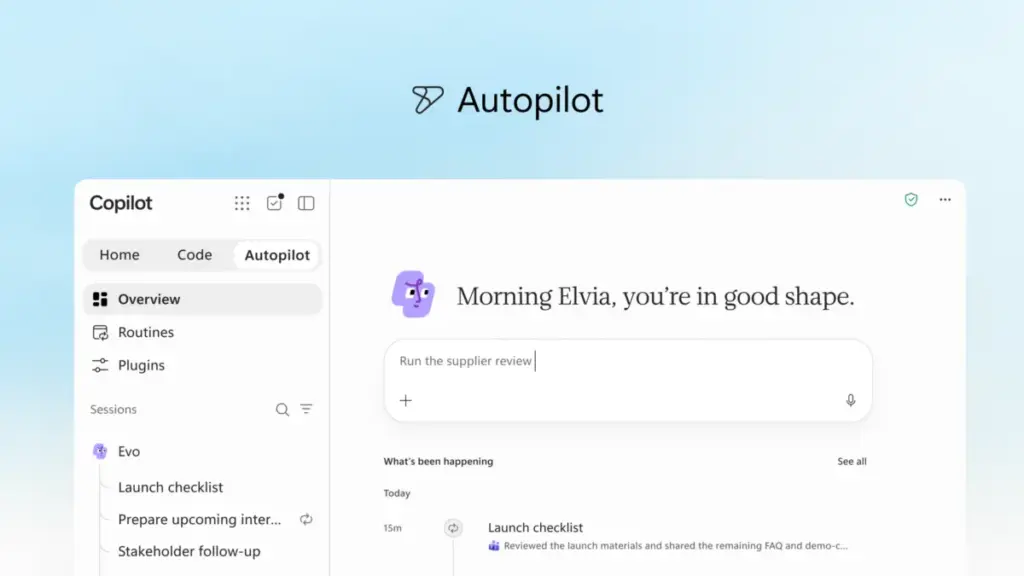
Perhaps the most significant leap toward autonomous AI is "Autopilot," a feature previously known by the internal codename "Scout." Unlike traditional AI assistants that wait for a prompt to act, Autopilot is designed to be a persistent, proactive agent that works even when the user is offline.
Users can assign Autopilot a specific name, role, and goal. Once activated, the agent can monitor communication channels, follow up on email threads, and manage recurring workflows. For example, Autopilot could be tasked with overseeing a full supplier review process. It would build the schedule, handle the preparation for meetings, reach out to stakeholders for updates, and manage the necessary follow-ups—all without constant human monitoring. Because it is cloud-hosted and possesses its own identity and "memory" within the organization’s tenant, Autopilot functions more like a digital colleague than a software tool. It is built on Microsoft IQ, ensuring it understands the specific context and operational nuances of the organization it serves.
Grounding AI in Deep Business Context

For AI to be truly effective in an enterprise setting, it must be grounded in the specific data and workflows of the business. To this end, Microsoft is expanding the business context available to Copilot through "Microsoft IQ," a unified intelligence platform.
A key component of this expansion is "Fabric IQ," which connects Copilot to the vast amounts of data held within Power BI semantic models. This integration allows Chat and Cowork to provide answers and execute tasks based on real-time business data. Furthermore, Copilot is now being grounded in data from Dynamics 365 and the Power Platform. This means a salesperson drafting a proposal can have Copilot automatically pull in deal histories or customer support tickets directly into the document, eliminating the need for distracting external lookups.
To facilitate the connection between Copilot and the various third-party actions that drive a business, Microsoft is also launching a new "Plugin Registry." This unified catalog will house plugins from Microsoft, its partners, and custom-built solutions. It provides IT departments with a centralized location to approve and govern the tools being used, while allowing developers to publish a plugin once and have it function across all supported Copilot experiences.
The Economics of Enterprise AI: FinOps and Billing
 Productivity Software & Office Suites
Microsoft Outlines Strategic Roadmap for Enterprise AI: Navigating the Shift from Hype to Economic Value
In a comprehensive memo addressed to the global business community, Jared Spataro,...
 Productivity Software & Office Suites
Microsoft Announces Fifth Annual Power Platform Community Conference in Las Vegas to Bridge the Gap Between AI Innovation and Business Process
As the global enterprise landscape continues to evolve, the fundamental machinery of...
 Productivity Software & Office Suites
Microsoft Reimagines the Future of Productivity with the Launch of the New Copilot
In a significant evolution of its artificial intelligence strategy, Microsoft has unveiled...







