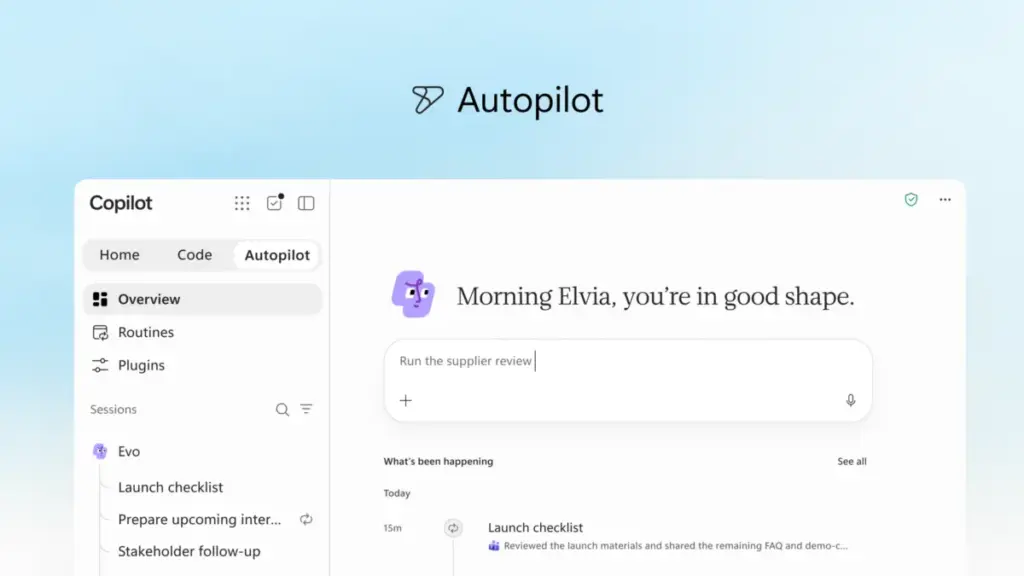
In a significant shift toward the next generation of digital labor, Microsoft has announced a comprehensive reimagining of its Copilot platform. This evolution, framed as the "new Copilot," aims to transition AI from a simple conversational assistant into a persistent, proactive, and deeply integrated engine for professional work. By connecting the tools that organizations rely on with advanced capabilities for building, customizing, and scaling artificial intelligence, Microsoft is positioning Copilot as the central interface for what it describes as the "flow of human ambition."
The core of this update is a fundamental restructuring of the Copilot application itself, which now introduces three distinct pillars of functionality: Home, Code, and Autopilot. These features are designed to meet the diverse needs of the modern workforce, ranging from quick information retrieval to complex project delegation and custom software solution building. As work continues to evolve across hybrid environments and increasingly complex digital ecosystems, Microsoft’s latest move signals a commitment to making AI a constant, reliable presence in the enterprise.
A Unified Starting Point for the Modern Workflow
The centerpiece of the user experience is "Home," a new starting point within the Copilot app where the previously separate functions of Chat and Cowork are unified. In the current corporate environment, employees often find themselves navigating a fragmented landscape of meetings, emails, documents, and specialized applications. Home is designed to serve as a grounding mechanism, allowing users to get their bearings, review recent activity, and receive intelligent suggestions on how to move projects forward.
Within this new interface, "Chat" remains the destination for instant, conversational interactions—ideal for quick lookups, drafting short messages, or catching up on missed discussions. "Cowork," however, represents a more advanced tier of delegation. Instead of simply asking for a summary, users can define a complex task, such as responding to a Request for Proposal (RFP), creating a product launch kit, or preparing a financial close package. Cowork then executes the task from end-to-end, returning a completed result that the human user can then iterate upon.
Further bridging the gap between AI and traditional productivity, Microsoft is introducing "Office in Copilot." This integration brings the full functionality of Word, Excel, and PowerPoint directly into the Copilot experience. The goal is to eliminate the friction associated with switching between apps, which often leads to broken formatting or version control issues. From the Home screen, a user can prompt Copilot to draft a brief or model a budget; the AI then creates a real, editable file that stays in sync across the entire Microsoft 365 suite. This allows for side-by-side refinement where teammates can be @mentioned, and their edits appear in real-time, ensuring that progress travels with the user regardless of which application they are using.

Democratizing Solution Building with "Code"
One of the most ambitious aspects of the new Copilot is the introduction of "Code." For decades, the primary unit of knowledge work has been the file—a document, a spreadsheet, or a slide deck. While these remain essential, Microsoft believes that small, purpose-built software solutions are becoming the fourth unit of work. With Code, the company is attempting to move solution-building beyond the exclusive domain of professional developers.
Powered by the same underlying technology as GitHub Copilot, the Code feature allows anyone to describe a needed application, automation, or dashboard in natural language. Copilot then selects the appropriate technical approach and builds the solution. These can range from simple desktop widgets for quick data reference to cloud-hosted internal apps that can be shared across a team. To ensure enterprise-grade security, Code runs in a sandboxed environment and is hosted within the organization’s own tenant. This is supported by "Microsoft Copilot Managed Runtime," a new hosting infrastructure that allows these custom-built solutions to run safely within the Microsoft 365 environment, governed by IT but accessible to the broader workforce.
 Productivity Software & Office Suites
Microsoft Unveils Microsoft 365 G7: A New Frontier for AI-Driven Productivity and Governance in the Public Sector
In a significant move to modernize the digital infrastructure of the United...
 Productivity Software & Office Suites
Microsoft Shifts AI Strategy Toward Agentic Workflows and Hybrid Economic Models
In a comprehensive communication addressed to customers this week, Microsoft’s Chief Marketing...
 Productivity Software & Office Suites
The Rise of the Agentic Operating Model: How ‘Frontier Firms’ Are Using Knowledge Spines to Outpace Competitors
As the initial hype surrounding generative artificial intelligence matures into a demand...