
The strategic necessity of this deal is underscored by the limitations facing even the largest players like Nvidia. With a market capitalization hovering around $5 trillion, Nvidia technically possesses the "funny money" required to buy any or all of these optical specialists. However, such a move would almost certainly trigger intense antitrust scrutiny. Furthermore, buying only one of the major laser suppliers would not satisfy Nvidia’s insatiable demand for components. In the current market, it is arguably more beneficial for multiple suppliers to exist, theoretically driving innovation and competition. Yet, as seen in the High Bandwidth Memory (HBM) market, competition does not always guarantee supply. The entire GenAI industry is currently gated by HBM capacity, and optical interposers and lasers are rapidly becoming the next critical bottleneck.
This is the central motivation behind Marvell’s move. Marvell has established a fast-growing business as a "chip shepherd," helping titans like Amazon Web Services, Microsoft, and Google design and manufacture their own custom CPUs and XPUs. By acquiring Lumentum, Marvell ensures that it can prioritize the supply of essential laser components for its own custom chip business while still generating significant revenue by selling to the broader market, including Nvidia, AMD, and Intel.
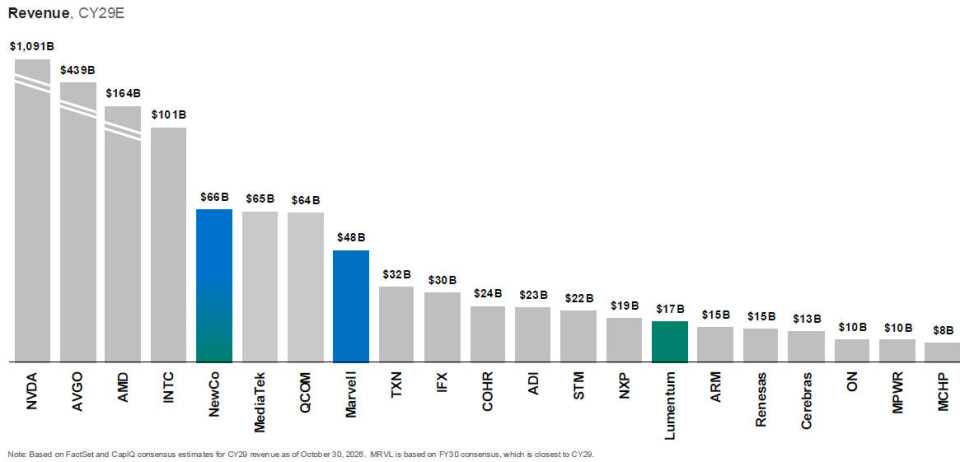
Marvell CEO Matt Murphy has framed the deal as a step toward becoming the "category leader for the next generation of AI connectivity." However, the subtext is one of supply chain security. Industry insiders suggest that the order books for high-end photonics lasers are already effectively sold out through early 2029. For Marvell, owning Lumentum is not just about market leadership; it is about ensuring the viability of its custom silicon roadmap.
The financial scale of the merger is significant relative to the current revenues of both companies, though both are experiencing "hockey stick" growth. Marvell’s previous acquisitions, such as the purchase of PHY maker Inphi and the $3.25 billion acquisition of Celestial AI for its photonics interposer technology, were early indicators of this strategy. These moves positioned Marvell to de-risk the optical on-package compute engines that its largest customers are now demanding.
Lumentum’s recent financial performance highlights the sudden surge in value for these technologies. While the company reported a technical loss of $7.16 billion two quarters ago due to debt-to-stock conversions, its underlying operations are robust. In its most recent quarter, Lumentum posted $360.3 million in profits on $1.26 billion in sales, demonstrating a higher profit margin than Marvell’s own $308 million net income on $2.74 billion in sales. This profitability reflects the newfound premium placed on the lasers that will power future Nvidia systems and other AI clusters.
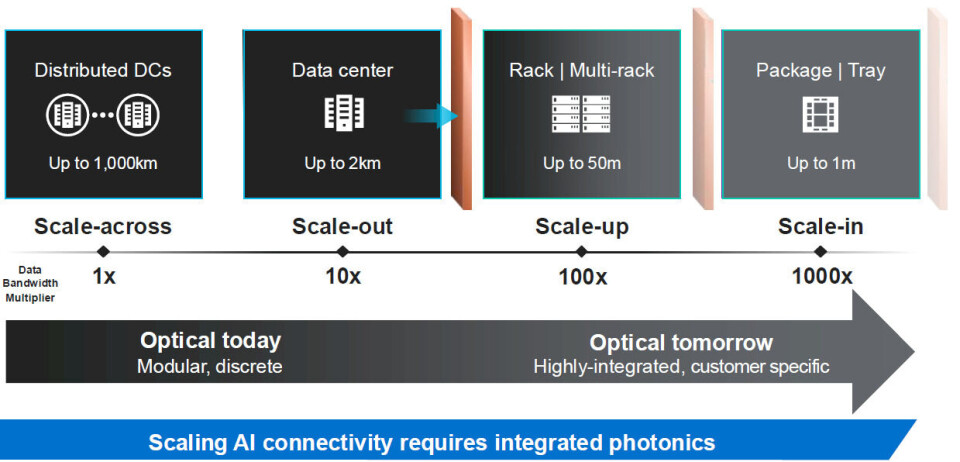
Murphy believes the Lumentum deal will prove even more transformational than the Inphi acquisition, which has been the primary driver of Marvell’s AI-related growth to date. He explained to investors that the industry is at the inception of a transition where the "copper wall" is moving from scale-out networking to scale-up and, eventually, scale-in architectures. The scale of the Lumentum opportunity over the next several years is estimated to be an order of magnitude larger than what was expected from Inphi five years ago, backed by firm orders rather than mere projections.
 Enterprise Tech & Infrastructure
Cerebras Systems Forges Cloud Path as OpenAI Mega-Deal Anchors Massive Revenue Backlog
Throughout 2026, Cerebras Systems, the innovator behind the world’s largest AI processors,...
 Enterprise Tech & Infrastructure
The Architecture of Modern Storage: Navigating the Technical Nuances of Flash Memory and Solid-State Drives
In the rapidly evolving landscape of data storage, the terminology used to...
 Enterprise Tech & Infrastructure
Micron Technology and the Global Memory Boom: HBM’s Ascent to the Most Profitable Product in IT History
The history of the commercial information technology sector spans more than six...







