

Beyond securing components, Marvell aims to elevate its status within the semiconductor hierarchy, moving past companies like MediaTek and Qualcomm to challenge the dominance of Intel and AMD in the datacenter. Marvell is positioning itself as the largest pure-play provider of datacenter connectivity chips, spanning the entire spectrum from individual compute engines to inter-region datacenter links. While Nvidia and Broadcom maintain larger overall connectivity businesses, Marvell’s focus on the "full stack" of optical fabrics is intended to capture a Total Addressable Market (TAM) that it estimates will reach $400 billion by 2030.
The fundamental driver for this full-stack optical approach is the need for massive compute complexes that function as a single entity. As the hierarchy of networking moves from "scale across" (connecting datacenters) to "scale out" (connecting racks) to "scale up" (coherent memory across elements) and finally "scale in" (on-package components), the bandwidth requirements increase by roughly 10x at each step. Copper signaling simply cannot maintain the necessary integrity at these densities.
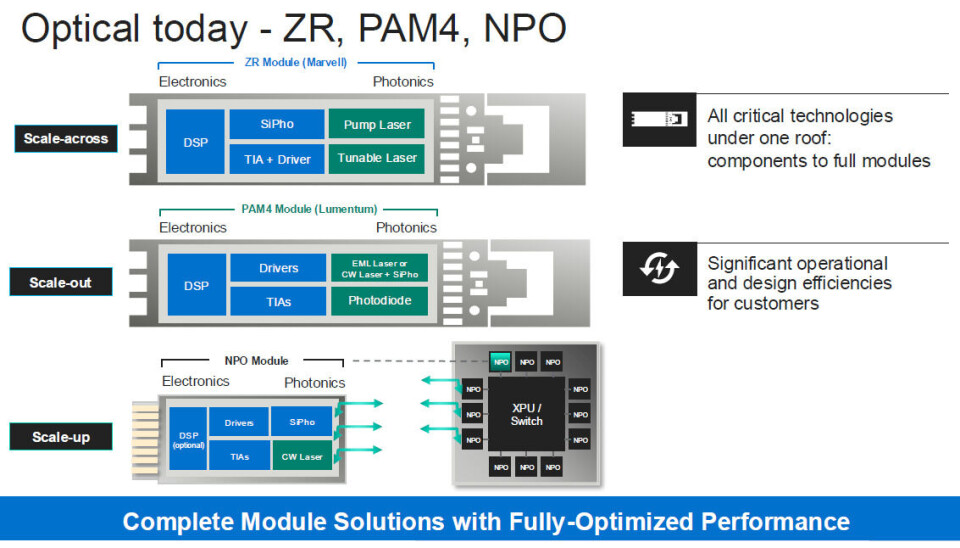
The combined expertise of Marvell and Lumentum covers the essential materials science required for this transition. This includes Indium Phosphide for lasers, Silicon Germanium for the analog front ends of optical links, and Gallium Arsenide for secondary laser applications. While this vertical integration provides a competitive advantage and simplifies the design process for customers, it also concentrates risk—a classic "all eggs in one basket" scenario for the supply chain.
Another significant element of the deal is the potential for optical circuit switches (OCS) to disrupt traditional networking. Google has already demonstrated the viability of this approach with its "Palomar" OCS, which uses micro-mirrors to connect thousands of TPU accelerators in reconfigurable topologies. By reducing power consumption and latency, OCS technology offers a compelling alternative to traditional Ethernet switches in AI backends. With Lumentum’s expertise, Marvell can now offer these optical switching solutions alongside its existing TeraLynx Ethernet ASICs.
The path to completion for this merger, however, is long. The deal is not expected to close until the first half of 2028, a timeline that feels like an eternity in the fast-moving AI sector. Regulatory hurdles loom large, particularly in China and Europe, where antitrust authorities have become increasingly wary of vertical integration in the semiconductor space. The 20-month window also leaves room for potential counteroffers or market shifts that could disrupt the arrangement. Furthermore, the deal immediately puts Coherent into play as a potential acquisition target for other industry giants, much as Intel’s acquisition of Altera a decade ago triggered a corresponding move for Xilinx.
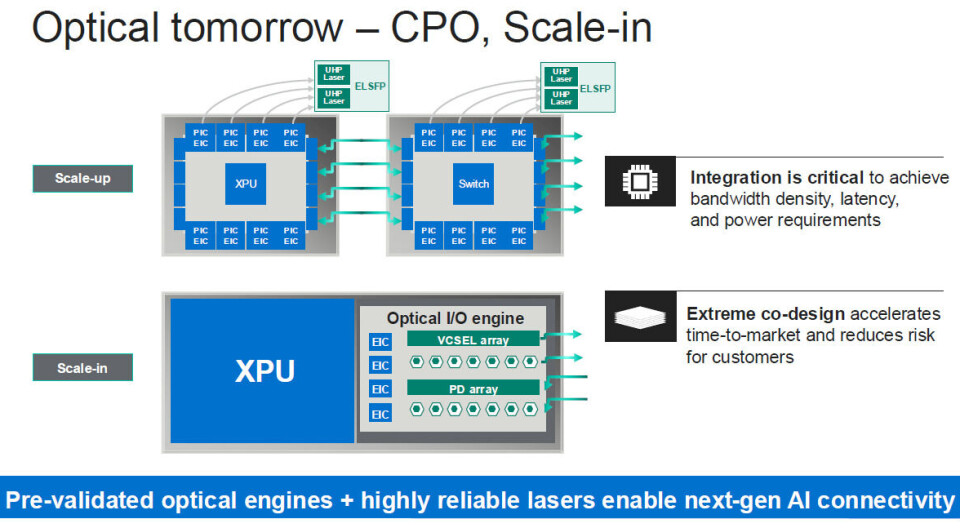
As the industry moves toward an era where light replaces electricity as the primary medium for data movement within the server, the Marvell-Lumentum merger represents a massive bet on the fundamental physics of the next decade of computing. If successful, it will cement Marvell’s role as the indispensable architect of the AI datacenter.
 Enterprise Tech & Infrastructure
Navigating the Complex Realities of Amazon S3 Cost Management for the Enterprise
In the landscape of modern enterprise cloud infrastructure, Amazon Simple Storage Service...
 Enterprise Tech & Infrastructure
Navigating the Hidden Complexities of Amazon S3 Cost Management for the Enterprise
The financial management of cloud storage has evolved into a discipline that...
 Enterprise Tech & Infrastructure
Micron and the High Bandwidth Memory Revolution: A Profit Engine Surpassing the Mainframe Era
In the sweeping six-decade history of commercial information technology, certain milestones stand...







