

Curating the Perfect Toolset
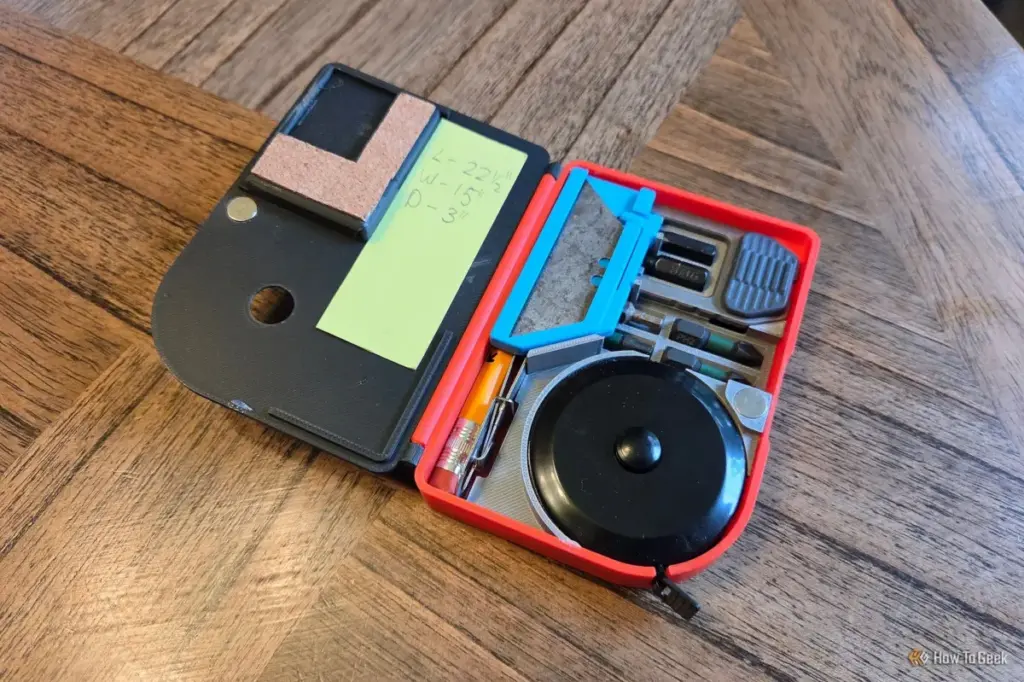
The search for the right components took several days of market research. The most difficult piece of the puzzle was the screwdriver. While many EDC enthusiasts use cylindrical keychain bit holders, these were deemed too thick for a slim, phone-mounted profile. The solution eventually came in the form of the Gerber Gear Driver Keychain.
At $16.99, the Gerber Gear Driver was the most expensive single component of the build, but it offered a unique set of advantages. It features a flat profile that fits easily into a shallow housing while still providing enough mechanical leverage to handle genuine repair tasks. As an added bonus, the tool includes a built-in bottle opener, a staple of the multi-tool genre.
For the other essentials, Fedewa turned to a mix of specialized EDC gear and modified household items. He selected Uncle Bill’s Tweezers—a high-precision tool favored by hobbyists for its durability and grip. For the measuring component, he sourced a compact tape measure featuring a manual retract button, which would later become a central design element of the toolbox lid.
The cutting tool required a more bespoke approach. When standard pocket knives proved too thick for the assembly, Fedewa pivoted to a utility knife blade housed in a modified 3D-printed slider, based on an existing open-source model. This allowed for a razor-sharp edge with a minimal footprint. Finally, a MagSafe magnetic ring was integrated into the back of the housing, ensuring a secure connection to the phone or any other metallic surface.

The Prototyping and "Tetris" Phase
With the tools selected, the project moved into the complex phase of spatial organization. Fedewa describes this process as a high-stakes game of "Tetris with tools." Fitting several irregularly shaped objects into a rectangular void while ensuring each remains easily removable is a classic engineering problem.
The design process involved a hybrid of physical and digital modeling. Fedewa began by printing "thin walls"—simple 3D-printed frames without bottoms—that represented the outer boundaries of the toolbox. This allowed him to physically arrange the tools on a desk and see how they interacted in the real world. This physical layout revealed that the tape measure, being the largest and most rigid object, had to be anchored in a corner to dictate the remaining flow of the space.
Once the physical layout was optimized, Fedewa took precise measurements of each tool and imported them into Fusion 360, a professional-grade CAD software. The digital environment allowed for the "tweaking" of tolerances—the minute gaps between the tools and the plastic walls—to ensure a snug fit that wouldn’t rattle, but wasn’t so tight that tools became stuck.
 Tech Tutorials & How-To Guides
Strategic Streaming: Top Netflix Series to Download Ahead of Hurricane Season Power Outages
As the United States moves into the peak of hurricane season, residents...
 Tech Tutorials & How-To Guides
Exploring the Frontiers of the Unknown: Three Essential Science Fiction Films to Stream on Netflix This Weekend
As the autumn of 2026 unfolds, the digital landscape of the American...
 Tech Tutorials & How-To Guides
Smart Solutions for Rising Utility Bills: How Specialized Tech Identifies and Reduces Residential Energy Waste
As global energy markets remain volatile and utility costs continue a steady...







