
In the modern landscape of personal productivity, the concept of "Every Day Carry"—commonly referred to as EDC—has evolved from a niche hobby into a sophisticated subculture of preparedness. For the DIY-minded individual, the daily ritual often involves reaching for a core set of essential tools: a reliable screwdriver, a sharp blade, a precise measuring device, and perhaps a pair of tweezers for fine tasks. While traditional multi-tools have long filled this gap, a new project by designer and technology writer Joe Fedewa seeks to merge these analog essentials with the one device most people never leave home without: the smartphone.
The project, which culminated in the creation of a 3D-printed, MagSafe-compatible pocket toolbox, represents a significant step forward in modular utility design. By utilizing the magnetic mounting system built into modern iPhones and many Android cases, Fedewa has developed a way to keep a functional toolkit literally attached to the user’s primary communication device.
The Evolution of the Pocket Toolbox
The inspiration for this modular toolkit did not emerge in a vacuum. Fedewa credits a viral concept from content creator Maurice Moves, titled "I Fit a Fully Functioning Toolbox into an Altoids Tin," as the primary spark for his design. In that original project, Maurice Moves demonstrated the possibility of cramming an impressive array of supplies—including Band-Aids, soap sheets, a flashlight, a multi-tool, and even SuperGlue—into the 6.5 cubic inches of a standard mint tin.

While the Altoids tin remains a classic staple of the EDC community due to its durability and nostalgic charm, it possesses inherent limitations in the digital age. It is bulky, often rattles in the pocket, and requires a dedicated space in one’s attire. Fedewa’s objective was to take that spirit of comprehensive utility and refine it into a slimmer, more integrated package. The goal was to move the toolkit from the bottom of a pocket to the back of a phone, utilizing the MagSafe standard to ensure the tools were always within reach without adding excessive bulk.
Engineering Within Physical Constraints
One of the primary challenges in designing a phone-mounted accessory is balancing utility with ergonomics. A toolbox that is too large would interfere with the phone’s camera lenses or make the device impossible to hold comfortably. Conversely, a toolbox that is too small would fail to house the very tools that make it useful.
To determine the ideal dimensions, Fedewa conducted extensive research into existing MagSafe accessories. He used the Spigen magnetic pouch as a reference point for what constitutes a "pocketable" and "phone-friendly" size. After producing several size-test prints to gauge how the object felt in the hand and how it sat on the back of various devices, he settled on dimensions that provided a universal fit. The design was intentionally kept generic enough to work across different phone models, rather than being tailored to one specific handset, allowing the 3D-printing community at large to utilize the files.
Selecting the tools to occupy this limited real estate was the next significant hurdle. Fedewa identified four "must-have" categories: a screwdriver with interchangeable bits, a cutting edge, a measuring tool, and a writing utensil. Any additional capacity would be used for secondary tools like tweezers or specialized bit storage.

Curating the Perfect Toolset
The search for the right components took several days of market research. The most difficult piece of the puzzle was the screwdriver. While many EDC enthusiasts use cylindrical keychain bit holders, these were deemed too thick for a slim, phone-mounted profile. The solution eventually came in the form of the Gerber Gear Driver Keychain.
At $16.99, the Gerber Gear Driver was the most expensive single component of the build, but it offered a unique set of advantages. It features a flat profile that fits easily into a shallow housing while still providing enough mechanical leverage to handle genuine repair tasks. As an added bonus, the tool includes a built-in bottle opener, a staple of the multi-tool genre.
For the other essentials, Fedewa turned to a mix of specialized EDC gear and modified household items. He selected Uncle Bill’s Tweezers—a high-precision tool favored by hobbyists for its durability and grip. For the measuring component, he sourced a compact tape measure featuring a manual retract button, which would later become a central design element of the toolbox lid.
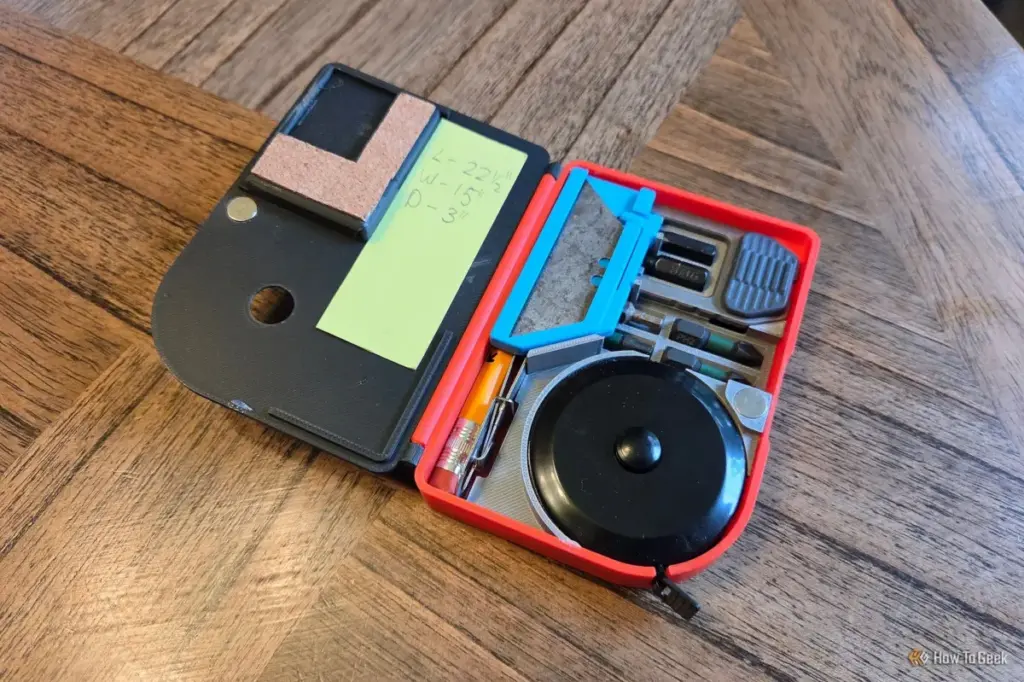
The cutting tool required a more bespoke approach. When standard pocket knives proved too thick for the assembly, Fedewa pivoted to a utility knife blade housed in a modified 3D-printed slider, based on an existing open-source model. This allowed for a razor-sharp edge with a minimal footprint. Finally, a MagSafe magnetic ring was integrated into the back of the housing, ensuring a secure connection to the phone or any other metallic surface.

The Prototyping and "Tetris" Phase
With the tools selected, the project moved into the complex phase of spatial organization. Fedewa describes this process as a high-stakes game of "Tetris with tools." Fitting several irregularly shaped objects into a rectangular void while ensuring each remains easily removable is a classic engineering problem.
The design process involved a hybrid of physical and digital modeling. Fedewa began by printing "thin walls"—simple 3D-printed frames without bottoms—that represented the outer boundaries of the toolbox. This allowed him to physically arrange the tools on a desk and see how they interacted in the real world. This physical layout revealed that the tape measure, being the largest and most rigid object, had to be anchored in a corner to dictate the remaining flow of the space.
Once the physical layout was optimized, Fedewa took precise measurements of each tool and imported them into Fusion 360, a professional-grade CAD software. The digital environment allowed for the "tweaking" of tolerances—the minute gaps between the tools and the plastic walls—to ensure a snug fit that wouldn’t rattle, but wasn’t so tight that tools became stuck.
The mechanical aspects of the box, specifically the hinge and the latching mechanism, proved to be the most frustrating elements to perfect. After multiple iterations and four full-scale prototype prints, Fedewa opted for a simplified, robust hinge design that prioritized longevity over complexity. The final full-sized version successfully housed the Gerber driver, six screwdriver bits, the utility blade, the tweezers, a compact pencil, and the integrated tape measure.

Community Feedback and Iterative Design
Following the release of the initial MagSafe EDC Toolbox, the project entered a second phase driven by community interaction. While many praised the ingenuity of the tape measure integration—where the tape pulls out through a slot in the side and the retract button is accessible through the lid—others noted that the inclusion of the tape measure made the overall package larger than they desired for daily phone carry.
In response to this feedback, Fedewa developed a second, "slimline" version of the toolbox. This update reflects a common trend in the maker community: the move toward hyper-optimization. By removing the tape measure, the pencil, and the MagSafe magnets, Fedewa was able to reduce the width of the toolbox by a substantial 41mm and the thickness by 2.5mm.
This smaller iteration still retains the core functional heart of the project: the Gerber Gear Driver, the six-bit storage array, the utility knife, and the tweezers. This version is aimed at users who prefer to carry their toolkit in a coin pocket or a bag rather than attached to their phone, proving that the design’s utility exists independently of the magnetic mounting system.
A Resource for the Maker Movement
In keeping with the spirit of the modern DIY movement, Fedewa has made the design files for both the original MagSafe version and the updated slim version available to the public. By uploading the models to MakerWorld, a popular platform for 3D printing enthusiasts, he has allowed others to print, modify, and improve upon the design.

The project serves as a practical example of how consumer-grade 3D printing and CAD software have empowered individuals to create professional-quality, bespoke solutions to everyday problems. What started as an inspiration from a YouTube video evolved into a functional piece of gear that addresses the specific needs of the modern "maker"—someone who values having the right tools at hand, whether they are fixing a loose screw on a pair of glasses or measuring a piece of material for a weekend project.
The MagSafe EDC Toolbox is more than just a novelty accessory; it is a testament to the ongoing intersection of technology and traditional craftsmanship. As mobile devices continue to become the central hub of our lives, the desire to attach physical utility to those devices is likely to grow, paving the way for more innovative, modular solutions in the world of personal carry.
 Tech Tutorials & How-To Guides
Bridging the Automation Gap: How Google Gemini is Transforming Smart Home Management Through Personal Intelligence
In the rapidly evolving landscape of the modern smart home, the promise...
 Tech Tutorials & How-To Guides
Milwaukee Tool’s M12 Series Redefines the Balance of Power and Portability for Professional and Home Applications
In the rapidly evolving landscape of cordless power tools, the long-standing industry...
 Tech Tutorials & How-To Guides
Windows 11 Search Receives Major Performance Overhaul as Microsoft Finally Addresses Long-Standing User Complaints
For years, the search functionality within Windows has been a point of...







